

Table of contents
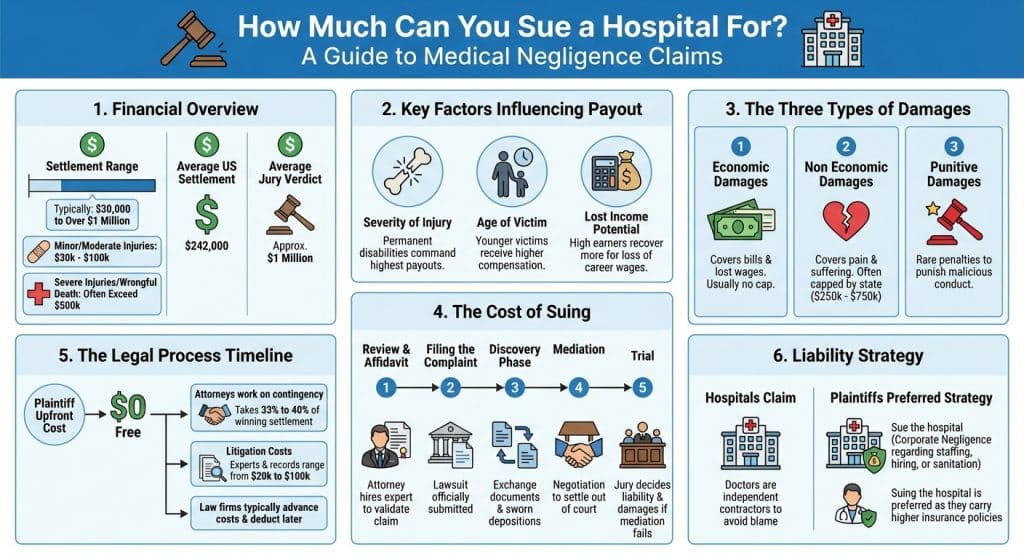
There is no fixed limit on how much you can sue a hospital for, but payouts typically range from $30,000 for minor injuries to over $1 million for catastrophic damage. Final compensation depends on economic losses (medical bills, lost wages), non-economic damages (pain and suffering), and state-specific caps on malpractice awards.
How Much Can You Sue a Hospital for Negligence? (The Short Answer)
There is no fixed price tag or limit on the amount you can demand when filing a lawsuit against a hospital. However, the amount you can realistically recover (receive in a payout) depends entirely on the severity of the injury and the financial losses incurred.
While headlines often highlight multi-million dollar verdicts, the reality is more nuanced. Most medical malpractice cases are resolved through settlements rather than jury trials.
- Minor to Moderate Injuries: Settlements often range from $30,000 to $100,000. These cover temporary injuries requiring corrective treatment.
- Severe Injuries: Cases involving permanent disability or long-term care often settle between $200,000 and $1 million.
- Catastrophic Injuries: Brain damage, paralysis, or wrongful death cases can result in verdicts or settlements exceeding $1 million to $5 million+, provided there are no state caps limiting the payout.
It is critical to distinguish between what you sue for (the demand in the complaint) and what the evidence supports. A lawyer will calculate a specific dollar figure based on the three types of damages below.
The 3 Types of Damages That Determine Your Payout
When calculating how much to sue a hospital for, attorneys aggregate three distinct categories of damages. The total of these categories forms the value of your claim.
1. Economic Damages
These are objective, calculable financial losses. Because they can be proven with receipts and actuarial data, they are rarely capped by state law.
- Medical Bills: Past, present, and estimated future costs (surgeries, rehab, medication).
- Lost Wages: Income lost during recovery.
- Loss of Earning Capacity: Future income lost if the patient can no longer work in their field.
2. Non-Economic Damages
These damages compensate for subjective losses that do not have a receipt. This is often the most contentious part of a negotiation.
- Physical pain and suffering.
- Emotional distress and mental anguish.
- Loss of enjoyment of life.
- Loss of consortium (impact on spousal relationships).
3. Punitive Damages
Punitive damages are not meant to compensate the victim but to punish the hospital for gross negligence or malicious intent. These are rare in standard negligence cases and are usually reserved for shocking conduct, such as a surgeon operating while intoxicated or a hospital intentionally destroying evidence.
How Much Can I Get From Medical Negligence?
The amount you can get from medical negligence typically aligns with the severity of the harm. According to industry data, the average payout for a medical malpractice settlement hovers around $242,000, while the average jury verdict is significantly higher, often exceeding $1 million.
However, settlements are more common because they remove the risk of losing at trial. Factors that maximize compensation include:
- Age of the Patient: Younger patients with lifelong disabilities often receive higher economic damages due to decades of lost wages and care costs.
- Income Level: High earners generally receive larger settlements for lost earning capacity.
- Clarity of Fault: If the hospital’s negligence is undeniable (e.g., operating on the wrong limb), they are more likely to offer a high settlement quickly to avoid bad publicity.
The ‘Glass Ceiling’: Understanding State Damage Caps
Before you decide how much to sue for, you must understand your state’s laws. Many states have implemented tort reform measures that place a “cap” on non-economic damages.
For example, in states like California (under MICRA) or Texas, there are strict limits on how much you can recover for pain and suffering, regardless of how tragic the outcome is. If a state caps non-economic damages at $250,000, a jury could award you $10 million for pain and suffering, but the judge would be legally required to reduce that portion of the award to $250,000.
Note: Economic damages (medical bills and lost wages) are almost never capped.
How Much Does It Cost to Sue a Hospital?
Suing a hospital is expensive, but most patients do not pay these costs upfront. Medical malpractice attorneys typically work on a contingency fee basis.
- No Win, No Fee: You only pay attorney fees if you win a settlement or verdict. The standard fee is 33% to 40% of the final recovery.
- Case Costs: Malpractice cases require hiring expert witnesses, obtaining thousands of pages of records, and paying court filing fees. These costs can range from $20,000 to $100,000+ depending on complexity.
- The ‘Net’ Recovery: Usually, the law firm advances these costs and deducts them from the final settlement after the contingency fee is taken.
How Hard Is It to Win a Negligence Case?
Winning a negligence case against a hospital is statistically difficult. Studies suggest that physicians and hospitals win a majority of cases that go to trial (often over 70%). This is why building a watertight case before filing is essential.
The Burden of Proof
You must prove “by a preponderance of the evidence” that the hospital breached the standard of care. It is not enough to prove that a mistake happened; you must prove that a competent hospital would not have made that mistake under similar circumstances.
Why Hospitals Fight Harder
Unlike a car accident claim where an insurance company simply pays out, hospital negligence claims impact the reputation and licensing of medical professionals. Hospitals often have aggressive legal teams dedicated to defending their standard of care, making expert medical testimony absolutely vital to winning.
What Happens When You Sue a Hospital for Negligence?
The process of suing a hospital is highly structured and can take anywhere from 18 months to several years.
- Investigation: Your lawyer gathers medical records and consults with a medical expert to confirm negligence occurred.
- Filing the Complaint: A formal lawsuit is filed against the hospital (and potentially specific staff).
- Discovery: Both sides exchange evidence. You may be deposed (interviewed under oath) by the hospital’s lawyers.
- Mediation: A neutral third party tries to help both sides reach a settlement to avoid trial.
- Trial: If no settlement is reached, the case goes to court where a jury decides the verdict.
Suing the Hospital vs. Suing the Doctor
A common misconception is that suing the hospital automatically covers the doctor. This is not always true due to employment status.
- Vicarious Liability: Hospitals are generally liable for the negligence of their employees, such as nurses, technicians, and support staff.
- Independent Contractors: Many doctors are not hospital employees but independent contractors. In these cases, you may need to sue the doctor individually, and their personal malpractice insurance limits will apply.
- Corporate Negligence: You can sue a hospital directly for systemic failures, such as understaffing, poor sanitation, or negligent hiring practices (credentialing an incompetent doctor).
Wrongful Death Lawsuits Against Hospitals
If negligence leads to the death of a patient, the claim becomes a wrongful death lawsuit. These claims are distinct from standard personal injury suits.
Damages in wrongful death cases focus on the loss sustained by the surviving family members, including:
- Funeral and burial expenses.
- Loss of the deceased person’s expected future income.
- Loss of companionship and guidance (consortium).
Eligibility to file varies by state; usually, it is restricted to the immediate family (spouse, children, parents) or the executor of the decedent’s estate. Strict statutes of limitations apply, often requiring the lawsuit to be filed within 1 to 2 years of the death.
FAQs
What happens when you sue a hospital for negligence?
When you sue a hospital, the process begins with a thorough investigation and review of medical records by experts. After filing a formal complaint, both sides enter a ‘discovery’ phase to exchange evidence. Most cases then move to mediation to attempt a settlement; if that fails, the case proceeds to a jury trial.
How much can I get from medical negligence?
The average settlement for medical negligence is approximately $242,000, while jury verdicts often average over $1 million. The exact amount depends on the severity of the injury, the cost of future medical care, lost earning capacity, and whether your state caps non-economic damages.
How hard is it to win a negligence case?
Winning a negligence case is difficult because the burden of proof lies with the patient. You must prove the hospital deviated from the standard of care, which requires expensive expert testimony. Statistics show that hospitals and doctors win the majority of malpractice cases that go all the way to a jury verdict.
How much does it cost to sue a hospital?
Most patients pay nothing upfront because malpractice lawyers work on a contingency fee (taking 33-40% of the winnings). However, the actual cost to build a case—including expert witness fees and court filings—can range from $20,000 to over $100,000, which is usually advanced by the law firm.
Can I sue a hospital for a doctor's mistake?
It depends on the doctor’s employment status. Hospitals are liable for the mistakes of their employees (like nurses), but many doctors are independent contractors. If the doctor is a contractor, you generally sue the doctor directly, unless you can prove the hospital was negligent in hiring or retaining them.