

Table of contents
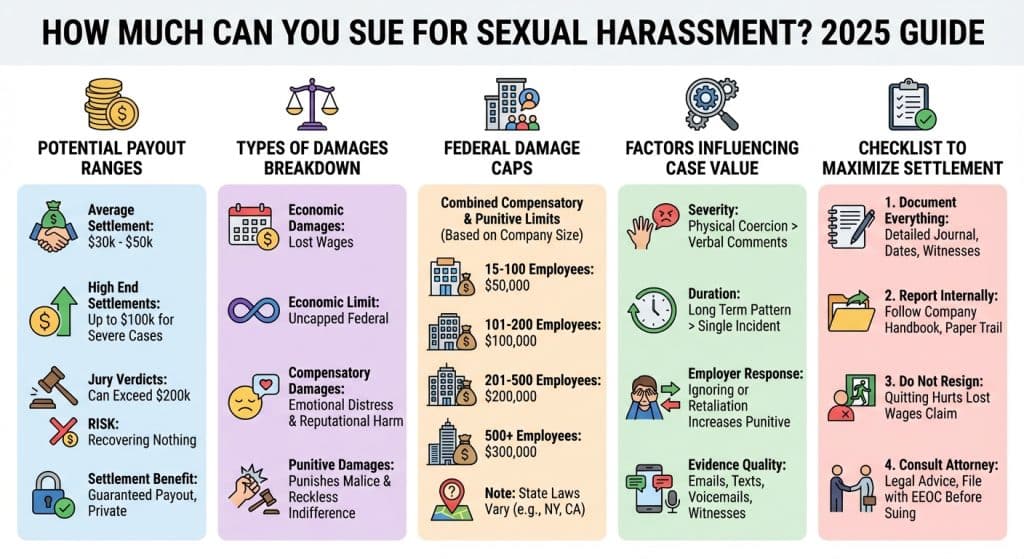
Sexual harassment settlements typically range from **$30,000 to $100,000**, while cases that proceed to trial often result in higher verdicts averaging around **$217,000**. The total amount you can sue for depends on your lost wages (which are usually uncapped) and federal limits on emotional distress damages, which are capped at **$300,000** for large employers.
How Much Can You Sue for Sexual Harassment? (2025 Guide)
When victims of workplace misconduct consider legal action, the first question is almost always financial: how much is this case actually worth?
The short answer is that while you can technically sue for any amount, the recoverable damages are often limited by federal caps and the specific details of your financial losses. Most sexual harassment cases settle out of court for between $30,000 and $100,000. However, cases that proceed to a jury trial often see significantly higher payouts, with average verdicts hovering around $217,000.
It is critical to distinguish between what you can demand in a lawsuit and what you will likely receive. Your final payout is calculated based on lost wages (which are usually uncapped) and emotional distress (which is often capped based on the size of your employer).
What Is the Average Sexual Harassment Settlement?
Because most employment disputes are resolved privately to avoid negative publicity, exact settlement data is often shielded by non-disclosure agreements (NDAs). However, legal industry data provides reliable benchmarks.
- Typical Settlements: The majority of negotiated settlements fall in the $30,000 to $100,000 range. This covers cases with clear evidence but moderate financial impact.
- High-Value Cases: Settlements exceeding $200,000 to $500,000 are generally reserved for cases involving high-income earners, executive-level harassers, or egregious physical conduct.
How much money can you get if you sue someone for harassment?
If you sue for harassment and win, the money you receive depends heavily on your “actual losses.” For example, if you were fired and remained unemployed for a year, you can recover that full year’s salary (back pay). If you quickly found a new job with equal pay, your economic damages are low, meaning your potential payout will rely almost entirely on proving severe emotional distress.
Types of Damages: What Exactly Are You Suing For?
In a sexual harassment lawsuit, you are not just suing for a single lump sum. You are suing for specific categories of damages, each calculated differently.
Economic Damages (Lost Wages)
This is the most concrete part of your claim. It includes:
- Back Pay: Wages, bonuses, and benefits you lost from the date of harassment/firing until the date of the verdict or settlement.
- Front Pay: Estimated future earnings if you cannot return to your old job and are unlikely to find comparable employment immediately.
Compensatory Damages
This covers the human cost of harassment: emotional distress, pain and suffering, reputational harm, and medical expenses for therapy. Unlike lost wages, these are subjective and decided by a jury.
Punitive Damages
These are awarded solely to punish the employer for malicious or reckless behavior. They are not meant to compensate you, but to deter the company from allowing harassment in the future.
Federal and State Limits: The ‘Cap’ on Your Payout
Under federal law (Title VII of the Civil Rights Act of 1964), there is a strict limit on the combined total of compensatory and punitive damages you can receive. This cap does not apply to your back pay or front pay.
The cap is determined by the number of employees in the company:
| Number of Employees | Maximum Damages Cap |
|---|---|
| 15 – 100 employees | $50,000 |
| 101 – 200 employees | $100,000 |
| 201 – 500 employees | $200,000 |
| 501+ employees | $300,000 |
Important Note on State Laws: Some states, such as New York and California, have human rights laws that do not cap compensatory damages. In these jurisdictions, high-value verdicts are more common because the federal limits do not restrict the payout for emotional distress.
What Proof Do You Need to Sue for Harassment?
To win a lawsuit or secure a high settlement, you must prove that the conduct was legally actionable. It is not enough for the behavior to be rude; it must be unwelcome and either severe or pervasive.
Successful claims typically rely on three pillars of evidence:
- A Paper Trail: Emails, text messages, or Slack logs that document the harassment. Even a personal diary with dates and times can be admissible evidence.
- Internal Reporting: Proof that you reported the behavior to HR or a supervisor and they failed to take effective action. This is crucial for establishing employer liability.
- Corroboration: Witness statements from colleagues who saw the behavior or heard about it shortly after it happened.
Factors That Increase or Decrease Case Value
Two cases with similar harassment facts can have vastly different values based on the following variables:
- The Employer’s Response: If the company immediately investigated and fired the harasser, your case for damages against the company is weaker. If they ignored you or retaliated, the case value increases significantly.
- Severity and Duration: Physical touching or a long pattern of daily abuse is worth more than a single verbal comment.
- Your Financial Loss: High-wage earners typically have higher case values simply because their “lost wages” calculation results in a larger number.
Is It Worth Suing for Harassment?
Deciding to sue is a personal calculation that goes beyond money. While the financial compensation can be validating, the process is invasive.
- Financial Gain vs. Emotional Toll: Litigation can take 18 to 24 months. You will be deposed, and defense attorneys may probe into your personal history.
- Settlement vs. Trial: This is why over 90% of cases settle. A settlement provides guaranteed closure and money without the risk and public exposure of a trial.
- Career Impact: While retaliation is illegal, many victims worry about being “blacklisted” in tight-knit industries. A confidential settlement often mitigates this risk better than a public lawsuit.
Next Steps: Calculating Your Potential Claim
Online “lawsuit calculators” are rarely accurate because they cannot account for the credibility of your witnesses or the specific judge assigned to your case. The only way to get a realistic valuation is to consult an employment attorney who can review your evidence.
Most sexual harassment attorneys work on a contingency fee basis, meaning they only get paid a percentage (typically 33-40%) if you win or settle. This aligns their interests with yours—they will generally give you an honest assessment of whether the case is worth pursuing.
FAQs
What is the average harassment settlement?
The average settlement for sexual harassment claims typically falls between $30,000 and $100,000. However, cases involving high-income earners or egregious conduct can settle for significantly more, while minor infractions with little evidence may settle for less than $20,000.
Is it worth suing for harassment?
Suing is often worth it if you have suffered significant financial loss or emotional trauma, as it can provide compensation and closure. However, you must weigh the potential payout against the emotional stress of litigation and the risk of a public trial; this is why many choose to settle privately.
What proof do you need to sue for harassment?
You need evidence showing the conduct was unwelcome and severe or pervasive. Strong proof includes a paper trail (emails, texts), records of reporting the issue to HR, witness testimony, and documentation of how the harassment impacted your work performance or mental health.
How much money can you get if you sue someone for harassment?
Payouts vary widely but generally include back pay (lost wages), compensatory damages for emotional distress, and potential punitive damages. While federal law caps non-economic damages at $300,000 for large companies, there is no limit on the lost wages you can recover.