

Table of contents
Yes, you can sue for defamation of character in Houston if a false statement harmed your reputation. Under Texas law, you must prove the defendant acted negligently or with malice. You generally have one year from the date of publication to file a lawsuit for libel or slander.
Can You Sue for Defamation in Houston? The Short Answer
Yes, you can sue for defamation of character in Houston, Texas, provided you can prove that a false statement of fact caused harm to your reputation or financial standing. However, Texas courts maintain a high burden of proof to protect First Amendment rights, meaning hurt feelings or negative opinions are rarely enough to win a case.
If you believe you have a case, time is critical. Texas has one of the shortest filing windows in the country.
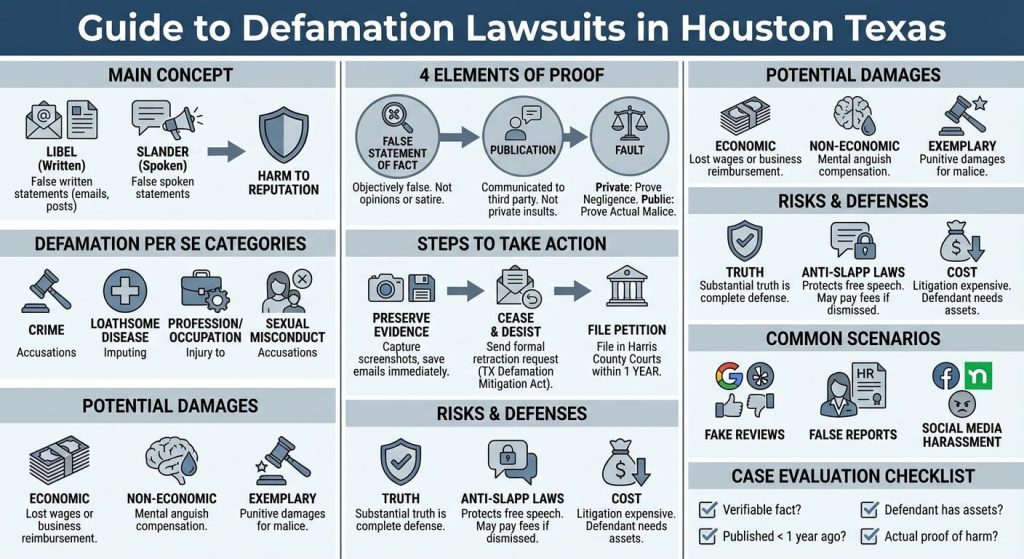
The 1-Year Statute of Limitations in Texas
Under the Texas Civil Practice and Remedies Code section 16.002, you generally have only one year from the date the defamatory statement was published or spoken to file a lawsuit. If you miss this deadline, your case will likely be dismissed immediately, regardless of how damaging the lies were.
Libel (Written) vs. Slander (Spoken) under Texas Law
Texas law distinguishes between two forms of defamation:
- Libel: Defamation expressed in written or other graphic form (e.g., social media posts, newspaper articles, emails). Because these statements are permanent, they are often treated more seriously.
- Slander: Defamation expressed orally (e.g., gossip, speeches, podcast audio). Slander is often harder to prove without a recording or credible witnesses.
What Proof Is Needed for Defamation in Texas?
To win a defamation lawsuit in Houston, you cannot simply claim that someone lied. You must provide evidence satisfying specific legal elements.
The 5 Key Elements
In Texas, a plaintiff must generally prove:
- Publication: The statement was communicated to a third party (not just to you).
- Falsity: The statement is objectively false (truth is an absolute defense).
- Identification: The statement clearly refers to you, even if your name wasn’t explicitly used.
- Fault: The defendant acted with at least negligence (for private individuals) or “actual malice” (for public figures).
- Damages: The statement caused specific harm, such as financial loss or mental anguish.
Fact vs. Opinion: Why ‘Mean’ Reviews Aren’t Always Illegal
A negative Google review stating, “I think this business has terrible service,” is typically protected as an opinion. However, a review stating, “This business stole $500 from me,” is a statement of fact. If that fact is untrue, it is actionable defamation. Courts look at whether the statement can be proven true or false; if it is purely subjective, it is not defamation.
Public Figures vs. Private Individuals
If you are a public figure (e.g., a politician, celebrity, or prominent local official in Harris County), the bar is higher. You must prove actual malice—that the defendant knew the statement was false or acted with reckless disregard for the truth.
Defamation Per Se vs. Defamation Per Quod
Texas recognizes that some lies are so damaging that the law assumes they caused you harm without you needing to show a receipt.
When Damages Are Presumed (Per Se)
Defamation Per Se refers to statements that are inherently injurious. If your case falls into this category, you may not need to prove specific economic losses to recover general damages for reputation harm.
Four Categories of Per Se
Texas courts generally classify the following as defamation per se:
- Accusations of committing a crime.
- Statements that you have a “loathsome disease.”
- Imputations of sexual misconduct.
- Statements that injure you in your office, profession, or business occupation.
When You Must Prove Financial Loss (Per Quod)
If the statement does not fall into the categories above (Defamation Per Quod), you must prove “special damages.” This means showing evidence of actual financial loss—such as a lost contract, a fired job, or a decline in business revenue—directly resulting from the statement.
How to Sue Someone for Defamation in Texas
Filing a lawsuit is a procedural minefield. Here is the general roadmap for a claim in Houston.
Step 1: The Texas Defamation Mitigation Act (Retraction Requests)
Before suing, Texas law (CPRC Chapter 73) strongly encourages you to send a request for a retraction. If you fail to request a correction, clarification, or retraction within the statutory timeframe (usually 90 days after knowledge of the publication), you may be barred from recovering exemplary (punitive) damages.
Step 2: Determining Jurisdiction
Most defamation cases in Houston are filed in the Harris County District Courts (for claims over $500) or County Civil Courts at Law. Filing in the wrong court can lead to dismissal.
Step 3: Filing the Petition and Serving the Defendant
Your attorney will draft an Original Petition detailing the defamatory statements and the damages sought. Once filed, a constable or process server must officially serve the defendant.
Step 4: The Discovery Phase
This is where evidence is gathered. Your lawyer may subpoena emails, text messages, and social media logs to prove the defendant knew they were lying (establishing malice).
How Much Can You Sue for Defamation of Character in Texas?
Damages in Texas defamation cases are divided into three main buckets.
Economic Damages
These are quantifiable losses, including:
- Lost wages or salary.
- Lost business profits or revenue.
- Medical bills (e.g., therapy for anxiety caused by the defamation).
Non-Economic Damages
These cover subjective harm, such as mental anguish, public humiliation, and impairment of reputation. While harder to calculate, juries in Harris County can award significant sums for severe reputational injury.
Exemplary (Punitive) Damages Caps
If you prove the defendant acted with malice, you may seek punitive damages to punish them. Texas law generally caps these damages at the greater of:
- $200,000; or
- Two times the amount of economic damages plus an amount equal to non-economic damages (up to $750,000).
Is It Worth Suing for Defamation in Texas?
Just because you can sue doesn’t always mean you should. Litigation is expensive and public.
The ‘Streisand Effect’
Filing a lawsuit makes the defamatory statements part of the public record. In some cases, suing draws more attention to the lie than the original statement did—a phenomenon known as the Streisand Effect.
The Anti-SLAPP Risk (Texas Citizens Participation Act)
Texas has a strong Anti-SLAPP law (the Texas Citizens Participation Act). If a defendant can show their statement was an exercise of free speech regarding a matter of public concern, they can file a motion to dismiss your case early. If they win, you may be ordered to pay their legal fees.
Cost vs. Reward: Analyzing Defendant Solvency
If the person defaming you has no assets, a million-dollar judgment is just a piece of paper. A prudent attorney will investigate the defendant’s ability to pay before filing suit.
Common Defenses: Why Defamation Suits Fail
Defendants have powerful tools to get cases thrown out.
- Truth: If the defendant can prove the statement is substantially true, you lose. Truth is an absolute defense.
- Privilege: Statements made in court or legislative proceedings are often “absolutely privileged,” meaning you cannot sue over them.
- Consent: If you invited the statement or interview, you may have waived your right to sue.
Finding the Right Houston Defamation Attorney
Defamation is a niche area of law. A general personal injury lawyer may not be familiar with the nuances of the Texas Defamation Mitigation Act or Anti-SLAPP motions.
Why Local Harris County Experience Matters
Judges in Harris County have specific local rules and tendencies regarding discovery and summary judgments. An attorney familiar with the local bench can navigate these procedural hurdles more effectively.
What to Bring to Your Consultation
To expedite your case evaluation, bring:
- Screenshots or copies of the defamatory statements (with dates).
- Evidence of the falsity of the statements.
- Proof of financial loss (tax returns, cancelled contracts).
- A timeline of events.
FAQs
How much can you sue for defamation of character in Houston?
There is no fixed limit on the total amount you can sue for, but Texas law requires you to prove actual financial damages (economic losses) to justify a large award. Damages can include economic losses, non-economic damages (pain and suffering), and potentially punitive damages if malice is shown.
Is it worth suing for defamation in Texas?
It depends on the defendant’s ability to pay and the extent of your damages. If the defendant is “judgment-proof” (no assets), the lawsuit may not be financially worth the time and expense. It is generally recommended for cases involving clear, significant financial harm.
How to sue someone for defamation in Texas?
To sue someone for defamation in Texas, you typically start by sending a formal demand or cease-and-desist letter. If that fails, you file a petition (lawsuit) in the appropriate District or County Court, detailing the false statements and the damages you have suffered.
What proof is needed for defamation?
You must prove five elements: (1) a statement of fact was published to a third party, (2) the statement was defamatory concerning the plaintiff, (3) the statement was false, (4) the defendant was at least negligent, and (5) the statement caused injury.
What is the difference between libel and slander?
Libel refers to defamatory statements that are written or published in a fixed medium (e.g., print, online article). Slander refers to defamatory statements that are spoken. Both are covered under Texas defamation law.