

Table of contents
In Houston, Texas, you can sue in civil court for breach of contract, personal injury, property damage, unreturned security deposits, and deceptive trade practices (DTPA). The specific court depends on the amount claimed: Justice of the Peace courts handle claims up to $20,000, while County and District courts handle larger disputes involving higher damages.
What Can You Sue For in Civil Court in Houston, Texas?
If you have suffered financial loss or property damage due to someone else’s actions in Houston, civil court is your avenue for relief. Unlike criminal court, which focuses on punishment and jail time, civil court focuses on compensation and dispute resolution.
In Texas, you can sue for a wide variety of grievances, ranging from an unreturned apartment deposit to complex business contract breaches. However, the success of your lawsuit often depends on filing in the correct tier of the Texas court system. Understanding the distinction between a "cause of action" (the legal ground for your suit) and "jurisdiction" (which court has the power to hear it) is the first step toward a judgment in your favor.
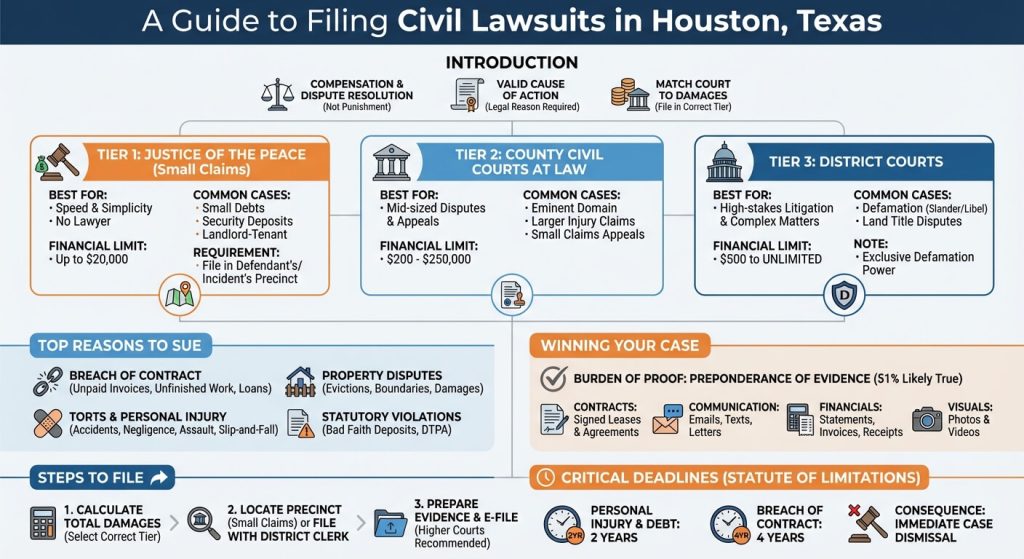
The 3 Tiers of Civil Courts in Harris County
Harris County divides civil cases into three main levels based primarily on the "amount in controversy"—the total dollar amount you are suing for.
Justice of the Peace (Small Claims): Claims under $20,000
Often called "The People’s Court," the Justice of the Peace (JP) court is designed for speed and simplicity. You do not need a lawyer to file here.
- Limit: Up to $20,000 (excluding statutory interest).
- Common Cases: Small debts, landlord-tenant disputes, minor property damage.
- Harris County Note: You must file in the specific precinct where the defendant lives or where the incident occurred.
County Civil Courts at Law: Claims up to $250,000
If your damages exceed the small claims limit, you move up to the County Civil Courts at Law. These courts handle mid-sized disputes and appeals from the JP courts.
- Limit: Generally $200.01 to $250,000.
- Common Cases: Eminent domain, larger personal injury claims, and appeal trials de novo.
District Courts: Unlimited Monetary Jurisdiction
District Courts are the highest trial courts in Texas. They have "exclusive jurisdiction" over certain types of cases regardless of the money involved, such as defamation (slander/libel) and title to land disputes.
- Limit: Generally $500 and up, with no maximum cap.
- Why it matters: If you file a defamation suit in Small Claims court, it will be dismissed because JP courts generally lack jurisdiction over slander cases.
Common Grounds for Civil Lawsuits (Causes of Action)
To file a lawsuit, you must have a valid cause of action. You cannot sue simply because someone was rude; you must prove they violated a legal duty or contract.
What are the three most common types of civil cases?
While there are dozens of reasons to sue, the three most common types of civil cases filed in Texas are contract disputes, torts (personal injury/negligence), and property disputes. These categories cover the vast majority of litigation, from unpaid invoices to car accidents and eviction proceedings.
Breach of Contract: Non-payment and Service Failures
This is the most straightforward civil claim. If you had an agreement (written or oral) and the other party failed to uphold their end, you can sue for damages. Examples include:
- A contractor failing to finish a renovation.
- A client refusing to pay a freelancer’s invoice.
- Failure to repay a personal loan.
Torts and Personal Injury: Negligence, Accidents, and Harm
A "tort" is an act that causes injury or harm to another person. This includes:
- Negligence: Car accidents or slip-and-fall cases.
- Intentional Torts: Assault or battery (you can sue for medical bills even if criminal charges are filed).
Property Disputes: Landlord-Tenant Issues and Damages
In Houston, property disputes are frequent. This includes eviction appeals, disagreements over property lines, or damage to personal property (like a neighbor cutting down your tree).
Specific Things You Can Sue For in Texas
Beyond the broad categories, Texas law provides specific statutes that allow for lawsuits in particular scenarios.
Unreturned Security Deposits (Texas Property Code)
Under the Texas Property Code, landlords must return security deposits within 30 days of the tenant vacating (provided a forwarding address was given). If a landlord acts in "bad faith," you can sue for three times the amount of the deposit plus $100 and attorney fees.
Deceptive Trade Practices (DTPA) Violations
The Texas Deceptive Trade Practices Act (DTPA) protects consumers against false, misleading, or deceptive business practices. If a business lied to you about a product’s capabilities or warranty, you might be able to sue for treble (triple) damages.
Defamation: Libel and Slander
You can sue if someone makes a false statement of fact about you that harms your reputation. Note: As mentioned, these cases must usually be filed in District Court, not Small Claims court.
Professional Malpractice
You can sue professionals (doctors, lawyers, accountants) if their service fell below the accepted standard of care, causing you financial or physical harm.
Neighbor Disputes (Nuisance, Trespass)
If a neighbor’s actions interfere with your enjoyment of your property (e.g., constant loud noise, flooding your yard, or illegal dumping), you can sue for "nuisance" or "trespass."
Financial Limits: How Much Can You Sue For?
Before filing, you must calculate your damages to ensure you are in the right court.
What is the maximum amount for a civil suit in Texas?
The maximum amount for a civil suit in Texas depends entirely on the court you choose. In Justice of the Peace (Small Claims) court, the maximum is $20,000. In County Courts at Law, the cap is generally $250,000. In District Court, there is no financial maximum.
What is the most you can sue for in civil court?
In theory, the most you can sue for in civil court (District Court) is unlimited. However, you are limited by the actual damages you can prove. You cannot sue for $10 million for a minor scratch on your car; the court requires evidence of actual financial loss, pain, and suffering to justify the award.
Winning Your Case: Burden of Proof & Evidence
Filing the suit is the easy part; winning requires proof.
What must be proven to win a civil case?
To win a civil case, you must prove your claim by a "preponderance of the evidence." This means you must show that it is more likely than not (at least 51% probable) that the defendant caused your damages. This is a lower standard than the "beyond a reasonable doubt" required in criminal cases.
Essential Documentation for Houston Courts
Judges in Harris County rely heavily on physical evidence. Bring the following:
- Contracts and Leases: Signed copies are best.
- Communication Logs: Emails, texts, and letters proving you tried to resolve the issue.
- Financial Records: Bank statements, invoices, and receipts.
- Photos/Video: Visual proof of damage is critical in property and injury cases.
How to File a Civil Suit in Harris County
Ready to proceed? Follow these logistical steps.
Locating the Correct Precinct for Justice Court
Harris County is huge. You cannot just walk into any courthouse. You must find the Justice of the Peace precinct where the defendant lives or the claim arose. Use the Harris County interactive map to find the correct precinct.
Filing with the Harris County District Clerk
For cases over $20,000, you will likely file with the Harris County District Clerk. This process is more formal and usually requires e-filing. While pro-se (self-representation) is allowed, hiring an attorney is highly recommended for District Court cases due to complex procedural rules.
Statute of Limitations: Deadlines You Cannot Miss
In Texas, the clock is ticking. For most personal injury and debt cases, the statute of limitations is two years. For breach of contract, it is generally four years. If you wait too long, your case will be dismissed immediately.
FAQs
What are the three most common types of civil cases in Texas?
The three most common types of civil cases in Texas are contract disputes (breach of agreement), torts (personal injury, negligence, car accidents), and family law matters (divorce, child custody).
What is the maximum amount for a civil suit in small claims court in Houston?
The maximum amount depends on the court: Justice of the Peace (Small Claims) court handles cases up to $10,000. For claims above this amount, you must file in a County or District Court.
What must be proven to win a civil case?
To win a civil case, the plaintiff must prove their claim by a ‘preponderance of the evidence,’ meaning it is more likely than not (over 50%) that their claim is true. This is a much lower standard than the ‘beyond a reasonable doubt’ required for criminal cases.
What is the most you can sue for in civil court in Texas?
There is no theoretical limit to what you can sue for in a Texas District Court. However, the amount awarded is limited by the damages you can legally prove (e.g., medical costs, lost income, pain and suffering).
Can I sue for pain and suffering in small claims court?
Yes, you can include pain and suffering in a small claims lawsuit in Texas, but it is generally capped by the $10,000 maximum jurisdictional limit of the Justice of the Peace court.