

Table of contents
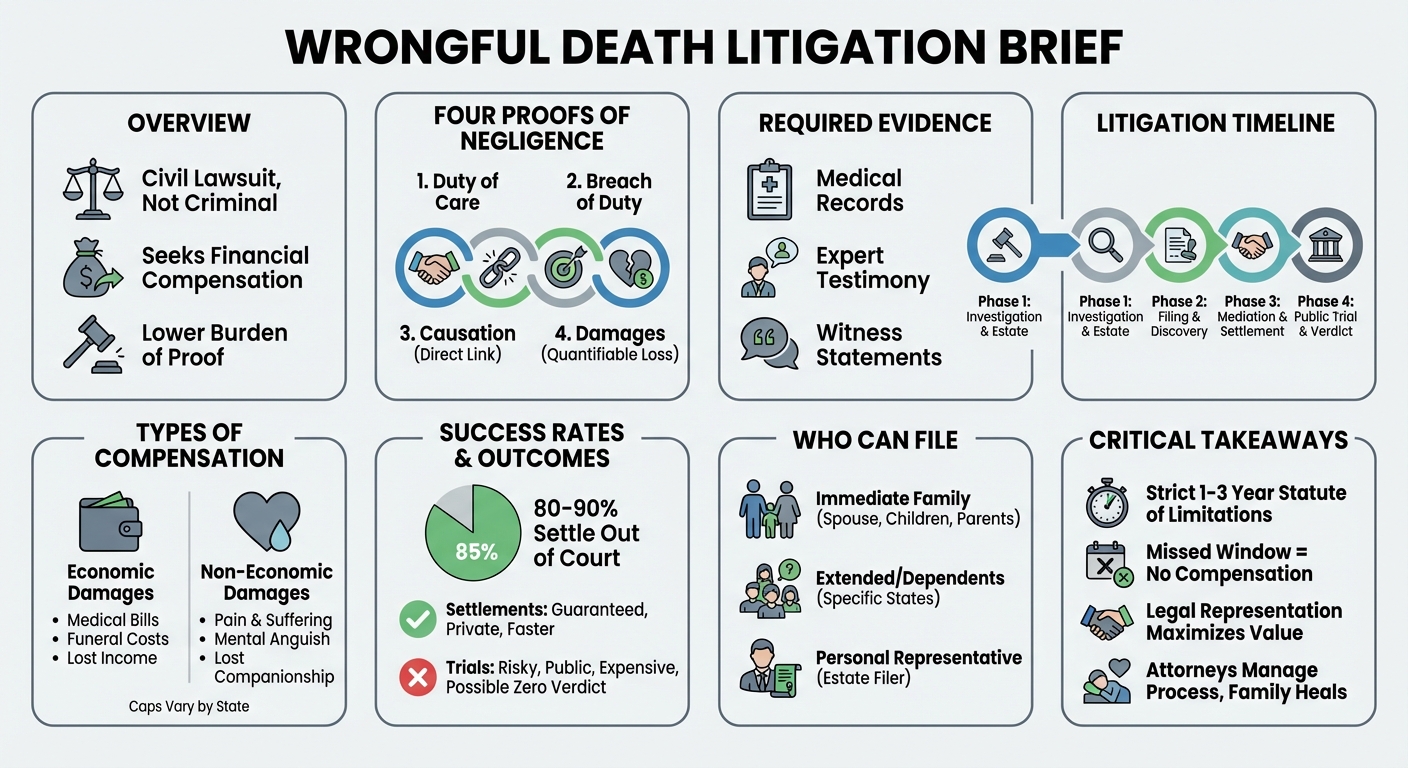
Wrongful death litigation is a civil lawsuit filed by surviving family members against an individual or entity whose negligence or intentional act caused their loved one’s death. Unlike criminal cases, these civil claims require a lower burden of proof, seeking financial compensation for the family’s economic and emotional losses.
1. Understanding Wrongful Death Litigation
What Constitutes a Wrongful Death Claim?
A wrongful death claim arises when a person dies due to the legal fault of another individual or entity. This type of litigation allows surviving family members or the deceased’s estate to seek financial compensation for their loss. Common scenarios include fatal car accidents, medical malpractice, workplace incidents, and defective products. The core objective is to hold the responsible party financially accountable for the devastating impact of the loss.
Civil Litigation vs. Criminal Charges (Burden of Proof)
Wrongful death lawsuits are civil actions, entirely separate from criminal prosecutions. A defendant can be acquitted in criminal court but still found liable in a civil wrongful death lawsuit. This occurs because the burden of proof differs significantly between the two systems.
| Feature | Civil Wrongful Death | Criminal Homicide |
|---|---|---|
| Burden of Proof | Preponderance of the evidence (more likely than not) | Beyond a reasonable doubt |
| Primary Goal | Financial compensation for survivors | Punishment (prison, fines) |
| Filing Party | Family members or estate representative | State or federal prosecutors |
2. How to Prove a Wrongful Death Case
What are the 4 proofs of negligence?
To win a wrongful death claim, you must establish the four proofs of negligence: duty of care (the defendant owed a legal obligation), breach of duty (they failed to meet that obligation), causation (their breach directly caused the death), and damages (resulting in quantifiable financial and emotional losses).
What are the 4 C’s of malpractice?
When wrongful death stems from medical errors, attorneys look for the 4 C’s of malpractice: Compassion, Communication, Competence, and Charting. While these are risk management principles for doctors, a failure in competence or charting often serves as the foundational evidence needed to prove negligence in litigation.
Gathering Evidence: Medical Records, Expert Testimony, and Witness Statements
Strong evidence is the backbone of any successful wrongful death claim. Attorneys meticulously gather documentation to build an undeniable case. Key evidentiary components include:
- Medical Records: To establish the exact cause of death and timeline of injuries.
- Expert Testimony: Accident reconstructionists, medical professionals, and economists who can explain complex details to a jury.
- Witness Statements: Firsthand accounts from bystanders or coworkers who observed the fatal incident.
3. The Wrongful Death Lawsuit Timeline: What to Expect
Phase 1: Investigation and Estate Setup
Before filing a lawsuit, an attorney will conduct a thorough investigation. During this phase, the family must also legally establish the deceased’s estate and appoint a personal representative, as this individual is often required to formally file the claim on behalf of the survivors.
Phase 2: Filing the Complaint and Discovery
Once the complaint is filed in civil court, the discovery phase begins. Both sides exchange evidence, request documents, and conduct depositions. This is typically the longest phase of wrongful death litigation, sometimes lasting several months to over a year.
Phase 3: Settlement Negotiations and Mediation
After discovery, attorneys usually enter settlement negotiations. Many courts require mediation, where a neutral third party helps both sides attempt to reach a financial agreement without going to trial. A strong evidentiary foundation often forces the defendant’s insurance company to offer a fair settlement here.
Phase 4: Trial and Verdict
If mediation fails, the case proceeds to trial. Both sides present their arguments, evidence, and witnesses before a judge or jury. The jury then deliberates and delivers a verdict, determining liability and the specific amount of damages to be awarded.
4. Damages and Compensation in Wrongful Death Claims
Economic vs. Non-Economic Damages
Compensation in wrongful death litigation is divided into two main categories: economic (quantifiable financial losses) and non-economic (intangible emotional losses).
| Economic Damages | Non-Economic Damages |
|---|---|
| Medical bills prior to death | Loss of companionship and love |
| Funeral and burial expenses | Pain and suffering of the survivors |
| Loss of the deceased’s expected income | Loss of consortium (for spouses) |
| Loss of benefits (e.g., pension, healthcare) | Mental anguish and emotional distress |
What is the maximum payout for wrongful death?
There is no universal maximum payout for wrongful death lawsuits, as compensation depends on the deceased’s earning capacity, medical bills, and state laws. However, some states impose statutory damage caps on non-economic damages, such as pain and suffering, particularly in medical malpractice wrongful death cases.
How State Damage Caps Impact Your Settlement
State laws heavily influence wrongful death compensation. While economic damages are rarely capped, many states limit the amount a jury can award for non-economic damages. Understanding your specific state’s tort reform laws is crucial for setting realistic settlement expectations.
5. Success Rates and Case Outcomes
What is the success rate of wrongful death lawsuits?
The success rate of wrongful death lawsuits is generally high when handled by experienced attorneys, with estimates suggesting that over 80% to 90% of viable claims reach a settlement before trial. However, cases that proceed to a jury trial face less predictable outcomes and lower overall win rates.
Settlement vs. Trial: Which is Better?
Settlements are generally preferred because they offer guaranteed compensation, privacy, and a faster resolution. Trials are public, expensive, and carry the risk of a zero-dollar verdict. However, if an insurance company refuses to offer a fair settlement, taking the case to trial may be the only way to secure maximum justice.
6. Who Can File a Wrongful Death Lawsuit?
Immediate Family Members (Spouses, Children, Parents)
In every state, immediate family members have the primary right to file or benefit from a wrongful death claim. Surviving spouses and children are always first in line. If the deceased was unmarried and had no children, surviving parents typically hold the right to sue.
Extended Family and Financial Dependents
State laws vary regarding extended family. Some jurisdictions allow siblings, grandparents, or financial dependents (even if unrelated by blood) to file a claim if they can prove they suffered a quantifiable financial loss due to the death.
The Role of the Estate Representative
In many states, individual family members cannot file the lawsuit directly. Instead, the personal representative (or executor) of the deceased’s estate must file the claim. Any damages won are then distributed to the surviving family members according to state law or the deceased’s will.
7. When to Hire a Wrongful Death Attorney
Understanding the Statute of Limitations
Every state has a strict statute of limitations for wrongful death claims, typically ranging from one to three years from the date of death. If you fail to file a lawsuit within this legal window, you permanently lose your right to seek compensation. Consulting an attorney immediately ensures critical deadlines are met.
How Legal Representation Maximizes Your Claim
Wrongful death litigation is legally complex and emotionally draining. An experienced attorney handles the aggressive tactics of insurance adjusters, hires necessary expert witnesses, and accurately calculates the lifetime value of your claim. Legal representation allows grieving families to focus on healing while ensuring the responsible parties are held fully accountable.