

Table of contents
There’s a phrase I hear from insurance adjusters all the time: “It’s just soft tissue.”
Those four words have probably cost injured Texans millions of dollars in compensation they deserved but never received. Because here’s what the insurance industry doesn’t want you to know: soft tissue injuries can be debilitating, long-lasting, and life-changing.
I’ve represented hundreds of clients with soft tissue injuries—neck strains, back sprains, whiplash, shoulder injuries. And I can tell you that the gap between how these injuries affect real people’s lives and how insurance companies value them is enormous.
Let me explain why this gap exists and what you can do about it.
What “Soft Tissue” Actually Means
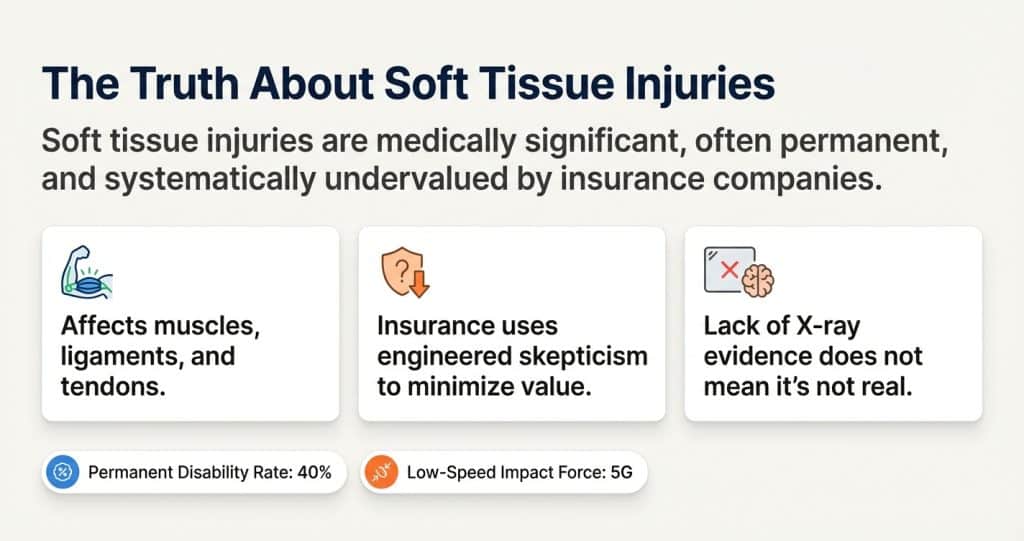
The term “soft tissue” refers to injuries affecting muscles, ligaments, tendons, and other non-bone structures in your body. Because they don’t show up on X-rays the way fractures do, the insurance industry has spent decades convincing people these injuries aren’t “real.”
But consider this: your spine is held together by soft tissue. The muscles that let you turn your head, bend over to pick up your child, sit at a desk for eight hours, or sleep through the night—those are soft tissue. When those structures are damaged, the pain can be constant and exhausting.
I’ve had clients who couldn’t sleep through the night for months after their accidents. Clients who had to give up hobbies they loved—gardening, golf, picking up grandchildren. Clients whose relationships suffered because chronic pain made them irritable and withdrawn. Clients who lost jobs because they couldn’t perform physical requirements anymore.
None of that shows up on an X-ray. But it’s all very, very real.
The Industry Campaign Against Soft Tissue Claims
Here’s something that might surprise you: the dismissive attitude toward soft tissue injuries didn’t happen naturally. It was engineered.
In the 1990s, certain major insurance companies made a strategic decision to fight soft tissue claims aggressively. They funded studies suggesting that low-impact collisions couldn’t cause significant injuries. They hired public relations firms to plant stories about “frivolous lawsuits.” They trained adjusters to view soft tissue claims with skepticism from the start.
The campaign worked. Today, many jurors come into courtrooms already skeptical of soft tissue claims. They’ve absorbed the messaging without even realizing it. “If it doesn’t show on an X-ray, how bad can it be?”
Insurance companies exploit this skepticism ruthlessly. They know that soft tissue claims make up the vast majority of injury cases. If they paid fair value on every soft tissue claim, it would cost them billions. So instead, they’ve developed sophisticated strategies to minimize these claims across the board.
Why Insurance Companies Fight These Cases So Hard
Consider the economics from the insurance company’s perspective. Soft tissue injuries are incredibly common—they represent the bulk of all personal injury claims. Even a small reduction in the average payout for soft tissue claims translates into massive savings industry-wide.
So they’ve invested heavily in systems to suppress these claims:
- Computer software assigns low values to injuries that can’t be “objectively” proven. The programs are designed to discount complaints of pain that aren’t backed by dramatic imaging findings.
- Training programs teach adjusters to view soft tissue claims skeptically. They’re given specific questions designed to elicit answers that undermine credibility. They’re taught to document anything that might suggest exaggeration.
- Medical examiners hired by insurance companies routinely conclude that treatment was excessive or unnecessary. These doctors earn substantial income from insurance company referrals, and they know what conclusions keep the referrals coming.
- Defense experts testify that low-impact collisions can’t cause serious injuries, citing studies conducted on small groups of volunteers who knew they were about to be rear-ended. Never mind that being braced for an impact is completely different from being caught off guard in real-world conditions.
- Publicity campaigns have convinced the general public that soft tissue claims are inherently suspicious. This affects jury pools, settlement negotiations, and even how judges view these cases.
The Medical Reality of Soft Tissue Injuries
Let me share what the medical literature actually shows—not the insurance-funded studies, but legitimate research:
Medical studies have documented that approximately 40% of patients with cervical sprain/strain injuries develop permanent symptoms and disabilities. That’s not a small number. Four out of ten people who suffer whiplash-type injuries will deal with lasting problems.
Long-term studies show that aches and pains persist in 20% to 45% of patients with significant whiplash injuries, with no apparent physical cause on imaging. The pain is real; it’s just not visible on the machines we currently have.
Chronic pain from soft tissue injuries results in documented impairment, disability, and handicap according to the American Medical Association’s guides. These aren’t subjective complaints—they’re medically recognized consequences.
And here’s something particularly relevant to car accident cases: research has shown that collisions at speeds as low as eight miles per hour can generate five times the force of gravity on a person’s head. That amount of force has been shown to produce brain stem injuries, cerebral concussions, and nerve stretch in half of experimental subjects.
Most rear-end collisions involve speeds well above eight miles per hour. The insurance industry’s assertion that low-speed impacts can’t cause real injuries is simply contradicted by the science.
What I Tell My Clients About Soft Tissue Cases
When someone comes into my office with a soft tissue injury, here’s what I need them to understand:
- your injury matters. It doesn’t matter that someone else might have walked away from the same accident unharmed. Bodies are different. Positions at impact matter. Pre-existing conditions (even ones you didn’t know about) matter. You were hurt, and you deserve fair compensation.
- documentation is everything. This is even more true for soft tissue cases than for cases involving obvious injuries like fractures. You need to create a clear record of your symptoms, your limitations, and how the injury affects your daily life.
Keep records of your medical visits. Make sure your doctors are documenting your complaints accurately—not minimizing them to be polite, but recording exactly what you tell them. Note objective signs like muscle spasm and reduced range of motion, which carry significant weight with adjusters and juries.
- be patient but persistent. Soft tissue cases often take longer to resolve than cases with more dramatic injuries. Insurance companies know that many people will get frustrated and accept lowball offers just to make the process end. Don’t let that be you.
- understand that consistency matters. One of the ways insurance companies attack soft tissue claims is by looking for inconsistencies. If you told the ER you were fine but told your doctor two days later you were in agony, they’ll use that against you. If you posted photos on social media of yourself hiking while claiming you couldn’t exercise, that will come up.
This doesn’t mean you should exaggerate your symptoms—quite the opposite. Be honest and consistent from the beginning. Don’t minimize to be polite; don’t exaggerate to build your case. Just accurately describe what you’re experiencing.
The Treatment Trap
One of the challenges with soft tissue injuries is the treatment paradox. Insurance companies criticize claimants who don’t seek treatment (arguing they must not really be hurt) and also criticize claimants who seek “too much” treatment (arguing they’re building a case rather than genuinely trying to get better).
My advice: follow your doctor’s recommendations. If physical therapy is prescribed, go to every session. If medication is recommended, take it as directed. If your doctor suggests you stay home from work, get that documented.
But also know when to stop. If you’ve been treating for months and you’re not getting better, it might be time for a different approach rather than continuing the same treatment indefinitely. Endless treatment with no improvement can actually hurt your case by making you look like you’re not trying to get better.
The goal is genuine recovery, documented appropriately. That’s what insurance companies ultimately respect, even if they don’t want to pay for it.
Objective Signs That Support Your Claim
Certain findings carry more weight than others in soft tissue cases. If your medical providers document any of the following, make sure it’s prominently featured in your claim:
- Muscle spasm is significant because it can’t be faked. When a doctor or physical therapist documents muscle spasm, that’s objective evidence of injury. The insurance company’s computer systems actually assign value to documented spasm.
- Limited range of motion measured by a physician is also objective. If you can’t turn your head as far as you should be able to, or you can’t bend at the waist normally, that can be measured and documented.
- Radiating pain patterns that follow known nerve distributions suggest nerve involvement, which elevates the seriousness of the injury.
- Functional limitations documented by treating providers—things you could do before the accident that you can’t do now—help paint a picture of real impairment.
- The more objective evidence you can document, the harder it is for the insurance company to dismiss your injury as “just soft tissue.”
When Soft Tissue Cases Go to Litigation
Here’s a reality I share with my soft tissue clients: juries are unpredictable in these cases. I’ve seen reasonable settlements rejected by stubborn clients who then received defense verdicts at trial. I’ve also seen cases that seemed weak on paper result in substantial jury awards.
The insurance industry knows that soft tissue cases are risky to try. Juries might be skeptical, but they also might connect with a sympathetic plaintiff and return a verdict much higher than the insurance company offered. This uncertainty gives both sides incentive to settle.
If your case does go to litigation, preparation becomes even more critical. Every inconsistency in your medical records will be exploited. Every gap in treatment will be questioned. Every social media post will be scrutinized. Defense attorneys are skilled at making soft tissue plaintiffs look unreliable, and you need to be prepared for aggressive cross-examination.
The Bottom Line on Soft Tissue Injuries
Your soft tissue injury is real. The pain you’re experiencing is real. The limitations on your life are real.
Don’t let the insurance industry’s carefully crafted messaging convince you otherwise. Don’t accept their dismissive attitude or their lowball offers. And don’t give up just because your injury doesn’t show up on an X-ray.
With proper documentation, consistent treatment, and patience, soft tissue claims can result in fair compensation. It’s harder than it should be—the system is designed to make it hard—but it’s absolutely possible.
If you’ve been injured in a Houston car accident and you’re being told your soft tissue injury doesn’t deserve fair compensation, I encourage you to get a second opinion. What you’re going through matters, and you deserve to be taken seriously.

About the Author
Chi Nguyen is a Houston personal injury attorney dedicated to helping accident victims understand their rights and receive fair compensation under Texas law. With extensive experience representing injured Texans, Attorney Nguyen combines legal expertise with a commitment to client education and empowerment.