

Table of contents
Introduction
The first 72 hours after a car accident in Houston are critical—not just for your health, but for your legal rights. What you do (and don’t do) in this narrow window can make or break your ability to recover fair compensation for your injuries.
I’ve represented hundreds of accident victims in Texas, and I’ve seen the same patterns repeatedly: clients who protected themselves in those early hours have stronger cases. Those who didn’t—who assumed everything would work out, who didn’t document anything, who gave recorded statements without thinking—often face an uphill battle that could have been avoided.
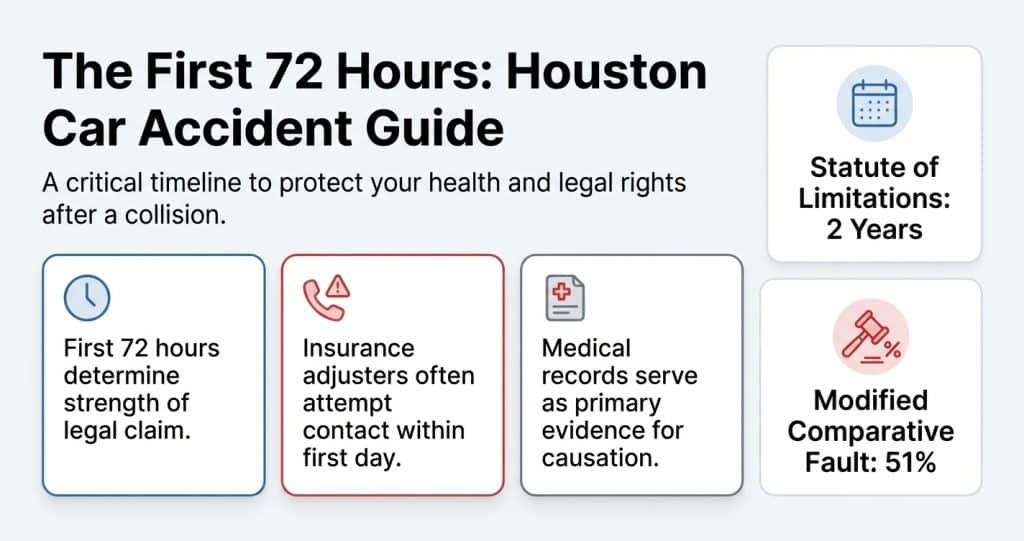
Here’s what most people don’t realize: the insurance company begins building its case against you the moment the accident is reported. According to established insurance industry practice, adjusters are trained to make same-day contact with claimants when receiving a new assignment. Within 72 hours, a field adjuster may appear at your door in person. They’re not there to help you—they’re there to gather information that minimizes what they’ll pay.
Texas law provides significant protections for accident victims, but those protections only work if you’re positioned to take advantage of them. This guide walks you through exactly what to do in the first 72 hours after a Houston car accident—and equally important, what to avoid.
The First Hour: At the Scene
The moments immediately after a collision are chaotic and frightening. Your adrenaline is pumping, you may be disoriented, and your instinct might be to downplay the situation. Fight that instinct. What you do at the scene matters enormously.
Safety First
Before anything else, assess whether you or anyone else needs immediate medical attention. If there are serious injuries, call 911 immediately. Under Texas Transportation Code Section 550.021, you are legally required to stop at the scene of an accident involving injury or death. Leaving the scene of an injury accident is a felony in Texas, punishable by up to 10 years in prison for accidents involving serious bodily injury.
If the vehicles are creating a traffic hazard and can be safely moved, Texas law allows you to move them to the side of the road. However, before moving anything, take photographs of the vehicles in their original positions if you can do so safely.
Call the Police
Even for seemingly minor accidents, always call the police and request an official report. In Houston, you can call the Houston Police Department non-emergency line at 713-884-3131, or 911 if there are injuries.
Under Texas Transportation Code Section 550.062, officers are required to investigate accidents involving injury, death, or property damage appearing to exceed $1,000. Given how expensive vehicle repairs are today, almost every accident meets this threshold. While police reports are not always admissible in court, they carry enormous weight in liability assessments and settlement negotiations.
Document Everything
Your smartphone is your most powerful evidence-gathering tool at the accident scene. While waiting for police, start documenting the scene if you are physically able to do so safely:
- Photograph all vehicles involved from multiple angles, showing overall damage and close-ups of specific impact points
- Document the overall accident scene including traffic signs, signals, lane markings, and road conditions
- Capture skid marks, debris fields, and any hazardous conditions that may have contributed to the accident
- Photograph the other driver’s license plate, driver’s license, and insurance card
- Document any visible injuries you have sustained
- Take pictures of weather conditions and lighting
One often-overlooked piece of evidence is the 911 recording. Most police departments and emergency agencies keep taped recordings of received phone calls. In some areas, these recordings are only kept for four months, so it’s important to obtain them as soon as possible. If you made the emergency call, your voice may show the fear and pain you experienced—powerful evidence at trial. If a witness made the call, they may have described your injuries or the defendant’s actions.
Exchange Information
Texas law requires you to exchange information with the other driver. Get their full legal name, current address and phone number, driver’s license number and state of issue, license plate number, vehicle make, model, and year, and insurance company name, policy number, and contact information. Also get contact information for any witnesses—name, phone number, and email address if they’ll provide it.
What NOT to Say
This is crucial. Do not admit fault, apologize, or say anything that could be interpreted as accepting blame. Texas follows a “modified comparative fault” rule under Civil Practice and Remedies Code Section 33.001, meaning your compensation can be reduced by your percentage of fault—and if you’re more than 50% at fault, you recover nothing.
A simple “I’m sorry” or “I didn’t see you” can be twisted into an admission of liability. Even if you think you might have been partially at fault, don’t say so. Stick to factual statements only.
Hours 1-12: Seeking Medical Attention
Even if you feel “fine” after the accident, you must seek medical attention within the first 12 hours—ideally immediately. This is non-negotiable.
The Adrenaline Problem
After a traumatic event, your body floods with adrenaline and endorphins that mask pain. These stress hormones are designed to help you survive dangerous situations—to keep you functioning even when injured. The problem is, they also prevent you from accurately assessing whether you’re hurt.
You might feel okay at the scene but wake up the next morning barely able to move. It is fairly normal to experience pain either hours or a few days after an incident. Any doctor who testifies will confirm that some muscle or ligament injuries—so-called “soft tissue” injuries—take time before the person actually feels them. Even fractures can be misdiagnosed or not noticed until a week or more after the incident.
In one case I handled, a client sustained what appeared to be minor whiplash. As the case progressed, it became clear he had also sustained a head injury affecting his memory. The case eventually settled for $53,000, with most of the value placed on the head injury because the emergency room and ambulance personnel had focused on more visible injuries. The lesson: what seems minor at the scene can turn out to be serious.
Why Immediate Treatment Matters for Your Case
From a legal perspective, your medical records are your case. The emergency room visit creates a documented connection between the accident and your injuries—what lawyers call establishing “causation.”
If you wait days or weeks to seek treatment, the insurance company will argue your injuries either weren’t caused by the accident or aren’t serious. They’ll suggest something else happened during the gap—you lifted something heavy, you slept wrong, you had a pre-existing condition that’s really to blame.
I recently had a case where a pedestrian was struck and taken by ambulance to the hospital. The ER focused on a wrist fracture and cuts. Neither the ambulance personnel nor emergency doctors documented the head injury with any seriousness. Four days later, the primary care physician identified a significant closed head injury. The underinsured motorist carrier dismissed the head injury claim entirely because it wasn’t in the initial records. It took mediation, well into litigation, before they finally accepted the injury was real.
Where to Go
If your injuries seem serious—head trauma, severe pain, difficulty breathing, numbness, or tingling—go to the emergency room immediately. For less severe symptoms, an urgent care facility can document your condition.
Either way, tell the medical provider exactly what happened. Describe all symptoms, no matter how minor: headaches, neck stiffness, back pain, dizziness, ringing in ears, difficulty concentrating, mood changes. Everything should be documented. If you don’t mention a symptom, it won’t appear in your medical records.
Many attorneys make the mistake of requesting only the hospital emergency report. However, nurses’ notes often contain crucial evidence about pain, suffering, complaints, medication effects, objective symptoms like swelling, and vital signs. Request the entire hospital record including nurses’ notes.
Hours 12-24: Documentation and Notification
Once you’ve addressed immediate medical needs, the documentation phase begins in earnest.
Notify Your Insurance Company
Under most Texas auto insurance policies, you have a duty to promptly notify your insurer of an accident. Call your insurance company to report the accident, but keep your statement brief and factual. Provide basic facts: date, time, location, vehicles involved, general description of what happened. Do not speculate about fault. Do not give detailed statements about your injuries since you don’t yet know their full extent.
Do NOT Give a Recorded Statement to the Other Insurance Company
Within 24 hours of your accident, you’ll likely receive a call from the at-fault driver’s insurance adjuster. They’ll sound friendly and helpful. They’ll say they just need a quick recorded statement to “process the claim.”
Do not comply.
Under Texas law, you have absolutely no obligation to provide a recorded statement to the other driver’s insurance company. As a general rule, giving a statement rarely leads to an early settlement, contrary to what adjusters claim. A statement pins you to a set of facts that may or may not be accurate—and any discrepancies will be used against you at trial.
The adjuster may ask about your injuries. You might assume they’re asking about injuries you have today and forget to mention the neck pain that went away, the bruises that have disappeared, the cuts that have healed. If you remember these later at deposition, you’ll be forced to explain why you didn’t mention them in your statement—creating the appearance of inconsistency or exaggeration.
Similarly, do not sign any authorizations allowing the other driver’s insurance company to obtain your medical records. They will try to obtain any and all records, whether related to the injury or not, hoping to find a prior injury they can blame for your current problems.
Politely decline: “I’m still recovering and getting medical treatment. I’m not able to provide a recorded statement at this time. Please communicate with me in writing.”
Start a Written Journal
Begin documenting your symptoms, pain levels, and how the accident is affecting your daily life:
- Your pain level on a scale of 1-10 at different times of day
- Activities you can no longer perform or that cause pain
- Sleep disturbances
- Emotional symptoms like anxiety, depression, or fear of driving
- Any medications you’re taking and their effects
- How the accident is affecting your work, family responsibilities, and relationships
This journal becomes powerful evidence of your pain and suffering—a category of damages that’s difficult to quantify but often substantial under Texas law.
Photograph Your Injuries
Take pictures of any visible injuries—bruises, cuts, swelling, abrasions—as they develop. Injuries often look worse a day or two after the accident as swelling and bruising fully emerge. Document the progression with dated photographs.
Photos taken before the accident are also valuable. They can show what type of activities you engaged in that you can no longer enjoy—camping, sailing, travel, family parties. This “before and after” evidence is crucial for demonstrating how the accident changed your life.
Hours 24-48: Medical Follow-Up and Legal Considerations
The second day after your accident is about building on the foundation you’ve established.
Follow Up With Your Doctor
If you went to the ER or urgent care, now is the time to see your primary care physician or a specialist. Describe your symptoms in detail. If the ER recommended follow-up imaging (MRI, CT scan) or specialist referrals, schedule those appointments now.
Delays in treatment create what insurance companies call “gaps”—and gaps destroy claims. Insurance adjusters are trained to look for them. A consistent treatment history from accident through recovery creates documentation that’s hard to dispute.
If you’re prescribed physical therapy, go to every session. If you’re given exercises to do at home, do them. If you’re told to rest and avoid certain activities, follow that advice.
Understand Texas’s Statute of Limitations
Texas Civil Practice and Remedies Code Section 16.003 gives you two years from the date of the accident to file a personal injury lawsuit. While two years may seem like plenty of time, building a strong case takes months. Evidence disappears. Witnesses forget details. Surveillance footage gets deleted—often within days.
Consider Consulting an Attorney
By the 24-48 hour mark, you should consider whether your case warrants legal representation. If your injuries are significant, if liability is disputed, or if the insurance company is already being difficult, consulting with a Houston personal injury attorney is wise. Most offer free consultations.
Don’t Post on Social Media
Insurance companies actively monitor claimants’ social media accounts. That photo of you smiling at a family dinner? They’ll argue you’re not really in pain. That check-in at the gym? Evidence you’re exaggerating your limitations.
The safest approach is to avoid posting anything until your claim is resolved.
Hours 48-72: Building Your Case
By the third day, you’re in case-building mode.
Obtain the Police Report
In Houston, police reports are typically available within 10 business days. You can request a copy through the Houston Police Department Records Division or the Texas Department of Transportation Crash Records Information System (CRIS) at cris.dot.state.tx.us.
Review the report carefully for accuracy. If there are errors, you may be able to submit a supplemental statement.
Request Medical Records
Submit written requests for copies of all medical records related to the accident. Under Texas Health and Safety Code Chapter 181, healthcare providers must furnish your records within 15 business days of your written request. Request the entire hospital record including nurses’ notes, ambulance driver reports, and all diagnostic imaging.
Preserve Physical Evidence
Keep everything related to the accident:
- The clothes you were wearing (don’t wash them if there’s blood or damage)
- Any personal items damaged in the accident
- Receipts for any accident-related expenses
- All correspondence from insurance companies
- Your vehicle (if totaled, don’t let it be destroyed without your attorney’s approval)
Understand Modified Comparative Fault
Texas follows a “51% bar” rule. Under Civil Practice and Remedies Code Section 33.001, you can recover damages only if you are 50% or less at fault. If you’re 51% or more responsible, you recover nothing. If you’re partially at fault but under 51%, your damages are reduced by your percentage of responsibility.
This makes early evidence preservation critical.
Common Mistakes to Avoid
In my years of practice, I’ve seen clients unknowingly damage their cases in the first 72 hours:
- Giving Recorded Statements to the Other Insurer: The other driver’s insurance company is not on your side. They are looking for any statement they can use to deny or minimize your claim.
- Admitting Any Fault: Even saying “I didn’t see you” can be used against you. Stick to facts.
- Downplaying Injuries to Medical Providers: Many people minimize their symptoms. Tell your doctors everything. Symptoms you don’t mention don’t get documented.
- Accepting Early Settlement Offers: Some insurance companies push “first call” settlements—quick lowball offers made before you know the extent of your injuries. Under Texas law, once you sign a release, you cannot seek additional compensation—even if your injuries turn out to be much worse than initially thought.
- Failing to Follow Medical Advice: Gaps in treatment give insurance companies ammunition to argue you weren’t really injured.
- Waiting Too Long to Act: While Texas gives you two years to file suit, the strongest cases are built on evidence gathered immediately.
Conclusion
The first 72 hours after a Houston car accident are a window of opportunity. The actions you take—seeking medical attention, documenting everything, avoiding damaging statements, and preserving evidence—lay the foundation for everything that follows.
Remember: insurance companies have teams of adjusters, investigators, and attorneys working to minimize what they pay you. Industry practice requires them to make same-day contact and attempt in-person meetings within 72 hours. They move fast because early information is powerful information—for them.
You deserve someone on your side moving just as quickly. If you’ve been injured in a Houston car accident, consider consulting with an experienced personal injury attorney who understands Texas law and knows how to fight for fair compensation.
The first 72 hours matter. Make them count.

About the Author
Chi Nguyen is a Houston personal injury attorney dedicated to helping accident victims understand their rights and receive fair compensation under Texas law. With extensive experience representing injured Texans, Attorney Nguyen combines legal expertise with a commitment to client education and empowerment.