

Table of contents
Immediately after a motorcycle accident, move to a safe location out of traffic and keep your helmet on. Call 911 to request police and emergency medical services. Document the crash scene with photos, exchange information with the other driver, and seek professional medical attention immediately, even if you feel fine.
What Should I Do Immediately After a Motorcycle Accident?
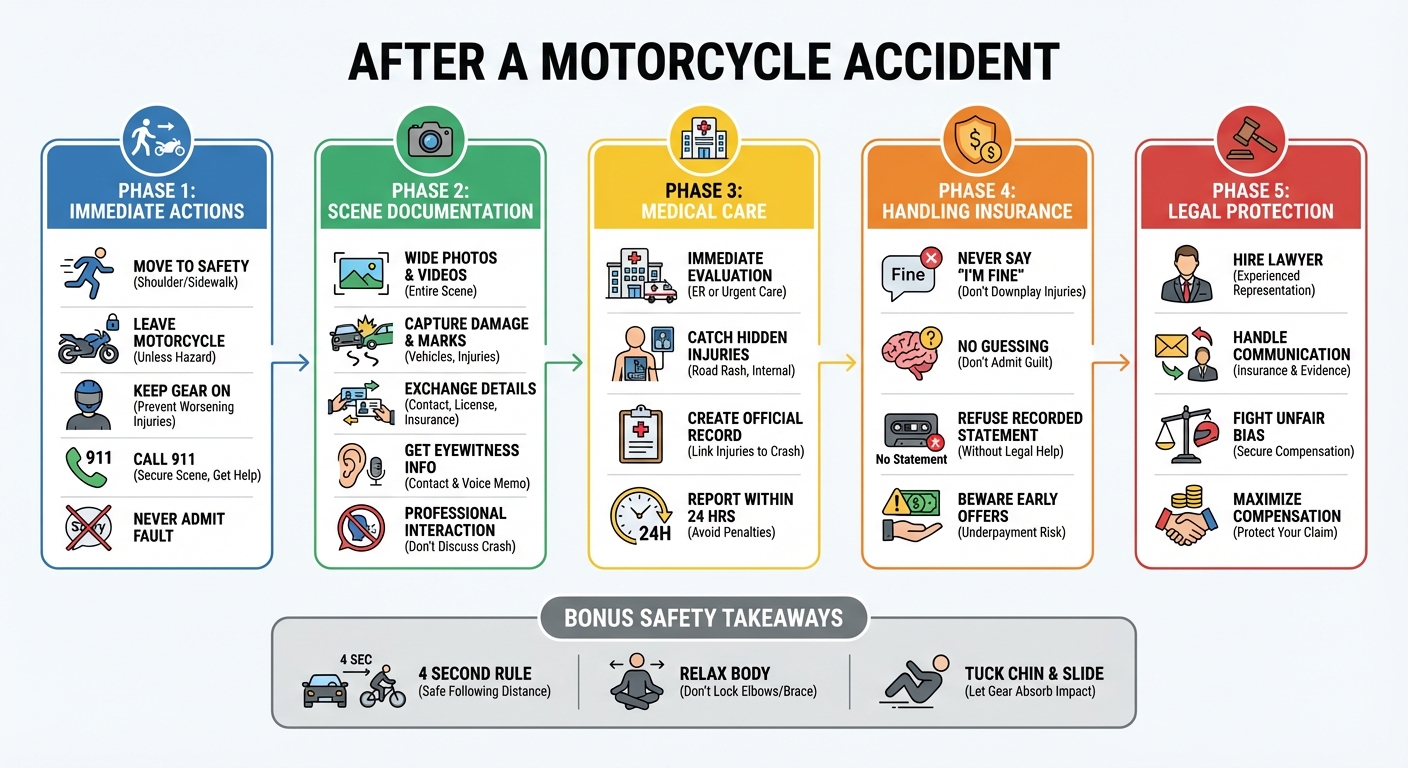
Immediately after a motorcycle accident, you should move out of the roadway to a safe location and keep your protective gear on. Call 911 to dispatch police and emergency medical services. Once secure, document the scene with photos and exchange contact and insurance information with the other driver.
Move to Safety and Avoid Further Danger
If you are physically able to move, get yourself and your motorcycle out of the flow of traffic. Secondary collisions are a major risk after an initial crash. Move to the shoulder or a nearby sidewalk, and turn on your hazard lights if your bike is still operable.
Keep Your Helmet and Protective Gear On
Adrenaline can mask severe injuries, particularly neck and spinal trauma. Do not remove your helmet or heavy protective gear immediately. Wait for emergency medical personnel to arrive, as improperly removing a helmet can worsen a spinal cord injury.
Call 911 for Police and Emergency Medical Services
Always call 911, even if the crash seems minor. You need a formal police report to document the facts of the collision, which is critical for any future insurance claim. Request an ambulance so paramedics can evaluate you on-site.
Documenting the Scene and Gathering Evidence
Evidence disappears quickly once the road is cleared. If you are not severely injured, take proactive steps to document the aftermath.
Take Comprehensive Photos and Videos
Use your smartphone to capture the scene from multiple angles. Photograph the damage to your motorcycle, the other vehicle, skid marks, road conditions, traffic signs, and your visible injuries. Video walkthroughs of the scene can also provide valuable context to accident reconstruction experts.
Exchange Details with the At-Fault Driver
Collect the other driver’s name, phone number, address, driver’s license number, license plate number, and insurance information. Keep the conversation brief and strictly factual. Do not discuss how the crash happened.
Collect Witness Contact Information
Bystanders who saw the crash are objective third parties whose testimony can prove the other driver’s negligence. Ask witnesses for their names and phone numbers before they leave the scene.
Medical Care and Coping with the Crash
Motorcycle accidents often result in severe physical and psychological trauma. Prioritizing your health is the most important step in your recovery.
Seek Professional Medical Attention Immediately
Go to the emergency room or an urgent care clinic immediately after leaving the scene. Delaying medical care gives insurance companies an excuse to argue your injuries are unrelated to the crash. Follow all prescribed treatment plans meticulously.
Monitor for Physical Shock and Concussion Symptoms
Symptoms of serious injuries like traumatic brain injuries (TBIs) or internal bleeding may not appear for hours or days. Watch for dizziness, confusion, nausea, blurred vision, or severe fatigue. If these occur, seek emergency care immediately.
Address the Emotional Toll of the Crash
It is normal to experience anxiety, depression, or PTSD after a motorcycle crash. Do not ignore your mental health. Consider speaking with a therapist who specializes in trauma to help you cope with the emotional aftermath.
What Not to Do After a Motorcycle Accident?
After a motorcycle accident, do not admit fault, apologize, or say you are uninjured. Never leave the scene without calling the police to file an official report. Additionally, do not post about the crash on social media or give a recorded statement to the insurance company without legal representation.
Never Admit Fault or Apologize at the Scene
Saying “I’m sorry” or “I didn’t see you” can be twisted into an admission of liability. Even if you think you might be partially to blame, let the police and investigators determine fault based on the evidence.
Do Not Skip the Official Police Report
Never agree to handle the accident “under the table” with the other driver. Without a police report, it becomes your word against theirs, making it nearly impossible to secure fair compensation for your damages.
Avoid Posting About the Crash on Social Media
Insurance adjusters monitor social media accounts to find evidence that undermines your claim. A photo of you smiling with friends or a post saying “I’m okay, just a little banged up” can be used to deny your injury claims. Stay offline until your case is resolved.
Dealing with Insurance: What Not to Tell Your Insurance Company?
When speaking to an insurance company, do not tell them you feel fine or apologize for the crash. Never provide a recorded statement, speculate about how the accident happened, or accept a quick settlement offer. Stick strictly to the basic facts, such as the date, time, and location.
Do Not Provide a Recorded Statement Without a Lawyer
Insurance adjusters are trained to ask leading questions that trick you into saying something damaging. You are not legally obligated to give a recorded statement to the at-fault driver’s insurance company. Speak to an attorney first.
Do Not Downplay Your Injuries or Say ‘I’m Fine’
If an adjuster asks how you are doing, do not reply with “I’m fine” out of habit. Simply state that you are currently receiving medical treatment. Downplaying your injuries can severely devalue your claim.
Do Not Accept the First Settlement Offer
Initial settlement offers are almost always lowball figures designed to close the case quickly and cheaply. Never sign a release or accept a check until you know the full extent of your future medical costs and lost wages.
Preventing Future Crashes: What is the 4 Second Rule on a Motorcycle?
The 4-second rule on a motorcycle is a safety guideline that dictates keeping a minimum of four seconds of following distance between you and the vehicle ahead. This buffer provides crucial reaction time to brake or swerve if the leading vehicle stops suddenly or encounters a road hazard.
How Following Distance Saves Lives
Motorcycles require more skill and balance to stop quickly than passenger cars. Maintaining a four-second gap ensures you have enough time to perceive a hazard, react, and bring your bike to a safe, controlled stop without locking the brakes or losing control.
Applying the Rule in Real-World Traffic
To use the 4-second rule, pick a stationary object on the side of the road, like a sign or a tree. When the rear bumper of the car ahead passes it, count “one-thousand-one, one-thousand-two, one-thousand-three, one-thousand-four.” If you pass the object before reaching four, you are following too closely.
When to Contact a Personal Injury Attorney
Navigating the aftermath of a motorcycle crash is overwhelming, especially when dealing with severe injuries and aggressive insurance adjusters. Partnering with a skilled legal professional levels the playing field.
Protecting Your Legal Rights
An attorney will handle all communication with the insurance companies, preserve critical evidence, and ensure you do not miss strict legal deadlines (statutes of limitations). They protect you from tactics designed to minimize your payout.
Maximizing Your Compensation
Motorcycle accidents often result in catastrophic injuries requiring long-term care. A personal injury lawyer will calculate your total damages—including medical bills, lost income, pain and suffering, and future rehabilitation costs—and fight relentlessly to secure the maximum compensation you deserve.