

Table of contents
I’ve attended seminars where defense attorneys openly discuss their strategies for winning personal injury cases. I’ve read their publications, studied their trial tactics, and sat across from them in hundreds of negotiations and depositions. What they share is eye-opening—and every accident victim should understand it.
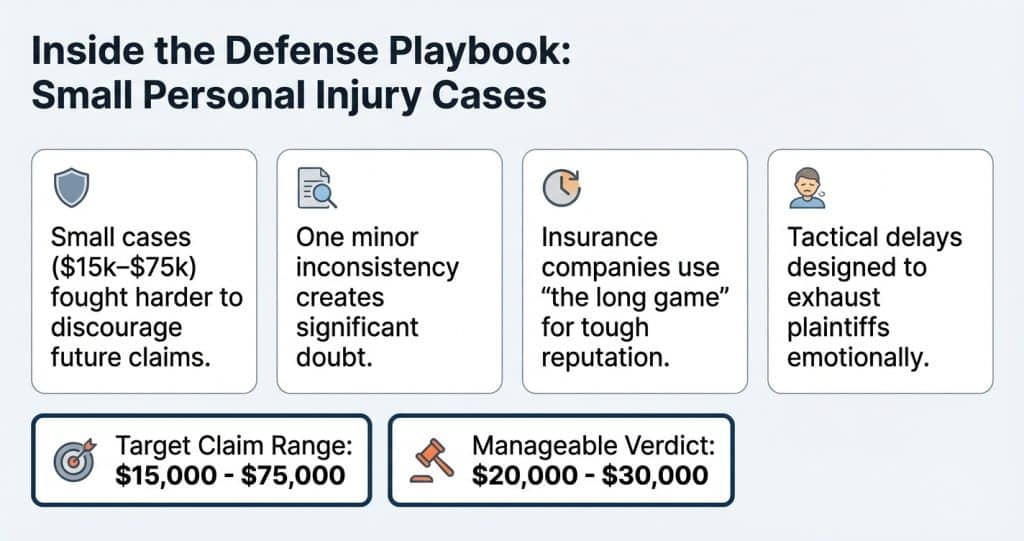
The truth is, small to medium cases are where defense attorneys feel most confident. When injuries are catastrophic and liability is clear, insurance companies settle. But in the $15,000 to $75,000 range, they’re often willing to roll the dice.
Understanding how the defense thinks about your case can help you make better decisions about how to handle it.
They Know Which Cases to Fight
Defense attorneys and insurance adjusters have told me directly: they’re not afraid of small cases. Even if they lose at trial, the verdict might be $20,000 or $30,000—manageable for their clients. But if they can win a defense verdict or push the plaintiff into an unfavorable settlement, they’ve saved significant money.
So they fight these cases hard, knowing that many plaintiffs will give up before trial or accept inadequate offers just to avoid the uncertainty of a verdict.
The economics are straightforward. It costs them money to defend cases—attorney fees, expert fees, court costs. But in bigger cases, those defense costs are a small fraction of potential exposure. In smaller cases, the defense costs might approach or even exceed the claim value. You’d think this would make them more eager to settle.
But here’s the catch: insurance companies play a long game. They know that if they get a reputation for paying fair value on every small claim, more people will pursue claims. So they fight some cases as a matter of principle, to send a message that they won’t be easy targets.
This means your small case might be selected for aggressive defense not because of anything specific about your situation, but because you happen to be the one they’ve chosen to make an example of.
They Look for One or Two Weaknesses
In a catastrophic injury case, it takes overwhelming evidence to defeat a plaintiff’s claim. Juries naturally want to help people who have suffered devastating losses. Defense attorneys know they’re fighting an uphill battle.
But in a small case, the defense knows they only need one or two solid points to win.
A gap in treatment that suggests you weren’t really hurt. A pre-existing condition that might explain your symptoms. A plaintiff who comes across poorly on video deposition. An inconsistent statement given to the adjuster right after the accident. Property damage photos showing minimal impact.
They don’t need to prove you’re a fraud. They don’t need to show the accident wasn’t the defendant’s fault. They just need to create enough doubt that a jury feels uncomfortable awarding you money.
I’ve seen defense verdicts in cases where liability was crystal clear and injuries were documented by multiple physicians. The defense found one weakness—maybe the plaintiff seemed greedy, maybe there was a social media post that looked bad, maybe the medical records had one inconsistency—and they hammered that weakness until the jury couldn’t see past it.
They Count on Jury Attitudes
Defense attorneys understand that many jurors are skeptical of personal injury claims. The insurance industry has spent decades running campaigns about “lawsuit abuse” and “frivolous claims.” Television shows and news programs have featured stories about supposedly outrageous verdicts. Those messages have sunk in.
Jurors often come into court with preconceptions. They wonder why someone with a “minor” injury is asking for money. They think about the lawsuits they’ve heard criticized. They remember stories about people faking injuries or exaggerating claims.
Defense attorneys don’t have to create this skepticism—they just have to activate it. A few well-placed questions during jury selection, some subtle suggestions during testimony, and the baseline skepticism does their work for them.
I’ve watched defense attorneys spend more time in closing arguments talking about lawsuit abuse generally than about the specific facts of the case. They’re not really arguing that this particular plaintiff is a fraud—they’re reminding jurors that fraud exists and letting the jurors make the connection themselves.
They Know What Makes Plaintiffs Give Up
Through experience, defense attorneys and adjusters have learned what breaks plaintiffs down:
Time. The longer a case drags on, the more exhausted plaintiffs become. The accident was traumatic. The injuries were painful. The medical treatment was burdensome. Now the legal process is adding more stress. Many plaintiffs eventually just want it to be over, even if that means accepting less than they deserve.
Expense. Litigation is expensive. Expert witnesses, court reporters, filing fees—costs add up. Defense attorneys know that plaintiffs who are paying these costs out of pocket (or watching their attorney advance them) start feeling pressure to settle.
Uncertainty. Even strong cases can lose at trial. Defense attorneys make sure plaintiffs understand this. “You might win big,” they suggest, “but you might also get nothing. Are you willing to take that risk?” The more they can amplify uncertainty, the more attractive their settlement offers become.
Personal exposure. The discovery process exposes plaintiffs’ lives to scrutiny. Medical records, employment records, financial records, social media—everything becomes fair game. Some plaintiffs don’t realize how invasive this process will be until they’re in the middle of it.
Defense attorneys use these pressure points strategically. They time low settlement offers to coincide with particularly stressful moments in the litigation. They ask for invasive discovery right before settlement conferences. They do whatever they can to make the plaintiff feel that settling is easier than continuing to fight.
They Evaluate You Personally
Make no mistake: from the moment you file a claim, you’re being evaluated. The adjuster is assessing you. The defense attorney is assessing you. They’re making judgments that affect how they handle your case.
They want to know: Is this plaintiff credible? Will they make a good witness? Are they likely to give up easily? Do they have an attorney who actually tries cases, or one who settles everything?
These assessments happen constantly. When the adjuster calls and asks how you’re doing, they’re noting your tone, your word choices, your apparent sophistication. When the defense attorney deposes you, they’re evaluating how you’ll come across to a jury. When they see your social media posts, they’re looking for anything they can use.
If they conclude you’re not credible, they’ll fight harder. If they think you’ll cave under pressure, they’ll offer less. If they believe your attorney doesn’t try cases, they’ll push for a lowball settlement, knowing there’s no real threat of trial.
They Know Which Experts to Hire
The defense has relationships with expert witnesses who consistently produce favorable opinions. Doctors who find that plaintiffs have fully recovered, or that their injuries are pre-existing, or that their treatment was excessive. Engineers who conclude that low-speed collisions can’t cause real injuries. Economists who minimize future damages.
These experts are professionals at being experts. They testify frequently, they know what works in front of juries, and they’ve been cross-examined enough times to avoid common traps. Their reports are carefully worded to provide maximum support for the defense position.
When the insurance company sends you to an “independent” medical examination, they’re sending you to one of these doctors. The examiner knows who’s paying the bill and what conclusion is expected. While not all defense experts are hired guns—some are genuinely impartial—the selection process ensures that the defense gets opinions that help their position.
They Communicate With Each Other
Here’s something plaintiffs often don’t realize: defense attorneys and adjusters talk to each other about cases, about attorneys, about strategies that work.
If you’ve had a claim against one insurance company, that information may be shared with others. If your attorney has a reputation—good or bad—defense counsel knows about it. If a particular expert witness has been effective in similar cases, defense attorneys recommend that expert to each other.
Large insurance defense firms have resources that solo practitioners can’t match. They have databases of prior verdicts. They have libraries of deposition transcripts. They have templates for every motion and brief. They know what’s worked in past cases and they apply those lessons systematically.
This isn’t nefarious—it’s just good practice from their perspective. But it means plaintiffs are often fighting against institutional knowledge and resources that dwarf their own.
What This Means for Your Case
Understanding how the defense thinks should inform how you approach your case:
Document everything meticulously. The defense will look for inconsistencies. Make sure your medical records accurately reflect your symptoms. Make sure your treatment is consistent and follows medical recommendations. Make sure there are no gaps that suggest you weren’t really injured.
Be careful on social media. Assume everything you post will be seen by the defense. That photo from your cousin’s wedding where you’re smiling? They’ll use it to argue you’re not really in pain. That check-in at the gym? They’ll argue you’re exaggerating your physical limitations.
Understand your weaknesses. Every case has them. Figure out what yours are before the defense exploits them. A good attorney can help you address weaknesses proactively rather than scrambling to explain them later.
Be patient. The defense is counting on you to get tired and give up. Don’t let their delay tactics work. If your case is worth fighting, commit to fighting it properly, even when the process feels endless.
Choose your attorney carefully. The defense knows which attorneys actually try cases and which ones settle everything. If you want the defense to take you seriously, you need representation that takes them seriously. An attorney who has never seen the inside of a courtroom won’t scare anyone into a fair settlement.
Be realistic. Not every case is worth fighting to the end. Sometimes the defense is right that a case has problems. Sometimes the best outcome is a reasonable settlement rather than the risk of trial. But make sure you’re being realistic based on honest assessment, not based on pressure tactics designed to wear you down.
The Bottom Line
Defense attorneys and insurance adjusters are professionals who have handled thousands of cases. They know what works, what doesn’t, and how to exploit plaintiff weaknesses. They’re not evil—they’re doing their jobs—but their job is to minimize what you receive.
Understanding their perspective helps you navigate the process more effectively. You can anticipate their tactics, shore up your weaknesses, and avoid the traps they set.
Your small personal injury case might not seem important in the grand scheme of things. But to you, it matters. And if you want to get fair value, you need to understand what you’re up against.

About the Author
Chi Nguyen is a Houston personal injury attorney dedicated to helping accident victims understand their rights and receive fair compensation under Texas law. With extensive experience representing injured Texans, Attorney Nguyen combines legal expertise with a commitment to client education and empowerment.