
Table of contents
Within days of your Houston car accident, you’ll get a call from an insurance adjuster asking for a recorded statement. They’ll tell you it’s routine, just to get the facts down while they’re fresh. They’ll sound friendly, helpful, even sympathetic.
What they won’t tell you is that this statement can be used against you for years to come—and that it’s specifically designed to help them, not you.
I’ve seen too many clients walk into my office with claims that were undermined before I ever met them, all because of something said in a recorded statement given without fully understanding the consequences. Let me explain how these statements work, why they’re dangerous, and what you should know before you talk to anyone.
Why Insurance Companies Want Recorded Statements
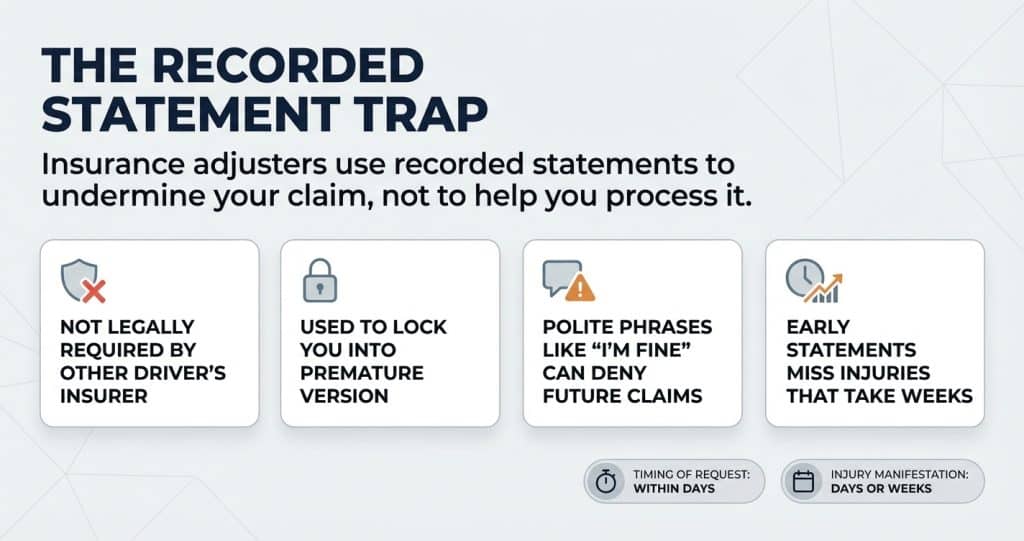
The first thing to understand is that insurance companies don’t need your recorded statement to process your claim. There’s no legal requirement that you provide one. They want it because it helps them, not because it helps you.
Here’s what they’re really doing when they ask for a statement:
- Locking you into a version of events. Once you’ve given a recorded statement, you’re stuck with whatever you said. If your recollection changes, if new details emerge, if you remember something you forgot to mention—it’s all going to be compared against that initial statement. Any inconsistency, no matter how minor or understandable, will be used to attack your credibility.
- Catching you at your worst moment. You’re typically asked for a statement within days of your accident, when you’re still in shock, possibly on pain medication, stressed about medical bills, worried about your car, and not thinking clearly. This is exactly when the insurance company wants you on record.
- Getting admissions they can use against you. Adjusters are trained to ask questions in specific ways that elicit damaging answers. “You were feeling okay right after the accident, weren’t you?” “You’re not planning any surgery, are you?” “This was really just a minor fender-bender, right?” Your polite, agreeable answers become weapons against your claim.
- Documenting limitations on your injuries. Right after an accident, you don’t know the full extent of your injuries. You mention your neck hurts but forget about the headaches that started the next day. You say you’re “doing okay” because you don’t want to complain. Months later, when the full picture becomes clear, that early statement haunts you.
How Statements Get Twisted Against You
Let me give you some examples from actual cases I’ve handled:
The paraphrase problem. An adjuster takes your statement and writes it down in their own words rather than transcribing exactly what you said. They ask if it’s “essentially correct” and you sign it. But their paraphrase subtly changes the meaning.
In one case I handled, my client told the adjuster he was “about two or three feet from the side of the road” before the collision. When the adjuster asked if he was exactly sure about that distance, he naturally said no—he wasn’t exactly sure, he was estimating. The written statement? “I am not exactly sure how far we were from the side of the road.” Same words, completely different implication. The defense used that statement to suggest my client was in the wrong lane.
The omission trap. In another case, my client gave a recorded statement focusing on her back injury, which was her primary complaint at the time. The adjuster asked about her physical condition and my client described her back pain in detail. She didn’t mention her knee, which had been injured previously in an unrelated incident but was aggravated in the collision.
Months later, when she raised the knee injury, the adjuster repeatedly pointed out that she “never mentioned” the knee in her initial statement. The implication was that she was making it up. In reality, the adjuster had focused the questions on certain injuries and my client simply addressed what was asked. But that nuance was lost.
The “doing fine” problem. Many people, especially immediately after an accident, minimize their injuries when talking to strangers. We’re conditioned to say “I’m fine” when people ask how we’re doing. If you tell an adjuster you’re “doing okay” or “feeling better” a week after your accident, those words will follow you forever.
I had a client who told an adjuster she was “hanging in there” when asked how she was feeling. That phrase showed up in the insurance company’s settlement offer letter, their responses to our demands, and their pre-trial briefs. “The plaintiff herself stated she was ‘hanging in there’ just days after the accident—hardly the description of someone severely injured.”
The Timing Problem
The biggest issue with early statements is that you simply don’t know what your injuries are yet.
A week after your accident, adrenaline is still masking some symptoms. Injuries that seem minor are still developing. Conditions that will become chronic haven’t revealed themselves yet. You might feel relatively okay right now and be in severe pain six weeks from now.
But once you’ve given a statement saying you feel fine, changing your story later looks suspicious—even if you’re being completely honest about how your symptoms developed. The insurance company will argue you’re exaggerating, that your injuries can’t be that bad because you said you were fine in your statement.
This is particularly problematic with soft tissue injuries and closed head injuries, both of which can take days or weeks to fully manifest. I’ve had clients who felt “a little stiff” after their accidents and were later diagnosed with herniated discs. I’ve had clients who mentioned headaches in passing and were eventually found to have traumatic brain injuries.
If they gave statements in that first week saying they felt basically okay, those statements became major obstacles to fair compensation.
What Adjusters Are Trained to Do
Insurance adjusters aren’t randomly asking questions—they’re following scripts designed to elicit responses that help the insurance company.
They’re trained to ask leading questions that suggest the answer the company wants: “You weren’t really hurt that badly, were you?” “The other driver wasn’t going that fast, was she?” “You’re feeling better now, right?”
They’re trained to sound sympathetic while gathering ammunition: “That must have been scary—you probably weren’t really paying attention to details in that moment, were you?”
They’re trained to ask about your entire medical history under the guise of being thorough: “Just so I have a complete picture, have you ever had any other injuries or medical conditions?”
They’re trained to listen for any admission that could be used to argue comparative fault: “So you were looking at your phone when you first noticed the other car?”
And they’re trained to document their impressions of you as a claimant: Are you sophisticated or naive? Aggressive or passive? Likely to hire a lawyer or handle things yourself? These notes help them calibrate how little they can offer you.
What You Should Know About Your Rights
Here’s the most important thing to understand: You are not legally required to give a recorded statement to the other driver’s insurance company. They may pressure you. They may imply it’s mandatory. They may say they can’t process your claim without it. This is not true.
You have every right to say: “I’m not comfortable giving a recorded statement at this time. Please communicate with me in writing.”
If you’re dealing with your own insurance company, the situation is slightly different. Your policy may require you to cooperate with their investigation. But “cooperate” doesn’t necessarily mean giving a recorded statement immediately after your accident. It’s reasonable to wait until you’ve fully assessed your injuries and, if appropriate, consulted with an attorney.
And in either case, you always have the right to have an attorney present during any statement.
If You’ve Already Given a Statement
Many of my clients come to me after they’ve already given a recorded statement. If that’s you, don’t panic—but do understand that we need to address it.
The first step is getting a copy of the statement. You’re entitled to this. Review it carefully for anything that might be inaccurate, incomplete, or misleading.
If there are problems with the statement, we have options. We can argue that it was taken under circumstances that make it unreliable—you were on medication, you were in shock, you weren’t given adequate time to think about your answers. We can point out that the statement was taken before your injuries fully manifested. We can present evidence that contradicts or contextualizes problematic portions.
But these arguments are harder than simply not having a damaging statement in the first place. Prevention is much easier than cure in this area.
The Written Statement Alternative
If an adjuster is insistent on getting some kind of statement and you’re not yet represented by an attorney, consider offering a written statement instead of a recorded one.
A written statement gives you time to think about your answers, review what you’ve said, and make sure you’re being accurate and complete. You can work on it over several days if needed. You can have someone else review it before you submit it.
The insurance company may push back—they prefer recorded statements precisely because those tend to favor them—but you have the right to insist.
If you do provide a written statement, stick to facts you’re certain about. Don’t speculate. Don’t estimate if you’re not sure. Don’t discuss your injuries in detail because you don’t yet know their full extent. And keep a copy of everything you submit.
The Bottom Line
The recorded statement request that comes a few days after your accident isn’t the routine administrative matter the adjuster makes it sound like. It’s a strategic move designed to help the insurance company minimize your claim.
You have the right to decline, to delay, or to insist on having an attorney present. You have the right to provide information in writing rather than on a recording. You have the right to protect yourself.
If you’ve been in an accident in Houston and you’re being pressured to give a recorded statement, take a breath. You don’t have to do it right now. You don’t have to do it alone. And you certainly don’t have to do it without understanding what’s really at stake.

About the Author
Chi Nguyen is a Houston personal injury attorney dedicated to helping accident victims understand their rights and receive fair compensation under Texas law. With extensive experience representing injured Texans, Attorney Nguyen combines legal expertise with a commitment to client education and empowerment.