

Table of contents
One of the most common questions I get from clients is simple: “How much is my case worth?”
The honest answer is: it depends. It depends on when you ask. It depends on how you negotiate. It depends on who you’re dealing with. It depends on factors you can control and factors you can’t.
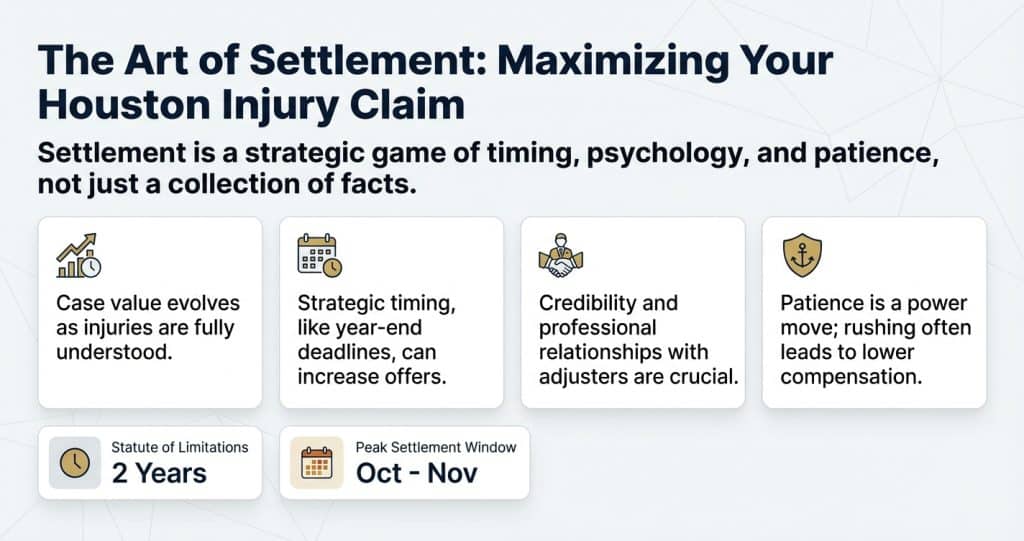
Settlement isn’t just about the facts of your case—it’s about strategy, timing, psychology, and patience. Understanding these elements can mean the difference between a disappointing outcome and fair compensation.
Why “What’s My Case Worth?” Is the Wrong First Question
When new clients ask about case value, I understand the impulse. You want to know what you’re dealing with. You want to set expectations. You want to plan for the future.
But the value of your case isn’t fixed. It changes over time. It depends on how the case is developed and presented. It depends on what the insurance company believes will happen if they don’t settle.
Early in your case, before your injuries are fully understood, any valuation is just a guess. The insurance company will guess low, hoping you’ll accept their number before you realize what your case is actually worth. You might guess high, based on stories you’ve heard about big verdicts, without understanding the realistic range for your type of injuries.
The better question isn’t “what’s my case worth?” It’s “what do I need to do to maximize the value of my case?” Focus on that, and the value takes care of itself.
Timing: The Element Most People Don’t Think About
Through years of practice, I’ve noticed patterns in when cases settle for the best value:
Late fall and early winter often produce better results. Insurance companies close their reserves before year-end, and adjusters want to clear files before the new year. A demand sent in October or November often gets resolved by Christmas. The same demand sent in February might sit for months.
Cases settle better after you’ve reached maximum medical improvement. Until you know the full extent of your injuries, you can’t accurately value your claim. Settling too early almost always means leaving money on the table because you didn’t know yet how serious your injuries would turn out to be.
Approaching trial dates create pressure. Insurance companies that have been stonewalling for months suddenly find settlement authority when trial is imminent. The prospect of actually having to try the case—with all its expense and uncertainty—motivates resolution.
Anniversary dates matter. Claims approaching the one-year mark sometimes see movement because reserves get reviewed. The two-year statute of limitations deadline creates obvious pressure.
Understanding these timing dynamics helps you make strategic decisions about when to push for settlement and when to wait.
The First Offer: What It Really Tells You
When an adjuster responds to your demand, pay attention. That first number tells you a lot about how the negotiation will go.
If the first offer is in the ballpark of your bottom line, you’re probably heading toward settlement. There’s room for both sides to move, and the adjuster clearly has meaningful authority. These negotiations tend to be relatively straightforward.
If the first offer is insultingly low, you might be dealing with:
A carrier that prefers to litigate rather than settle. An adjuster who’s testing how serious you are. A company that’s decided to fight this case on principle. Authority that’s artificially constrained by computer systems. An adjuster who genuinely believes the case has problems you haven’t addressed.
The appropriate response depends on which of these is actually happening. Sometimes a low first offer is just a negotiating tactic, and the adjuster has plenty of room to move. Sometimes it signals that you’re heading to litigation no matter what you do.
Learning to read these signals accurately is part of the art of settlement.
The Psychology of Negotiation
Settlement negotiations aren’t purely rational. They involve psychology, emotion, and relationship dynamics that affect outcomes.
Anchoring matters. The first number put on the table influences everything that follows. This is why insurance companies want you to name a number first—they’re hoping you’ll anchor low. It’s also why unrealistic demands can backfire—if you anchor ridiculously high, you lose credibility.
Credibility is currency. If the adjuster believes you’re honest about the facts and realistic about value, they’re more likely to stretch their authority to settle with you. If they think you’re exaggerating or playing games, they dig in.
Relationships affect outcomes. Adjusters are human. They respond better to people they like and respect. An attorney who treats adjusters professionally, communicates clearly, and follows through on commitments often gets better results than one who’s unnecessarily adversarial.
Desperation is visible. If the insurance company senses that you need to settle—that you’re under financial pressure, emotional strain, or time constraints—they’ll use that against you. Patience and apparent willingness to walk away are powerful negotiating tools.
The Demand Letter: First Impressions Matter
Your demand letter is often the insurance company’s first substantive look at your case. It sets the tone for everything that follows.
A credible demand letter includes:
- A clear liability summary. Why is their insured at fault? What evidence supports this?
- Thorough documentation of injuries. Medical records, bills, diagnostic findings, treatment summaries. Everything should be organized and complete.
- Reasonable damage calculations. Medical expenses, lost wages, pain and suffering—all supported by documentation.
- An asking price that’s ambitious but defensible. You want room to negotiate, but you don’t want to destroy your credibility with a number that bears no relationship to reality.
- The adjuster reading your demand is making judgments: Is this attorney organized? Do they know what they’re doing? Is this case well-documented? Is the demand reasonable?
- A sloppy demand letter with missing records, math errors, and an outrageous asking price tells the adjuster they’re dealing with someone who doesn’t know the value of the case. A polished, complete, well-reasoned demand commands respect and often produces better offers.
When to Negotiate and When to Walk Away
Not every moment is the right time to negotiate. Part of the strategy is knowing when to engage and when to wait.
Don’t negotiate before you’re ready. If you don’t have complete medical records, if treatment is ongoing, if you haven’t analyzed liability thoroughly—you’re not ready. Premature negotiation almost always hurts plaintiffs.
Don’t negotiate with someone who has no authority. If the adjuster keeps saying they need to “get approval” for every movement, you’re wasting time. Find out who actually has authority and focus your efforts there.
Do negotiate when the adjuster seems genuinely engaged. Some adjusters are just going through motions; others are genuinely trying to resolve cases. Learn to tell the difference, and invest your time in the productive relationships.
Walk away when the numbers don’t work. If the gap between their best offer and your bottom line is too large to bridge, continuing to negotiate is pointless. File suit and prepare for litigation. Sometimes the only way to get reasonable settlement authority is to show you’re serious about trial.
Concessions: The Give and Take
Effective negotiation involves strategic concessions—what you give up, what you demand in return, and when you move.
Never bid against yourself. If you’ve made a demand and they haven’t responded with an offer, don’t lower your demand. Wait for their number.
Make them earn every concession. If you’re going to reduce your demand, get something in return—an increased offer, a commitment to respond by a certain date, an agreement on some disputed issue.
Move in decreasing increments. If your first concession is $20,000, your next shouldn’t be $25,000. The pattern of your movement signals where you’re willing to end up.
Know your walkaway number. Before negotiations begin, decide the minimum you’ll accept. Having this number clear in your mind prevents you from getting pushed into a bad deal through fatigue or pressure.
The Adjuster Relationship Factor
Here’s something that might surprise you: my relationship with specific adjusters affects outcomes.
Over years of practice, I’ve built relationships with adjusters at various companies. They know how I handle cases. They know I’m honest about strengths and weaknesses. They know I’ll follow through on what I say. And they know I’ll take cases to trial when necessary.
These relationships create efficiency. With adjusters who know me, negotiations move faster because we skip the posturing phase. They trust my representations about medical records and treatment. They know what kind of demand signals a case I’ll take to trial versus one I’m trying to settle quickly.
Building these relationships takes years. It’s one of the hidden values of experienced representation that clients don’t always see.
When Settlement Fails
- Not every case settles. Sometimes the gap is too large. Sometimes the insurance company has decided to fight. Sometimes you’re better off taking your chances with a jury.
- When settlement fails, the question becomes: what’s the best path to resolution?
- Litigation changes the dynamic. Once you file suit, the insurance company faces real defense costs. Their attorney has to get involved, take depositions, respond to discovery. These costs create new incentive to settle.
- Mediation can break logjams. A neutral mediator sometimes gets movement when direct negotiation can’t. The mediator can reality-test both sides and help parties see past their entrenched positions.
- Trial is always an option. If the insurance company won’t offer fair value, sometimes the only way to get it is through a jury verdict. Trial is risky and expensive, but it’s also the ultimate leverage.
- The goal throughout is resolution on fair terms. Settlement is usually the best way to achieve that, but it’s not the only way.
The Bottom Line on Settlement
Settlement is an art, not a science. It requires patience, strategy, and understanding of the human dynamics at play.
Don’t rush. Don’t get pushed into premature decisions. Don’t let the insurance company’s timeline become your timeline.
Document your case thoroughly. Present it credibly. Know your value and be willing to fight for it. But also be realistic—not every case is worth a battle to the death.
The best settlements come when you’ve done everything right: solid documentation, clear presentation, appropriate timing, and the credibility that comes from being prepared to go to trial if necessary.

About the Author
Chi Nguyen is a Houston personal injury attorney dedicated to helping accident victims understand their rights and receive fair compensation under Texas law. With extensive experience representing injured Texans, Attorney Nguyen combines legal expertise with a commitment to client education and empowerment.