

Table of contents
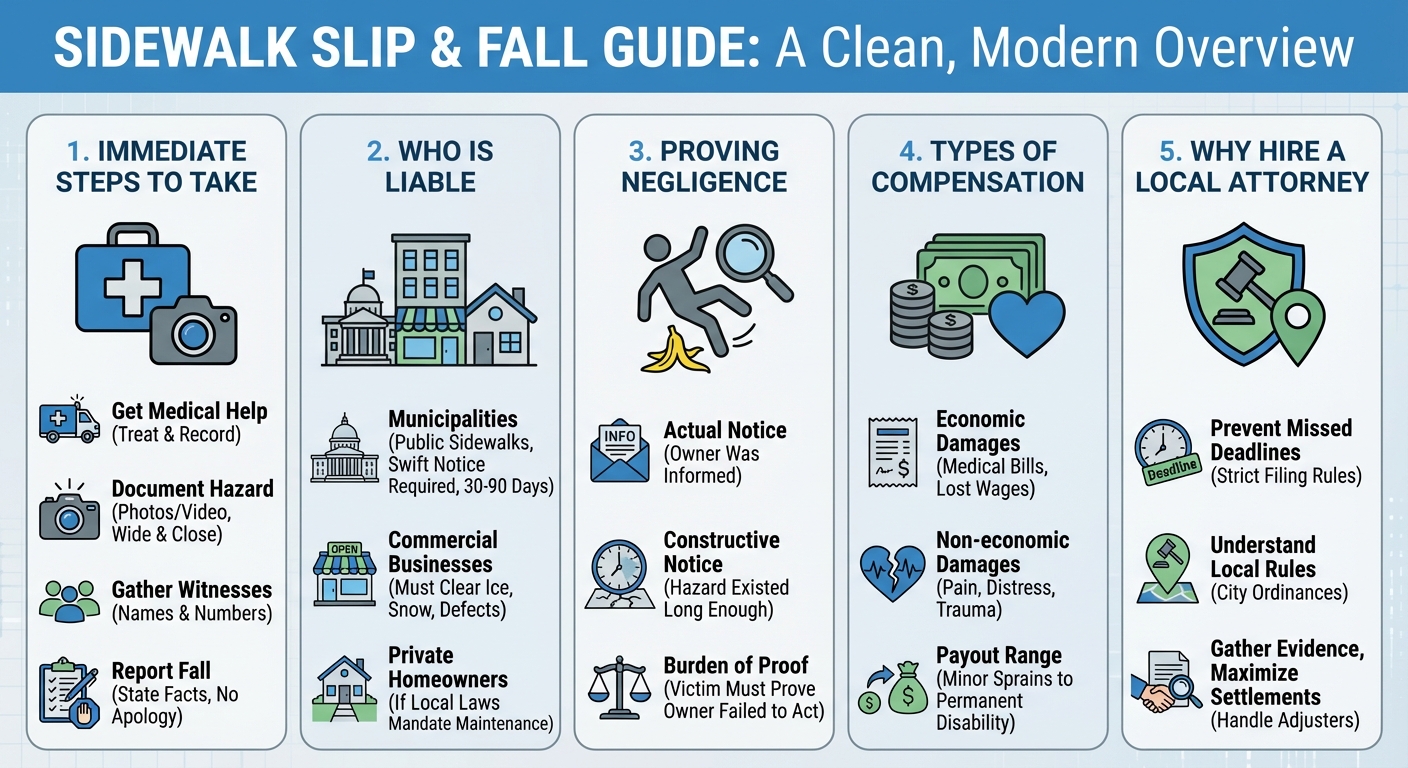
If you slip and fall on a sidewalk, liability depends on who owns and maintains the property. You may be able to sue the local municipality, a commercial business, or a private homeowner. To protect your claim, seek immediate medical attention, photograph the hazard, and report the incident promptly.
What to Do After a Slip and Fall on a Sidewalk
A slip and fall on a sidewalk can happen in an instant, but the physical and financial consequences can last a lifetime. Whether caused by cracked concrete, uneven pavement, or untreated ice, knowing the exact steps to take immediately after your accident is critical for protecting both your health and your legal rights.
Seek Immediate Medical Attention
Your health is the top priority. Even if you feel fine initially, adrenaline can mask severe injuries like concussions, hairline fractures, or soft tissue damage. Seeing a doctor immediately not only ensures you get the necessary treatment but also creates an official medical record linking your injuries directly to the sidewalk fall.
How to tell if pain is serious after a fall?
To tell if pain is serious after a fall, watch for severe swelling, inability to bear weight, visible deformities, or sharp, radiating pain. Additionally, symptoms like dizziness, nausea, or numbness indicate potential head or spinal injuries. Always consult a doctor immediately, as adrenaline can mask severe trauma initially.
Document the Scene and Gather Evidence
Evidence disappears quickly, especially if the property owner rushes to fix the hazard after you fall. Before leaving the scene (if you are physically able), take clear photos and videos of the exact defect that caused your fall. Capture wide angles to show the location and close-ups of the hazard. Collect names and phone numbers of any eyewitnesses who saw the incident.
Report the Incident to the Property Owner or Municipality
Notify the responsible party about your fall as soon as possible. If the fall happened outside a business, file an incident report with the manager and request a copy. If it occurred on a public or residential sidewalk, you may need to notify the local municipality or police. Stick to the basic facts and never apologize or admit fault.
Who is Liable for a Sidewalk Slip and Fall?
Determining liability for a sidewalk accident is notoriously complex. It depends heavily on local ordinances, state laws, and exactly where the fall occurred.
Municipalities and Local Governments (The Notice Rule)
In many areas, the city or town is responsible for maintaining public sidewalks. However, suing a government entity involves strict rules due to sovereign immunity. You must typically file a formal Notice of Claim within a very short window—often 30 to 90 days from the date of the accident. Missing this deadline usually bars you from recovering any compensation.
Commercial Property Owners and Businesses
Many municipalities have laws shifting the responsibility of sidewalk maintenance to the adjacent commercial property owner. If a business fails to clear snow, ice, or debris, or neglects to fix a known structural defect on the sidewalk fronting their store, they can be held liable for your injuries under premises liability law.
Can you be sued if someone falls on the sidewalk in front of your house?
Yes, you can be sued if someone falls on the sidewalk in front of your house. In many municipalities, local ordinances shift the responsibility of maintaining public sidewalks to the adjacent property owner. If you fail to clear snow, ice, or repair cracks, an injured pedestrian can file a claim.
Proving Negligence in Sidewalk Accidents
Simply falling on a sidewalk does not automatically entitle you to compensation. You must prove that the responsible party was negligent in their duty to maintain a safe walkway.
The Reasonable Care Standard
Property owners and municipalities are expected to exercise reasonable care in maintaining sidewalks. This means performing regular inspections and addressing obvious hazards in a timely manner. If a tree root has been lifting a sidewalk slab for years and the owner did nothing, they have likely breached their duty of reasonable care.
Constructive vs. Actual Notice of the Hazard
To win your claim, you must prove the defendant had notice of the hazard. Actual notice means they explicitly knew about the danger (e.g., someone previously complained about the cracked pavement). Constructive notice means the hazard existed for a long enough period that a reasonably prudent owner should have discovered and fixed it.
Are slip and fall cases hard to win?
Slip and fall cases are often hard to win because the burden of proof rests on the injured party. You must prove that the property owner knew or should have known about the sidewalk hazard and failed to fix it, and that your own negligence did not cause the fall.
Settlements and Financial Recovery
A successful premises liability claim can provide the financial lifeline you need to recover from a severe sidewalk injury.
How much compensation for a fall on pavement?
Compensation for a fall on pavement varies widely based on injury severity, ranging from a few thousand dollars for minor sprains to six figures for surgeries or permanent disability. Settlement amounts depend on your total medical bills, lost wages, and the degree of the property owner’s proven negligence.
Types of Damages You Can Recover
Victims of sidewalk accidents are generally entitled to two main categories of compensatory damages:
| Type of Damage | Examples and Description |
|---|---|
| Economic Damages | Quantifiable financial losses, including emergency room bills, physical therapy costs, prescription medications, and lost wages from missed work. |
| Non-Economic Damages | Subjective losses such as physical pain and suffering, emotional distress, PTSD, and loss of enjoyment of life. |
When to Contact a Slip and Fall Attorney
Handling a sidewalk slip and fall claim on your own is risky, especially when dealing with aggressive insurance adjusters or government legal departments.
Navigating the Statute of Limitations
Every state has a statute of limitations for personal injury claims, typically ranging from one to four years. However, as mentioned earlier, claims against government entities require a Notice of Claim within weeks or months. An attorney ensures you do not miss these critical, case-breaking deadlines.
Why You Need a Local Premises Liability Lawyer
Premises liability laws vary drastically from city to city. For example, the ordinances governing sidewalk maintenance in a major metro area will differ entirely from those in a rural town. A local premises liability lawyer understands the specific municipal codes, knows how to identify the correct liable party, and has the resources to gather compelling evidence to maximize your settlement.