

Table of contents
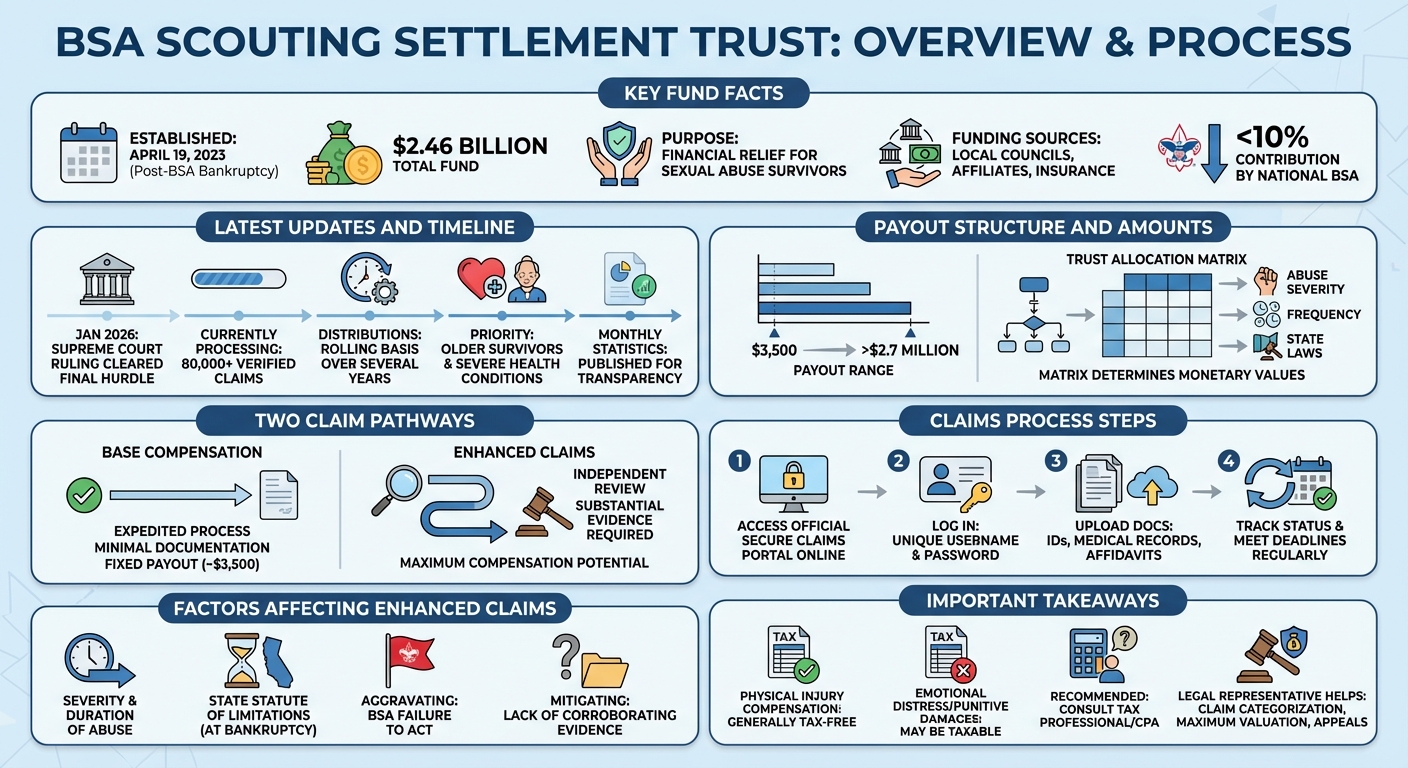
The Scouting Settlement Trust is a $2.46 billion compensation fund established on April 19, 2023, following the Boy Scouts of America’s Chapter 11 bankruptcy. It was created to fairly evaluate, process, and distribute financial relief to survivors who experienced sexual abuse while participating in Scouting programs.
The resolution of the Boy Scouts of America (BSA) bankruptcy has culminated in one of the largest sexual abuse compensation funds in United States history. For survivors, understanding how this fund operates is a critical step toward securing justice and financial relief. This guide breaks down the structure, timeline, and claims process for the newly established compensation fund.
What is a scouting settlement trust?
A Scouting Settlement Trust is a legally mandated, $2.46 billion compensation fund established on April 19, 2023, resulting from the Boy Scouts of America’s Chapter 11 bankruptcy. The Trust’s primary purpose is to fairly evaluate, process, and distribute financial relief to survivors of sexual abuse within Scouting programs.
The Boy Scouts of America Chapter 11 Bankruptcy
Facing thousands of lawsuits from survivors of childhood sexual abuse, the Boy Scouts of America filed for Chapter 11 bankruptcy to halt the litigation and consolidate the claims. This legal maneuver allowed the organization to continue operating while negotiating a global settlement. The result was the creation of an independent Trust, managed by a trustee, tasked with compensating the tens of thousands of men and women who came forward.
Funding the $2.46 Billion Trust
The Trust is funded through multiple channels to reach its $2.46 billion total. The Boy Scouts of America national organization is contributing less than 10% (approximately $219 million) of the total amount. The vast majority of the funding comes from local BSA Councils, affiliated organizations, and various insurance companies that provided liability coverage to the BSA over the past 72 years.
What is the latest on the BSA trust payout?
The latest on the BSA trust payout is that a January 2026 Supreme Court ruling declined to review the $2.46 billion bankruptcy settlement, officially clearing the path for survivor distributions. The Trust is now actively processing claims, calculating matrix values, and issuing payments to verified survivors.
January 2026 Supreme Court Ruling
In January 2026, the U.S. Supreme Court rejected an appeal that sought to challenge the legality of the BSA bankruptcy plan. By declining to hear the case, the Supreme Court effectively cemented the settlement. This was a monumental victory for survivors, as it removed the final major legal hurdle delaying the distribution of funds.
Current Timeline for Survivor Distributions
With legal challenges resolved, the Trust has accelerated its distribution timeline. Claims are being processed in batches, prioritizing older survivors and those with severe health conditions. While the Trust is working diligently, the sheer volume of claims—over 80,000—means that distributions will occur on a rolling basis over the next several years.
Monthly Program Statistics and Updates
To maintain transparency, the Trust, overseen by Honorable Barbara J. Houser (Ret.), publishes Monthly Program Statistics. These reports detail the number of claims reviewed, the amount of funds distributed to date, and the remaining balance of the Trust. Claimants and their attorneys use these reports to gauge the pace of the payout process.
How much will people get from the Boy Scout lawsuit?
Payouts from the Boy Scout lawsuit vary significantly, generally ranging from $3,500 for base-level claims to over $2.7 million for the most severe enhanced claims. The exact amount individuals get depends on the Trust Allocation Matrix, which weighs the severity of abuse, frequency, and applicable state laws.
The Trust Allocation Matrix Explained
The Trust uses a standardized “Allocation Matrix” to ensure funds are distributed equitably. This matrix assigns a base point value to different categories of abuse. The more severe and frequent the abuse, the higher the base point value. These points are then converted into a monetary figure based on the total funds available in the Trust.
Base Compensation vs. Enhanced Claims
Claimants generally have two distinct pathways for compensation:
- Base Compensation (Expedited Distribution): A faster, streamlined process requiring less documentation. It offers a fixed, lower settlement amount (often around $3,500) for survivors who prefer a quicker resolution without undergoing a detailed investigation.
- Enhanced Claims (Independent Review): A more rigorous process requiring substantial evidence, sworn statements, and sometimes interviews. This route is designed for survivors seeking maximum compensation based on the specific details and severe impacts of their abuse.
Factors Influencing Individual Payout Amounts
For those pursuing Enhanced Claims, several variables can increase or decrease the final payout:
- Severity and Duration: The nature of the abuse and how long it lasted.
- Statute of Limitations: Whether the survivor’s claim was still legally viable in their state at the time of the bankruptcy filing.
- Aggravating Factors: Evidence that the BSA knew about the abuser but failed to act.
- Mitigating Factors: Lack of corroborating evidence or inconsistencies in the claim.
Navigating the Claims Processing Portal
The Trust operates a secure online platform to manage the tens of thousands of claims efficiently. Understanding how to use this portal is essential for survivors and their legal representatives.
How to Log In and Submit Documentation
Claimants or their attorneys can access the official Claims Processing Portal via the Trust’s website. You will need your unique Username and Password to log in. Once inside, the portal allows users to securely upload required documentation, such as identification, medical records, sworn affidavits, and any corroborating evidence of the abuse or the abuser’s affiliation with the BSA.
Tracking Your Claim Status
The portal serves as the central hub for tracking a claim’s progress. Status updates will indicate whether a claim is under review, requires additional documentation, has been assigned a matrix value, or is approved for payment. Regularly checking the portal ensures that you do not miss critical deadlines for submitting requested information.
Do I have to pay taxes on my boy scout settlement?
In most cases, you do not have to pay taxes on your Boy Scout settlement. The IRS generally excludes compensation for physical injuries or physical sickness from gross income. However, because tax laws surrounding emotional distress and legal settlements are complex, you should always consult a qualified tax professional.
IRS Rules on Personal Injury Settlements
According to the IRS, settlements awarded for personal physical injuries are non-taxable. While sexual abuse involves physical injury, the IRS has strict definitions regarding compensation strictly for “emotional distress.” If a portion of the settlement is explicitly categorized as punitive damages or solely for emotional distress without a physical injury component, that specific portion could potentially be taxable.
Consulting a Tax Professional
Because the BSA settlement involves unique legal structuring and trust distributions, it is highly recommended that survivors speak with a Certified Public Accountant (CPA) or tax attorney. A professional can review your specific settlement agreement and ensure you remain compliant with state and federal tax laws while protecting your compensation.
How an Attorney Can Help Maximize Your Trust Claim
Even though the Trust is established and the matrix is set, navigating the claims process is not automatic. Having experienced legal representation can significantly impact the final outcome of your claim.
Ensuring Accurate Claim Categorization
An attorney understands the nuances of the Trust Allocation Matrix. They can help gather the necessary evidence, draft compelling affidavits, and ensure your claim is placed in the highest possible severity tier. Without legal guidance, survivors risk under-documenting their trauma, resulting in a lower matrix valuation.
Appealing Trust Decisions
If the Trust assigns a value to your claim that you believe is too low, or if your claim is denied due to technicalities, you have the right to appeal. An attorney can navigate the complex appeals process, present additional evidence, and advocate on your behalf to secure the compensation you rightfully deserve.