

Table of contents
If you had back problems before your car accident, does that mean the insurance company doesn’t have to pay for your injuries?
That’s what they want you to believe. It’s one of the most common tactics I see insurance adjusters use to minimize claims—and one of the most misunderstood areas of personal injury law.
The truth is more nuanced, and much more favorable to injured people, than the insurance industry wants you to know.
How the Pre-Existing Condition Defense Works
Here’s how it usually plays out: You’re in a car accident. Your neck or back, which had been manageable for years, suddenly becomes unbearable. Maybe you had some arthritis that wasn’t really bothering you. Maybe you had a bulging disc that hadn’t caused symptoms in years. Maybe you’d had some physical therapy five years ago for similar complaints.
You seek treatment, rack up medical bills, miss work. Then the adjuster requests your medical records—not just from after the accident, but from five, ten, even fifteen years before.
They find evidence of prior issues. Maybe you mentioned back pain to your doctor in 2019. Maybe you saw a chiropractor in 2017. Maybe you took muscle relaxants after a fall in 2015.
Suddenly, they’re arguing that your current pain is from those old issues, not from the accident. They offer you a fraction of what your claim is worth, claiming they’re only responsible for new injuries—and according to them, you don’t have any.
I’ve seen this tactic used countless times. It’s effective because it sounds reasonable on the surface. Why should they pay for problems you already had?
But the law doesn’t work that way.
What the Law Actually Says
Here’s the truth that insurance companies don’t advertise: if someone injures you, they take you as they find you.
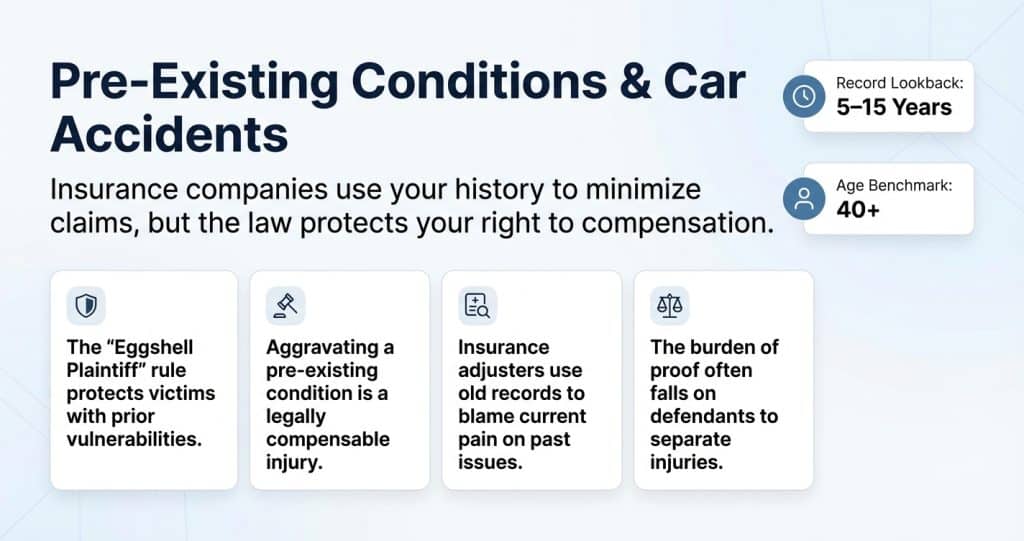
This principle is called the “eggshell plaintiff” rule (or sometimes the “thin skull” rule), and it’s been established law for over a century. The basic idea is simple: a defendant can’t escape liability just because the plaintiff was more vulnerable to injury than an average person.
If you have a condition that makes you more susceptible to injury, that’s the defendant’s problem, not yours. If your degenerative disc disease meant that a fender-bender caused a herniation that wouldn’t have happened to someone with a perfectly healthy spine, you’re still entitled to full compensation for your actual injuries.
The defendant must take the plaintiff as they find them—eggshell skull and all.
The Aggravation Principle
Even more important for most cases is the principle of aggravation. If a defendant aggravates a pre-existing condition, making it worse than it was before, that aggravation is a compensable injury.
Think about it this way: If your back pain was under control before the accident—manageable with occasional over-the-counter medication, not affecting your work or daily activities—and now it’s debilitating, that change is what you’re entitled to recover for.
The law doesn’t say you have to be in perfect health to deserve compensation. It says you’re entitled to be made whole for the difference between your condition before the accident and your condition after.
I handled a case recently where the client had a history of neck problems going back years. She’d had treatment in the past, but by the time of the accident, she’d been symptom-free for over two years. She was working full-time, exercising regularly, sleeping through the night.
After the accident, everything changed. She needed surgery. She couldn’t return to her previous job. Her quality of life was dramatically reduced.
The insurance company tried to argue that all her problems were pre-existing. But the evidence was clear: she had been functioning well before the accident and was severely impaired after. That was the injury she was entitled to recover for—and we did recover for it.
The Burden of Proof Battle
One of the sneaky things insurance companies do is try to flip the burden of proof. They act as if you have to prove exactly how much of your current condition was caused by the accident versus how much was pre-existing.
In many jurisdictions, that’s not how it works. When a defendant aggravates a pre-existing condition and the injuries can’t be neatly separated, it’s the defendant’s burden to prove how much should be attributed to the pre-existing condition. If they can’t make that separation clearly, you’re entitled to recover for the full extent of your current condition.
This is a crucial legal principle that insurance companies routinely ignore. They’ll assert confidently that 70% of your problems are pre-existing and only 30% are from the accident, as if they have some scientific basis for that split. Usually, they don’t. They’re just making numbers up.
Your attorney should challenge these arbitrary allocations. If the defense can’t prove with real evidence exactly how much of your condition is pre-existing versus accident-related, you may be entitled to full compensation.
What Insurance Companies Do With Your Medical History
When an insurance company requests your medical records going back five or ten years, they’re looking for ammunition. Here’s what they’re hoping to find:
- Any mention of similar symptoms. If you told your doctor in 2018 that your back was “a little stiff,” that mention will be highlighted and used to argue that your current back problems are just a continuation of that old complaint.
- Prior treatment for similar issues. Past physical therapy, chiropractic care, or medication for similar symptoms will be characterized as evidence of a chronic, ongoing problem.
- Diagnostic findings. If an old MRI showed any abnormality—even one that wasn’t causing symptoms—they’ll argue that your current problems stem from that finding.
- Any inconsistencies. If your current complaints don’t perfectly match what you told doctors in the past, they’ll suggest you’re exaggerating or fabricating.
Then they’ll send all this information to a doctor they hire—an “independent” medical examiner who makes significant income from insurance company referrals. Surprise, surprise: these doctors almost invariably conclude that most of your problems are pre-existing.
How to Protect Your Claim
If you have pre-existing conditions, here’s how to protect your claim:
- Be honest from the start. Don’t try to hide your medical history. It will come out eventually, and trying to hide it destroys your credibility. Instead, own it and address it proactively.
- Document your pre-accident functioning. This is crucial. If you were working full-time, exercising, sleeping well, and generally functioning before the accident, we need evidence of that. Employment records, gym memberships, testimony from family and friends—all of this helps establish your baseline.
- Document the change. The difference between your before and after is what you’re entitled to recover. Make sure your doctors understand and document how your condition changed as a result of the accident.
- Get the right medical support. You need a treating physician who understands the difference between a pre-existing condition and an aggravation of that condition. Ideally, your doctor can clearly articulate how the accident worsened your situation.
- Don’t minimize to your doctors. Tell them exactly what you’re experiencing. If the pain is worse than before, say so specifically. If you could do things before that you can’t do now, make sure that’s in the record.
- Be prepared for their medical examiner. When you go to the insurance company’s “independent” medical examination, be thorough in describing your symptoms. Don’t minimize to be polite. And understand that the examiner is looking for ways to attribute your problems to pre-existing conditions.
The Pre-Existing Condition That Wasn’t
Sometimes what the insurance company calls a “pre-existing condition” isn’t really what they’re making it out to be.
I’ve seen cases where the insurance company pointed to degenerative changes on imaging—arthritis, disc degeneration, bone spurs—as evidence of pre-existing problems. But here’s the thing: most adults over 40 have some degenerative changes on imaging. It’s a normal part of aging. And importantly, these changes often don’t cause any symptoms.
The fact that your MRI shows degenerative changes doesn’t mean you were suffering from back pain before the accident. Many people with significant degeneration on imaging have no pain at all. The imaging finding is not the same as a symptomatic condition.
If the insurance company is pointing to imaging findings as evidence of pre-existing problems, ask: Was the claimant actually experiencing symptoms from those findings before the accident? Were they seeking treatment? Were they limited in their activities?
If the answer is no, then it’s not really a pre-existing condition in any meaningful sense. It’s just background noise that the accident transformed into actual injury.
When Apportionment Is Legitimate
I want to be balanced here: sometimes apportionment between pre-existing conditions and accident injuries is legitimate. If you were actively treating for back problems right up until the accident, and your post-accident complaints are basically the same as your pre-accident complaints, the insurance company may have a point.
In these situations, the question becomes: Did the accident make things worse, and if so, by how much?
This is where honest medical assessment becomes important. A good treating physician can often distinguish between baseline symptoms and accident-related aggravation. They can document whether treatment needs increased, whether functional limitations worsened, whether the prognosis changed.
Even in cases with significant pre-existing problems, there’s usually some compensable aggravation. The key is being realistic about what that aggravation is worth—neither inflating it nor letting the insurance company pretend it doesn’t exist.
The Bottom Line
Having a pre-existing condition doesn’t disqualify you from fair compensation after a car accident. The law recognizes that defendants take plaintiffs as they find them, and that aggravating a pre-existing condition is a compensable injury.
Don’t let the insurance company convince you that your claim is worthless because you weren’t in perfect health before the accident. That’s not how the law works, and it’s not what fairness requires.
Be honest about your history, document the change the accident caused, and don’t accept their attempts to minimize what you’ve been through. Your prior medical history is part of who you are—it doesn’t forfeit your right to compensation when someone else’s negligence makes your condition worse.

About the Author
Chi Nguyen is a Houston personal injury attorney dedicated to helping accident victims understand their rights and receive fair compensation under Texas law. With extensive experience representing injured Texans, Attorney Nguyen combines legal expertise with a commitment to client education and empowerment.