
Table of contents
If you suspect elder abuse, finding a nursing home abuse lawyer near you is critical to protecting your loved one. A local attorney can immediately investigate the facility, secure medical records, report violations to state agencies, and file a lawsuit to hold negligent caregivers financially and legally accountable.
Nursing Home Abuse Lawyer Near Me: Get Justice for Your Loved One
Discovering that a loved one has suffered in a facility you trusted to care for them is devastating. When a long-term care facility prioritizes profits over patient safety, vulnerable seniors pay the price. If you are searching for a “nursing home abuse lawyer near me,” you need immediate, aggressive legal intervention to stop the harm and hold the responsible parties accountable.
Why Fast Legal Action is Crucial for Elder Protection
Time is the most critical factor in elder abuse cases. Nursing homes have high staff turnover rates, meaning witnesses can disappear quickly. Furthermore, facilities may attempt to alter or “lose” medical records to cover up negligence. Hiring a local attorney immediately ensures that evidence is preserved, surveillance footage is secured, and your loved one is moved to a safe environment without delay.
How Our Local Legal Team Can Help
Our legal team understands the specific state and local regulations governing assisted living and nursing facilities in your area. We handle the heavy lifting by:
- Filing emergency injunctions if your loved one is in immediate danger.
- Subpoenaing staffing logs, medical charts, and internal facility communications.
- Coordinating with local elder abuse task forces and state health departments.
- Navigating complex corporate structures to identify the true owners of the facility.
What are the signs of abuse in a nursing home?
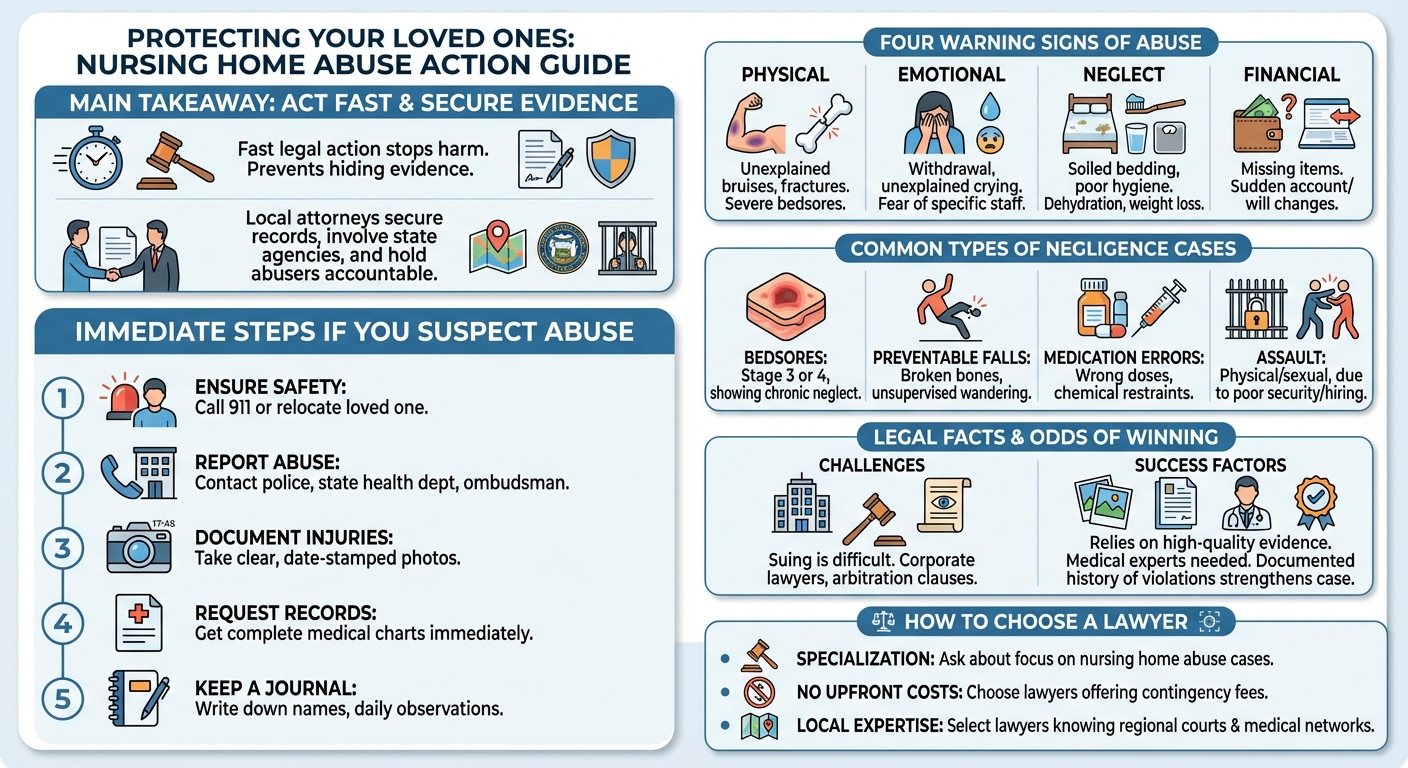
The most common signs of abuse in a nursing home include unexplained bruises, sudden weight loss, poor hygiene, and severe bedsores. You may also notice emotional red flags, such as your loved one becoming withdrawn, fearful around specific staff members, or exhibiting sudden changes in behavior.
Physical Signs: Unexplained Bruises, Bedsores, and Injuries
Physical abuse and neglect often leave visible marks. Be highly suspicious of:
- Unexplained fractures, sprains, or frequent falls.
- Bruises, particularly bilateral bruising (marks on both sides of the body, indicating restraint).
- Stage 3 or Stage 4 bedsores (decubitus ulcers), which are almost always a sign of severe neglect.
Emotional and Behavioral Red Flags
Elder abuse isn’t always physical. Psychological abuse can cause profound changes in a resident’s demeanor. Watch for sudden withdrawal from social activities, unexplained crying, rocking back and forth, or visible terror when a specific caregiver enters the room.
Signs of Neglect and Poor Hygiene
Neglect is the most common form of elder mistreatment. It manifests as soiled clothing or bedding, a strong smell of urine or feces in the room, unwashed hair, overgrown nails, and rapid, unexplained weight loss or dehydration.
Financial Exploitation Indicators
Financial abuse occurs when staff or administrators manipulate residents for monetary gain. Warning signs include missing personal items, sudden changes to a will or power of attorney, unexplained bank withdrawals, or unpaid facility bills despite adequate funds.
Immediate Steps to Take If You Suspect Elder Abuse
Ensuring Immediate Medical Safety
Your first priority is your loved one’s physical safety. If they require urgent medical attention, call 911 immediately. Do not wait for the facility’s staff to authorize a hospital transfer. If the situation is non-life-threatening but still dangerous, arrange to move them to a different facility or bring them home.
Reporting to Local Authorities and State Agencies
File a formal complaint with your state’s Department of Health or the local ombudsman program. These agencies have the authority to conduct unannounced inspections. Additionally, report physical or sexual assault directly to local law enforcement.
Documenting Evidence and Gathering Records
Before the facility has a chance to hide evidence, take action:
- Take clear, date-stamped photographs of injuries, soiled bedding, or safety hazards.
- Request a complete copy of your loved one’s medical chart.
- Write down the names of the caregivers, nurses, and administrators on duty.
- Keep a detailed journal of your observations and conversations with staff.
Is it difficult to sue a nursing home?
Yes, it can be difficult to sue a nursing home because large corporate facilities often have aggressive legal teams and complex arbitration agreements. However, an experienced nursing home abuse lawyer can overcome these hurdles by gathering strong medical evidence and proving the facility breached its standard of care.
Overcoming Corporate Arbitration Agreements
Many nursing home admission contracts contain hidden arbitration clauses designed to keep disputes out of court. A skilled attorney knows how to challenge the enforceability of these agreements, especially if the resident lacked the cognitive capacity to sign or if the clause was buried in confusing legal jargon.
Proving Negligence and Liability in Care Facilities
To win, you must prove that the facility failed to provide the standard of care required by law, and that this failure directly caused injury. We do this by cross-referencing staffing logs with patient charts to prove understaffing, and by utilizing independent medical experts to testify about the facility’s failures.
What are the odds of winning a lawsuit against a nursing home?
The odds of winning a lawsuit against a nursing home depend heavily on the quality of your evidence. Cases with clear documentation of neglect, such as severe bedsores, repeated falls, or medical records showing malnutrition, have a much higher probability of reaching a successful settlement or favorable jury verdict.
Factors That Influence Case Success Rates
Several variables impact the outcome of your claim:
- Evidence Quality: Photographs, medical records, and witness statements are paramount.
- Facility History: A documented history of state health code violations strengthens your case.
- Legal Representation: Facilities are more likely to settle fairly when facing a law firm with a proven track record in elder abuse litigation.
The Importance of Strong Medical Evidence
Medical records are the backbone of any nursing home abuse claim. Discrepancies between a nurse’s notes and the patient’s actual physical condition often reveal a cover-up. We employ medical specialists to review these charts and pinpoint exactly where the standard of care was breached.
Types of Nursing Home Neglect and Abuse Cases We Handle
Stage 3 and Stage 4 Bedsores (Decubitus Ulcers)
Bedsores are highly preventable. They occur when immobile patients are not turned regularly. A Stage 3 or 4 bedsore—where muscle or bone is exposed—is a definitive indicator of chronic neglect and grounds for serious legal action.
Falls and Unsupervised Wandering
Facilities must assess each resident’s fall risk and implement safety measures, such as bed alarms or lowered beds. If a resident falls and breaks a hip due to inadequate supervision, or wanders off the premises (elopement) because of unsecured doors, the facility is liable.
Medication Errors and Over-Sedation
Understaffed facilities sometimes use antipsychotic medications as “chemical restraints” to keep residents docile. Other times, overworked nurses administer the wrong medication or incorrect dosages, leading to fatal overdoses or severe medical complications.
Physical and Sexual Assault by Staff or Residents
Nursing homes have a duty to perform rigorous background checks on staff and to separate residents with known violent tendencies. If your loved one is assaulted by a caregiver or another resident, the facility can be held liable for negligent hiring or inadequate security.
How to Choose the Best Nursing Home Abuse Attorney Near You
Questions to Ask During Your Free Consultation
When evaluating local lawyers, ask specific questions to gauge their expertise:
- How much of your practice is dedicated specifically to nursing home abuse?
- Have you successfully litigated against the specific corporate entity that owns this facility?
- Will you handle my case personally, or pass it off to a junior associate?
Understanding Contingency Fees (No Upfront Costs)
You should never have to pay out of pocket to protect your loved one. Reputable nursing home abuse lawyers work on a contingency fee basis. This means they advance all costs for investigations and expert witnesses, and you only pay a legal fee if they secure a settlement or verdict in your favor.
Why Local Courtroom Experience Matters
A lawyer familiar with your local court system, judges, and opposing defense firms holds a distinct advantage. Local attorneys also have established networks of regional medical experts and investigators who can mobilize quickly to build your case.
Contact Our Nursing Home Abuse Legal Team Today
Schedule Your Free, Confidential Case Evaluation
If you suspect your loved one is suffering from abuse or neglect, do not wait for the situation to worsen. Contact our dedicated nursing home abuse lawyers today. We offer a free, completely confidential consultation to review your case, explain your legal options, and help you take immediate action to protect your family.