
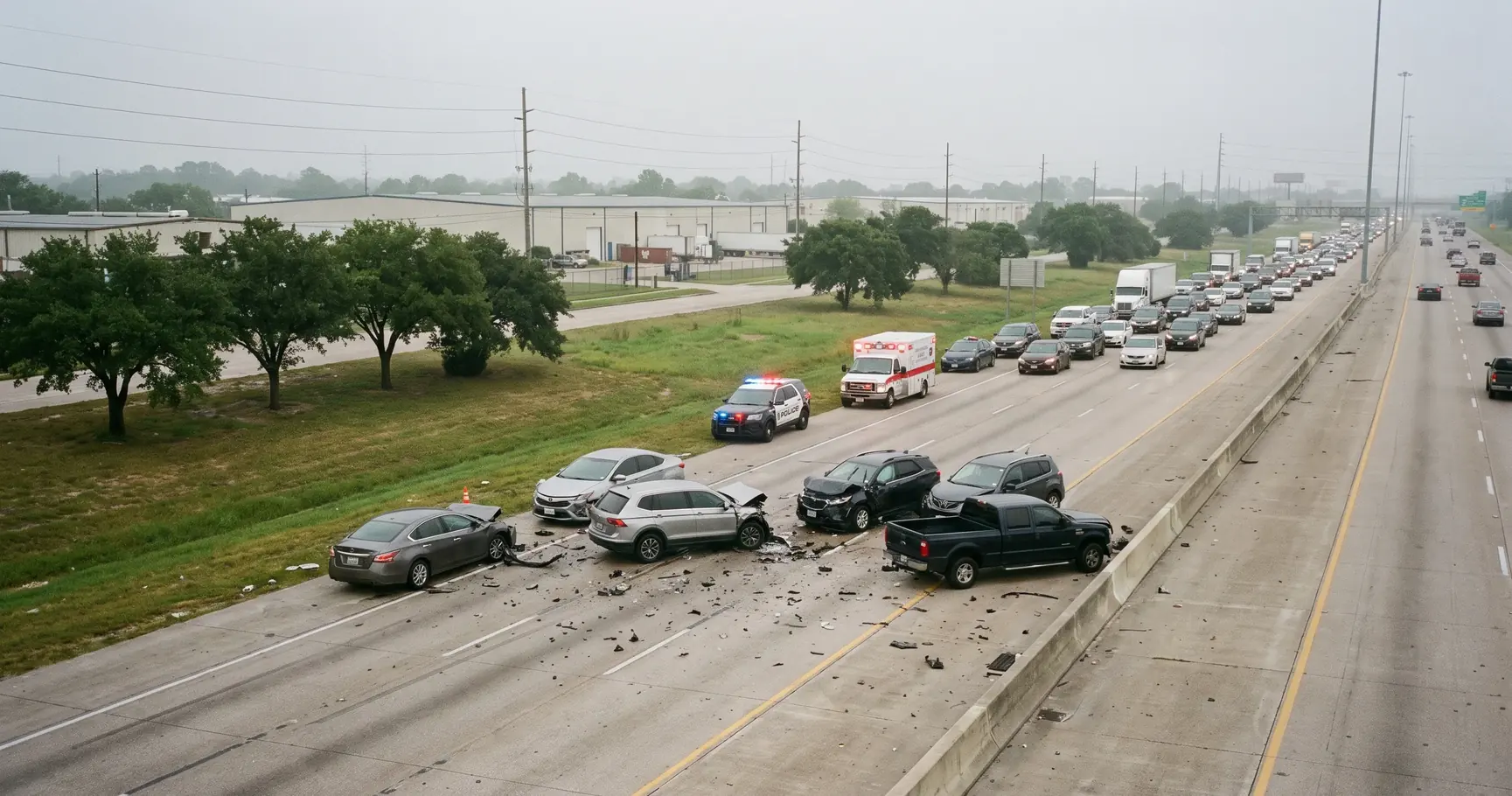
In a Texas chain reaction crash there is rarely a single at-fault driver. A jury assigns each participant a percentage of responsibility, your damages are reduced by your own percentage, and you recover nothing if your share is greater than 50 percent. Several insurance policies may end up paying parts of one claim, and the order in which those claims are handled can change what each injured person actually receives.
Pileups also create a problem that a two-car crash does not: too many injured people chasing too little coverage. Understanding both halves, how fault is divided and how the money is divided, is what separates a fair outcome from a token check.
At a glance: multi-vehicle crashes in Texas
| Question | General answer |
|---|---|
| Is only the last driver at fault? | No. Fault is apportioned among everyone who contributed, which can include drivers who never touched your vehicle. |
| Can I recover if I was partly at fault? | Yes, unless your share is greater than 50 percent. Your recovery is reduced by your percentage. |
| Can more than one policy pay? | Yes. Each at-fault driver's policy can contribute, and your own coverage may add to it. |
| What if the coverage runs out? | Claimants can end up sharing one limited pool, which is why timing and documentation matter. |
| What decides these cases? | Physical evidence: vehicle data, damage patterns, video, and final rest positions. |
Who hit whom is not the same as who is liable
Insurers like the simple story: the car behind you rear-ended you, so that driver pays. Chain reaction crashes rarely work that way. A vehicle can be pushed into the car ahead of it and still bear no meaningful responsibility. A driver at the front who stopped abruptly for no reason, changed lanes without space, or was blocking a lane with no hazard lights can carry a large share even though the impact to your car came from behind.
Frequently, the vehicle that caused the entire sequence is a truck or SUV traveling too fast for conditions several positions back, or a driver who was never touched at all and kept going. The legal question is who caused the harm, not who made contact.
How Texas divides fault in a pileup
Texas uses proportionate responsibility under Chapter 33 of the Civil Practice and Remedies Code. The framework matters more in a pileup than anywhere else, because there are so many parties to point at:
- Section 33.003: the trier of fact assigns a percentage of responsibility to each claimant, each defendant, each settling person, and each designated responsible third party.
- Section 33.012: the damages awarded are reduced by the claimant's own percentage of responsibility.
- Section 33.001: a claimant whose percentage of responsibility is greater than 50 percent recovers nothing.
- Section 33.013: a liable defendant generally pays only its own percentage, and is jointly and severally liable for the full amount only in limited circumstances, including where its share exceeds 50 percent.
Read those together and the strategy becomes obvious. Every defendant has a financial incentive to move percentage points onto someone else, including onto you. Percentage points are the currency of a pileup case.
The empty chair problem
Section 33.004 lets a defendant designate a responsible third party, meaning a person or company that is not a defendant in the lawsuit but who the defendant says shares the blame. In a multi-vehicle crash the empty chair is often an unidentified driver who left the scene, a driver whose insurer already settled, or a contractor responsible for a lane closure or a debris hazard.
The designation does not produce a recovery from that absent party. It can reduce the percentage assigned to the defendant who is actually paying. That is why a serious pileup case gets investigated as a whole sequence, with every vehicle identified, rather than as a dispute with the one driver whose insurance information you collected at the scene.
The harder problem: not enough insurance to go around
Texas minimum liability limits are set by Section 601.072 of the Transportation Code at $30,000 for bodily injury to one person, $60,000 for bodily injury to two or more people in one collision, and $25,000 for property damage. A driver carrying the minimum who triggers a six-vehicle pileup has $60,000 of bodily injury coverage for every person hurt in it, combined.
When that happens, the available recovery usually has to be assembled from several sources:
- Each at-fault driver's liability policy, since more than one driver in the chain may share responsibility.
- Your own uninsured and underinsured motorist coverage, which is designed for exactly this shortfall. See our guide on being hit by an uninsured driver in Houston.
- Personal injury protection or medical payments coverage, which pays regardless of fault and does not wait on the liability fight.
- Commercial and employer policies, which carry far higher limits when a work vehicle is in the chain. See company vehicle accident liability in Texas and our Houston truck accident lawyer page.
- Umbrella and excess policies, which are frequently not disclosed unless someone specifically asks.
Insurers facing multiple claimants and one small policy sometimes deposit the limits with a court and let the claimants divide it. That process moves on the insurer's schedule. A claim that is documented early, with medical evidence in hand, is in a much stronger position than one still being assembled.
Evidence that decides a chain reaction case
- Event data recorders. Most modern vehicles store pre-crash speed, braking, and throttle data. Multiple downloads can reconstruct the true sequence of impacts.
- Commercial vehicle data. Electronic logging devices, telematics, and forward-facing cameras on trucks are subject to short retention schedules.
- Video. Dashcams from uninvolved drivers, nearby business cameras, and traffic cameras are often overwritten within days.
- Final rest positions and damage patterns. Where each vehicle came to rest and where the crush damage sits tell an accident reconstructionist what actually happened.
- 911 call and dispatch timing. Timestamps can establish the gap between a first impact and later ones.
- The Texas peace officer crash report. Useful, but not the last word. See what the Texas police report contains and what it misses.
Preservation letters have to go out fast and to multiple companies at once. In a pileup, the single most valuable piece of proof is usually held by a party who has no reason to keep it.
What to do in the first days after a pileup
- Get evaluated medically, even if the adrenaline made you feel fine at the scene.
- Photograph every vehicle involved, not only the ones that hit you, and capture the whole scene and lane positions.
- Collect names, plates, and insurance details for as many vehicles as possible, and note any vehicle that left.
- Ask nearby witnesses and drivers whether they have dashcam footage, and request it immediately.
- Report the claim to your own insurer, including any UM, UIM, PIP, or MedPay coverage you carry.
- Give no recorded statement about fault or injuries until you have advice. See documenting your Texas accident scene.
Frequently asked questions
I was in the middle of the chain. Am I at fault for hitting the car ahead?
Not necessarily. If you were stopped or slowing safely and were pushed forward by an impact from behind, the physical evidence often supports that. Damage patterns, event data, and the sequence of impacts are what answer this, not the assumption that the trailing driver is always to blame.
Can I still recover if the police report blames me?
Yes. The officer's opinion is not a legal finding of liability, and officers often arrive after the vehicles have been moved. Reports are regularly corrected or outweighed by physical evidence.
What if the driver who caused it drove away?
An unidentified driver may still be pursued as a responsible third party, and your own uninsured motorist coverage may apply. Prompt reporting and any available video are critical.
Should I accept the first offer if several people were hurt?
Be careful. Early offers in limited-coverage crashes are often made before the full injury picture is known, and signing a release can end your claim against everyone involved. Review the language before accepting anything.
How long do these cases take?
Longer than a two-car crash, generally. More vehicles mean more insurers, more investigation, and often a reconstruction expert. Getting the evidence secured early is what keeps the timeline from stretching further.
Talk to a Houston car accident lawyer about your pileup claim
Multi-vehicle crashes are decided by percentages and by how quickly the evidence is locked down. Contact Nguyen Injury Law or call (713) 747-7777 for a free, confidential case review, or learn more about how our Houston car accident lawyer team builds these claims.
This article provides general information, not legal advice. Results depend on the specific facts and law applicable to each case.
 Call (713) 747-7777