

Table of contents
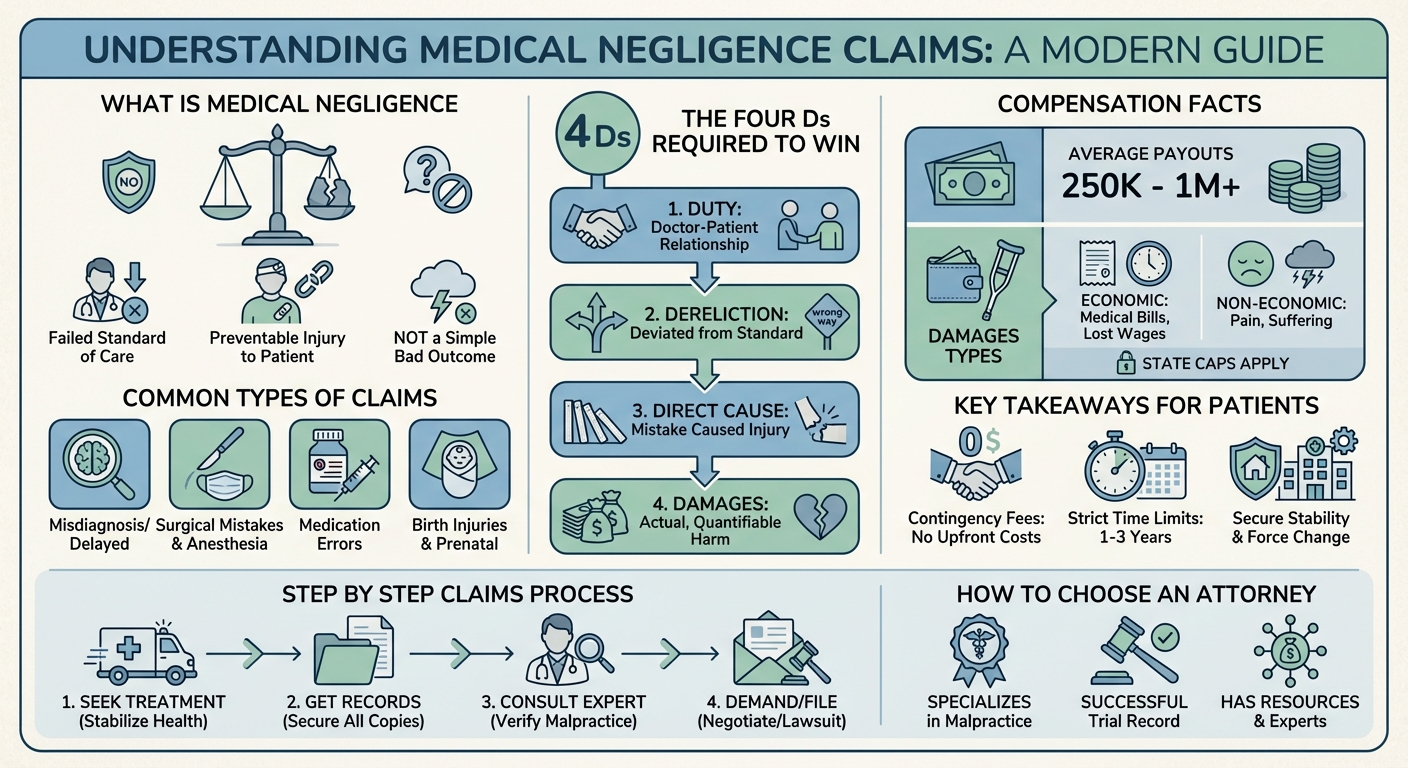
A medical negligence claim is a legal action taken when a healthcare provider deviates from the accepted standard of care, causing patient injury. To win, plaintiffs must prove the “Four Ds”: Duty of care, Dereliction (breach of standard), Direct cause, and Damages (quantifiable harm).
Understanding Medical Negligence Claims: A Complete Legal Guide
When you seek medical treatment, you trust healthcare professionals to heal, not harm. Unfortunately, preventable errors happen. Understanding medical negligence claims is the first step toward holding at-fault providers accountable and securing the compensation you need to recover.
What separates a bad medical outcome from actual legal negligence? Medicine is not an exact science. A negative outcome, an unsuccessful surgery, or a known complication does not automatically equal malpractice. Legal medical negligence only occurs when a healthcare provider fails to meet the accepted standard of care—meaning they did something a reasonably competent provider in the same field would not have done under similar circumstances.
The medical malpractice landscape in the US is notoriously complex. These cases require extensive evidence, expert medical testimony, and a deep understanding of state-specific laws, including strict statutes of limitations and damage caps.
What can be considered medical negligence?
Medical negligence occurs when a healthcare professional deviates from the accepted standard of care, resulting in patient injury. Common examples include misdiagnosis, surgical errors, incorrect medication dosages, and birth injuries. It is not simply a bad medical outcome, but a preventable error caused by substandard treatment.
While negligence can take many forms, the most common claims fall into these categories:
- Misdiagnosis or delayed diagnosis: Failing to recognize a life-threatening condition (like cancer or a heart attack) in a timely manner, depriving the patient of crucial treatment windows.
- Surgical errors and anesthesia mistakes: Operating on the wrong body part, leaving surgical instruments inside the patient, or administering incorrect anesthesia doses.
- Medication and prescription errors: Prescribing the wrong drug, administering an incorrect dosage, or failing to check for dangerous drug interactions.
- Birth injuries and negligent prenatal care: Failing to monitor fetal distress, improper use of delivery instruments (like forceps), or missing signs of maternal complications like preeclampsia.
What four things must be proven in a medical malpractice case?
To win a medical malpractice case, you must prove the “Four Ds”: Duty, Dereliction, Direct Cause, and Damages. This means establishing a doctor-patient relationship existed, the provider breached the standard of care, that specific breach directly caused your injury, and you suffered quantifiable harm as a result.
Here is a closer look at each element:
- Duty of Care: You must show that a formal doctor-patient relationship existed. This establishes that the provider owed you a legal duty to provide competent care.
- Dereliction (Deviation): You must prove the provider breached their duty by deviating from the accepted medical standard of care. This usually requires testimony from a medical expert in the same specialty.
- Direct Cause: It is not enough to show the doctor made a mistake; you must prove that this specific mistake directly caused your injury or worsened your condition.
- Damages: You must have suffered actual, quantifiable harm. Without physical, emotional, or financial damages, there is no basis for a claim.
What’s the average payout for medical negligence?
The average payout for a medical negligence claim typically ranges from $250,000 to over $1 million, depending on the severity of the injury. Settlements cover economic damages like medical bills and lost wages, plus non-economic damages like pain and suffering, though many states cap these non-economic awards.
Compensation in these claims is divided into two main categories:
- Economic Damages: Reimburses you for out-of-pocket costs. This includes past and future medical bills, rehabilitation, lost wages, and loss of future earning capacity.
- Non-Economic Damages: Compensates for subjective losses, such as physical pain, emotional distress, loss of enjoyment of life, and loss of consortium.
State Caps on Damages: Many US states have enacted tort reform laws that place a hard cap on the amount of non-economic damages a plaintiff can recover, regardless of how severe the injury is. Economic damages are rarely capped.
Additionally, payouts vary wildly depending on the type of facility where the negligence occurred. For specific breakdown estimates, review our guides on how much you can sue a hospital for negligence and nursing home negligence settlement amounts.
Is it worth suing for medical negligence?
Suing for medical negligence is often worth it if you suffered severe, lasting injuries that require ongoing care or caused significant financial loss. Because attorneys work on contingency, there are no upfront costs. A successful claim provides financial stability, emotional closure, and helps prevent similar harm to future patients.
When weighing your options, consider the following:
- The role of contingency fees: Medical malpractice lawyers work on a contingency fee basis. This means they front all the costs for expert witnesses and investigations, and you only pay legal fees if you win your case.
- Time investment and the statute of limitations: These cases can take anywhere from a few months to several years to resolve. Furthermore, every state has a strict statute of limitations (often 1 to 3 years). If you wait too long, you lose your right to sue entirely.
- Emotional closure: Beyond financial recovery, holding a negligent provider accountable can force hospitals to change dangerous policies, ultimately protecting future patients from suffering the same fate.
The Medical Negligence Claims Process: Step-by-Step
Filing a claim is a structured process. Here is what you can expect:
Step 1: Seeking corrective medical treatment
Your health is the priority. Seek treatment from a different, independent healthcare provider to stabilize your condition and document the damage caused by the previous provider.
Step 2: Securing your medical records
Medical records are the foundation of your claim. Request complete copies of your charts, imaging, and surgical notes immediately before they can be altered or lost. For more details on how to leverage these documents, read our guide: Your Medical Records Are Your Case.
Step 3: Consulting with a medical expert
Most states require an “Affidavit of Merit” or “Certificate of Merit” before you can even file a lawsuit. Your attorney will hire an independent medical expert to review your records and swear under oath that malpractice likely occurred.
Step 4: Pre-suit settlement negotiations vs. filing a lawsuit
Once evidence is gathered, your lawyer will issue a demand letter to the provider’s malpractice insurance company. If the insurer refuses to offer a fair settlement, your attorney will officially file a lawsuit and begin the discovery phase, which may eventually lead to a trial.
How to Choose the Right Medical Malpractice Attorney
Medical negligence claims are vastly different from standard car accident cases. You need an attorney with specific, specialized experience in medical malpractice. They must have a network of credible medical experts and the financial resources to take a complex case to trial.
Questions to ask during your free consultation:
- How much of your practice is dedicated specifically to medical malpractice?
- Have you handled cases involving my specific type of injury or condition?
- What is your track record for taking malpractice cases to trial versus settling?
- Do you have the financial resources to front the costs of expert witnesses?
Choosing the right advocate can make the difference between a dismissed claim and securing the compensation you need to rebuild your life.