

Table of contents
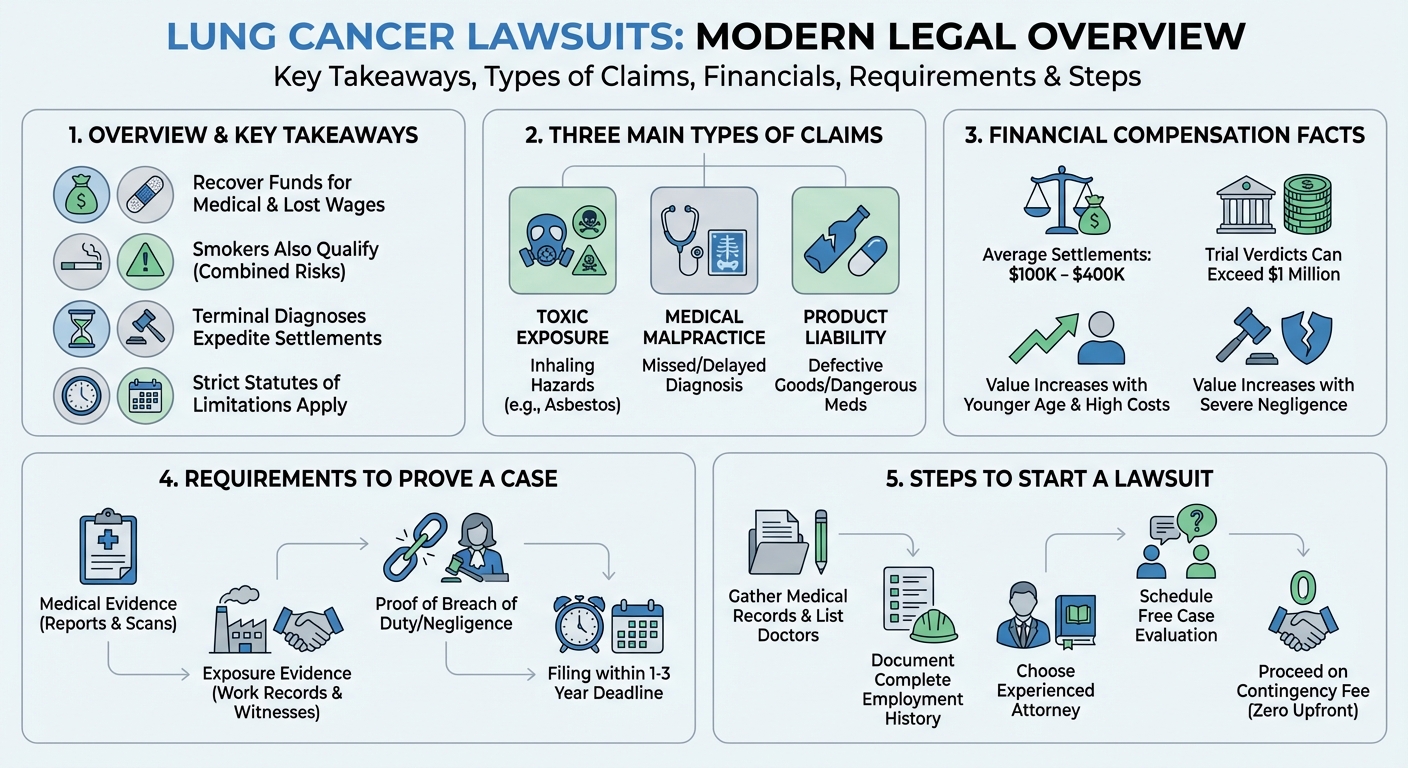
A lung cancer lawsuit helps victims recover financial compensation for medical bills, lost wages, and pain and suffering. These claims typically fall into three categories: asbestos exposure, medical malpractice (such as a delayed diagnosis), or product liability. Settlements generally average between $100,000 and $400,000, with some cases exceeding $1 million.
Understanding Lung Cancer Lawsuits: An Overview
A lung cancer diagnosis is a devastating event that brings immense physical, emotional, and financial burdens. In many cases, this illness could have been prevented or treated more effectively if not for the negligence of a corporation or medical professional. Lung cancer lawsuits provide a legal pathway for victims and their families to seek justice and recover financial compensation.
The Difference Between Toxic Exposure and Medical Malpractice
Lung cancer claims generally fall into two distinct legal categories. Understanding the difference is the first step in determining your legal options.
| Claim Type | Core Issue | Common Defendants |
|---|---|---|
| Toxic Exposure | The cancer was caused by inhaling hazardous substances (like asbestos) without proper warning or protective gear. | Former employers, manufacturers of asbestos-containing products, property owners. |
| Medical Malpractice | The cancer was present, but a doctor failed to diagnose it in a timely manner, allowing the disease to progress. | Primary care physicians, radiologists, hospitals, clinics. |
Why Prompt Legal Action is Critical for Patients and Families
Time is of the essence when filing a lung cancer lawsuit. First, state laws impose strict deadlines known as statutes of limitations. Second, building a strong case requires gathering medical records, preserving witness testimonies, and documenting employment histories before evidence is lost. Finally, securing an early settlement can provide the crucial funds needed to pay for life-extending treatments and support your family.
Primary Types of Lung Cancer Claims
Asbestos and Occupational Exposure Lawsuits
For decades, asbestos was heavily used in construction, shipbuilding, manufacturing, and automotive industries. Workers who inhaled microscopic asbestos fibers are at a significantly higher risk of developing lung cancer. Many of these cases are resolved through asbestos trust funds—pools of money set aside by bankrupt asbestos companies specifically to compensate victims.
Medical Malpractice: Failure to Diagnose and Misdiagnosis
Early detection is the most critical factor in surviving lung cancer. When a medical professional ignores symptoms, misreads an X-ray or CT scan, or fails to order a biopsy, the cancer can advance to an incurable stage. Patients who suffer a worsened prognosis due to a delayed diagnosis can file a medical malpractice lawsuit to recover damages for the lost opportunity for early treatment.
Product Liability and Defective Medications
In some instances, lung cancer is linked to defective consumer products or dangerous medications. If a company fails to warn the public about known carcinogenic risks associated with their product, they can be held strictly liable for the resulting harm.
Who Qualifies to File a Lung Cancer Lawsuit?
Can Cigarette Smokers Still File a Claim?
Yes. A common misconception is that a history of smoking disqualifies you from filing a lawsuit. If you were exposed to asbestos, the combination of smoking and asbestos exposure creates a “synergistic effect,” multiplying your risk of developing lung cancer. Courts and asbestos trust funds routinely award compensation to current and former smokers.
Proving Liability and Negligence
To win a lung cancer lawsuit, your legal team must prove that another party’s negligence directly contributed to your illness or worsened your prognosis. This requires:
- Medical Evidence: Pathology reports, imaging scans, and expert medical testimony.
- Exposure Evidence: Employment records, union dispatch slips, and co-worker testimonies to prove asbestos exposure.
- Breach of Duty: Demonstrating that a doctor deviated from the standard of care or a manufacturer failed to warn of hazards.
Understanding the Statute of Limitations in Your State
Every state has a statute of limitations that dictates how long you have to file a claim. For personal injury claims, this is typically 1 to 3 years from the date of your lung cancer diagnosis. If the patient has passed away, the family usually has 1 to 3 years from the date of death to file a wrongful death lawsuit. Missing this deadline permanently bars you from recovering compensation.
What is the average settlement for lung cancer?
The average settlement for a lung cancer lawsuit typically ranges between $100,000 and $400,000, though some verdicts exceed $1 million. The exact amount depends on the severity of the illness, the defendant’s negligence, and whether the claim involves asbestos exposure, medical malpractice, or wrongful death.
Typical Settlement Ranges ($100,000 to $400,000+)
While asbestos trust fund payouts may offer quicker, scheduled amounts (often in the tens of thousands), negotiated settlements with solvent companies or malpractice insurers frequently reach the $100,000 to $400,000 range. Cases that go to trial and result in a jury verdict can yield multi-million dollar awards, though trials carry higher risks and take longer.
Factors That Increase Settlement Value
Several variables can significantly increase the value of a lung cancer settlement:
- Age and Earning Capacity: Younger patients with dependents and higher lost future wages generally receive larger settlements.
- Severity of Negligence: Egregious errors by a doctor or blatant cover-ups by a corporation can lead to punitive damages.
- Cost of Treatment: The necessity for expensive, experimental, or ongoing therapies increases the economic damages.
Compensation for Medical Bills, Lost Wages, and Pain
A successful lawsuit compensates victims for both economic and non-economic damages. This includes past and future medical expenses, lost income, loss of earning capacity, physical pain, emotional suffering, and loss of consortium for the victim’s spouse.
Medical Prognosis and Its Impact on Your Legal Case
Is stage 4 lung cancer very serious?
Yes, stage 4 lung cancer is very serious. At this advanced stage, the cancer has metastasized, meaning it has spread from the lungs to other areas of the body, such as the brain, bones, or liver. While it is generally considered incurable, modern treatments can help manage symptoms and extend life.
Has anyone survived stage 4 lung cancer?
Yes, people have survived stage 4 lung cancer. While the overall five-year survival rate for advanced lung cancer remains low, recent breakthroughs in targeted therapies and immunotherapy have allowed a growing number of patients to live for many years, effectively managing the disease as a chronic condition.
What’s the longest you can live with lung cancer?
The longest you can live with lung cancer depends heavily on the stage at diagnosis and treatment response. Patients diagnosed at early stages (Stage 1 or 2) can often be cured and live out their normal life expectancy. Even some advanced-stage patients are now living 10 years or more with newer treatments.
How Prognosis Affects Expedited Trial Dates and Settlements
Courts recognize that lung cancer patients may not have the time to wait through years of standard litigation. If a patient has a terminal prognosis, attorneys can file a motion for “preference,” which expedites the trial date. The looming threat of an expedited trial often forces defendants to offer fair settlements much faster.
How to Start Your Lung Cancer Lawsuit
Gathering Essential Medical Records and Employment History
Your attorney will handle the heavy lifting, but you can speed up the process by providing basic information. Collect your initial diagnosis records, pathology reports, and a list of all treating physicians. For exposure cases, write down your work history, including job titles, locations, and dates of employment.
Choosing an Experienced Lung Cancer Attorney
Lung cancer litigation is highly complex. It is crucial to select a law firm with a proven track record in either asbestos litigation or complex medical malpractice, depending on the nature of your claim. Look for attorneys who have access to top-tier medical experts and industrial hygienists.
Free Case Evaluations and Contingency Fee Agreements
Most reputable lung cancer attorneys offer free, no-obligation case evaluations. Furthermore, they operate on a contingency fee basis. This means you pay zero upfront costs or hourly fees. The law firm only gets paid a percentage of your settlement or verdict if they successfully recover compensation on your behalf.