

Table of contents
At some point in your injury claim, the insurance company may demand that you submit to an “independent medical examination.” The name suggests a neutral evaluation by an objective doctor who will fairly assess your condition.
The reality is very different.
After years of dealing with these examinations and their aftermath, I can tell you that the word “independent” is one of the biggest misnomers in personal injury law. Understanding how these exams actually work is essential to protecting your claim.
What “Independent” Actually Means
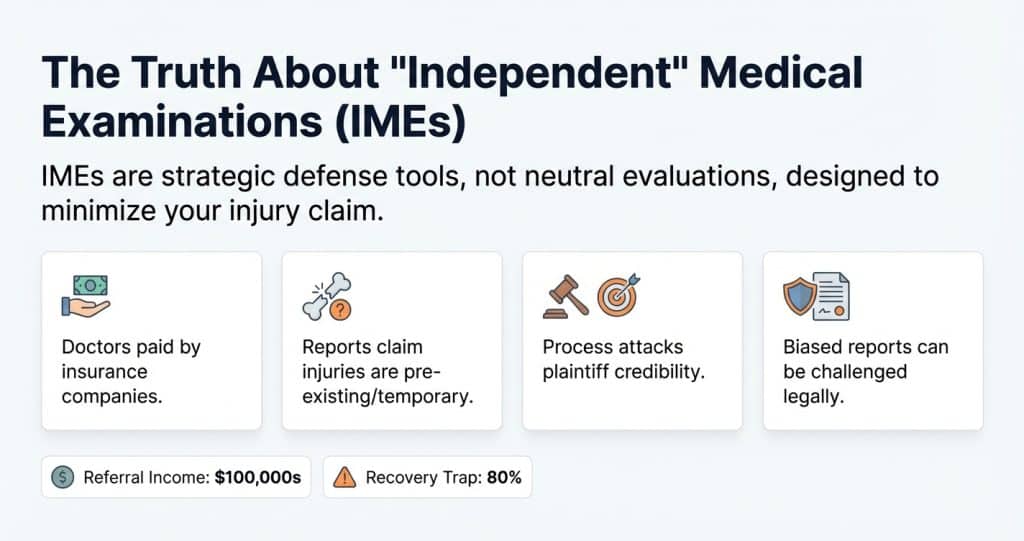
Let me be direct: these examinations are not independent. The doctor is selected and paid by the insurance company. They make significant income from insurance company referrals—sometimes hundreds of thousands of dollars per year. Their continued referrals depend on producing reports that help the insurance company’s position.
I’ve never seen a case where an insurance medical examiner concluded that the plaintiff was more injured than their treating doctors believed. Not once. The reports almost invariably say that treatment was excessive, that injuries were pre-existing, that the accident caused only temporary problems that have since resolved, or that no objective basis exists for the plaintiff’s complaints.
This isn’t because injured people universally exaggerate. It’s because doctors who don’t produce favorable reports for insurance companies stop getting referrals. The financial incentives are overwhelming.
Some of these doctors earn more from insurance examinations than from treating actual patients. They’ve essentially built careers on providing ammunition for insurance companies to deny or minimize claims.
Why Insurance Companies Request These Exams
Insurance companies request independent medical examinations for strategic reasons:
- To create counter-evidence. Your treating doctors have been documenting your injuries and recommending treatment. The insurance company needs contradictory opinions to justify their low offers or denials. The IME report provides that contradiction.
- To intimidate plaintiffs. The examination process itself can be intimidating. You’re sent to a strange doctor’s office, subjected to an examination by someone who’s clearly evaluating you for purposes other than treatment, and left to wonder what they’ll write. Some plaintiffs feel so discouraged by this process that they become more willing to settle.
- To attack credibility. If the IME doctor says you’re fine but your treating doctors say you’re injured, the insurance company argues that your treating doctors are biased or that you’re exaggerating to them. This credibility attack can be effective with juries.
- To set up for litigation. If the case goes to trial, the insurance company wants expert testimony supporting their position. The IME report becomes the foundation for that testimony.
What to Expect at the Examination
The examination itself is usually brief—often far shorter than appointments with your regular doctors. The examiner will ask about your symptoms, perform some physical tests, and review your medical records.
But here’s what they’re really doing: looking for anything they can use against you.
They’re watching for inconsistencies. If you describe your pain differently than you did in your medical records, they’ll note it. If you seem more functional than your records suggest, they’ll note it. If you make any statement that contradicts anything you’ve said before, they’ll note it.
They’re looking for signs of exaggeration. Are you moving better than you claim? Did you twist or bend in ways that should be painful if you’re really as injured as you say? Did you have difficulty with some tests but not others in ways that seem inconsistent?
They’re evaluating your credibility. How do you present yourself? Are you believable? Do you seem like someone a jury would sympathize with or someone who might be milking a claim?
They’re documenting limitations on your injuries. Everything that suggests you’re not as injured as claimed gets recorded. Everything that supports your claim gets minimized or ignored.
The Questions They Ask (And Why)
Insurance medical examiners are skilled at asking questions designed to help the defense:
- “Would you say you’re about 80% better?” This sounds like a neutral question, but your answer will be used to minimize your ongoing symptoms. “The plaintiff herself admitted she’s 80% recovered” will appear in the report.
- “Can you still do [activity]?” They’re looking for things you can still do to argue your limitations aren’t that severe. Even if you do the activity with pain, they may report that you “admitted” you can still do it.
- “When did you first have back problems?” They’re fishing for pre-existing conditions. Any prior complaint, no matter how minor or long ago, becomes ammunition.
- “Are you taking any medications for this?” If you’re not, they’ll argue you must not be in that much pain. If you are, they’ll suggest dependency or that your problems are primarily psychological.
- Every question has a purpose, and that purpose is usually not to help you.
- How the Reports Get Written
After the examination, the doctor writes a report that typically includes:
- A summary of your history that emphasizes anything helpful to the defense—prior injuries, gaps in treatment, inconsistent complaints.
- Findings from the examination that either minimize objective signs of injury or attribute them to causes other than the accident.
- Opinions about causation that usually conclude the accident caused only temporary injury, that you should have recovered by now, or that your current complaints are related to pre-existing conditions.
- Opinions about treatment that typically characterize your care as excessive, unnecessary, or not related to the accident.
- The language is crafted carefully. These doctors know their reports will be scrutinized by attorneys. They’ve learned to write in ways that support the defense position while appearing objective.
Protecting Yourself at the Examination
Be honest—lying will destroy your credibility. But also be thorough and accurate:
- Don’t minimize your symptoms. Many people, when talking to doctors, instinctively downplay their complaints. Don’t do this. If you’re hurting, say so. If activities are difficult, describe that difficulty accurately.
- Don’t exaggerate either. Exaggeration is worse than minimization. It gives the examiner exactly what they’re looking for.
- Be consistent. Before the examination, review your medical records so you can describe your symptoms consistently with how you’ve described them to your treating doctors.
- Describe your bad days, not just your good days. If you have significant variation in your symptoms, make sure the examiner knows that. Don’t let them characterize a relatively good day as your normal baseline.
- Bring someone with you if possible. Having a witness can help if there’s later dispute about what happened during the examination. At minimum, make notes immediately afterward about what was asked and what you said.
- Note how much time was spent. If the examiner spent only ten minutes with you but writes a detailed report criticizing months of treatment, that discrepancy is worth noting.
- Challenging the IME Report
If the IME report is unfavorable—and it probably will be—there are ways to challenge it:
- Point out the financial relationship. This doctor makes substantial income from insurance company referrals. Juries understand that financial incentives can affect opinions.
- Compare time spent. Your treating doctors have seen you dozens of times over months. This examiner spent maybe 20 minutes with you. Who knows your condition better?
- Highlight selective reporting. If the examiner ignored objective findings documented by your treating physicians, point that out. If they mischaracterized your statements, correct the record.
- Depose the examiner. In litigation, you have the right to depose the IME doctor. Skilled cross-examination can expose biases, inconsistencies, and the financial relationships that color their opinions.
- Get a rebuttal opinion. Your treating physicians can respond to the IME report, explaining why they disagree and what the examiner got wrong.
Do You Have to Go?
Whether you have to submit to an IME depends on the circumstances:
- Before litigation: You generally are not legally required to submit to an IME at the insurance company’s request. They may pressure you, they may condition settlement negotiations on it, but there’s no legal obligation.
- During litigation: Once suit is filed, the defense can typically compel an IME under the rules of civil procedure. At that point, refusal can result in sanctions or dismissal.
- Your own insurance company: If you’re making a claim under your own policy, the policy language may require you to submit to examinations. Refusal might give them grounds to deny benefits.
The strategic question is whether attending an IME before litigation serves your interests. Sometimes it does—if your injuries are well-documented and you’ll present well, letting them examine you might actually help. Often it doesn’t—giving them ammunition before they’ve even made a serious offer is rarely advantageous.
The Bottom Line
“Independent” medical examinations are neither independent nor neutral. They’re defense tools designed to generate evidence that minimizes your injuries and maximizes the insurance company’s arguments.
Understanding this reality helps you navigate the process. Be prepared. Be honest. Be thorough. And don’t assume that a negative IME report means your case is over—these reports can be challenged, and juries increasingly understand the bias built into the system.
If you’ve been asked to submit to an IME, or if you’ve already been examined and received an unfavorable report, talk to an experienced attorney about your options. The examination is just one part of the process, and a hostile report doesn’t have to be the final word on your injuries.

About the Author
Chi Nguyen is a Houston personal injury attorney dedicated to helping accident victims understand their rights and receive fair compensation under Texas law. With extensive experience representing injured Texans, Attorney Nguyen combines legal expertise with a commitment to client education and empowerment.