

Table of contents
To effectively talk to a personal injury lawyer, start by gathering all accident-related documents, including police reports and medical records. During your consultation, be completely honest about the incident, avoid exaggerating your injuries, and ask specific questions about their experience, fee structure, and your case’s potential outcome.
How to Talk to a Personal Injury Lawyer: The Ultimate Guide to Your First Consultation
Learning how to talk to a personal injury lawyer is the first step toward securing the compensation you deserve. Your initial consultation is crucial because it sets the foundation for your entire case. During this meeting, the attorney evaluates the strength of your claim, and you decide if they are the right fit for your needs.
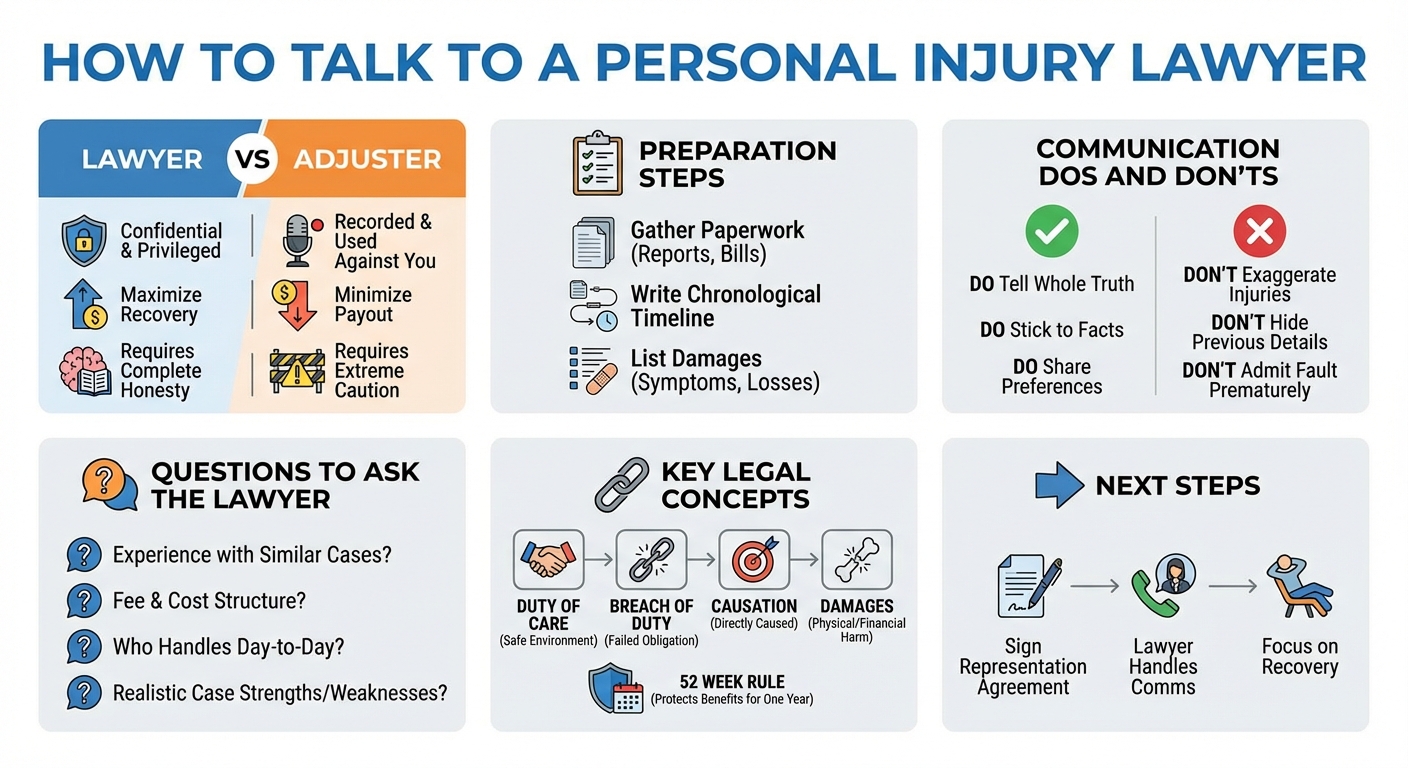
It is vital to understand the difference between talking to your lawyer and speaking with an insurance adjuster. While you must be cautious with insurance companies, your attorney is your advocate.
| Talking to Your Lawyer | Talking to the Insurance Adjuster |
|---|---|
| Protected by attorney-client privilege. | Recorded and can be used against you. |
| Goal is to maximize your financial recovery. | Goal is to minimize or deny your payout. |
| Requires complete honesty, including bad facts. | Requires extreme caution; avoid recorded statements. |
Step 1: How to Prepare Before You Meet Your Attorney
Preparation is key to a productive first meeting. By organizing your information in advance, you allow the attorney to spend less time gathering basic facts and more time building a legal strategy.
- Gathering your documents: Bring physical or digital copies of all relevant paperwork. This includes police reports, medical records, discharge summaries, medical bills, and photos of the accident scene or your injuries.
- Writing down a chronological timeline: Memory fades quickly. Write down exactly what happened before, during, and after the accident in chronological order.
- Listing your current symptoms and financial losses: Document every ache, pain, and physical limitation. Additionally, list your missed days of work, lost wages, and out-of-pocket expenses related to the injury.
5 Essential Tips for Communicating Effectively With Your Lawyer
Clear communication ensures your legal team can represent you effectively. Follow these five tips when discussing your case:
- Tell the whole truth (including the bad parts): Your lawyer needs to know everything. If you were speeding or had a pre-existing condition, tell them. They can strategize around bad facts, but surprises ruin cases.
- Understand attorney-client privilege: Everything you discuss with your lawyer in private is strictly confidential. This privilege allows you to be completely transparent without fear of your words being shared with the defense.
- Stick to the facts and avoid guessing: If you do not know the answer to a question, simply say “I don’t know.” Guessing distances, speeds, or times can create inconsistencies in your testimony later.
- Do not exaggerate your injuries: Be honest about your pain levels. Exaggerating injuries damages your credibility with the insurance company, the judge, and the jury.
- Share your communication preferences: Let your lawyer know if you prefer phone calls, emails, or text messages, and establish how often you expect updates on your case.
What not to say to an injury lawyer?
When speaking to your attorney, never lie or omit details about previous injuries. Avoid admitting fault prematurely without legal context, and never make exaggerated claims about your physical limitations. Your lawyer needs the unvarnished truth to build a solid, credible case and prevent surprises during litigation.
Top Questions to Ask During Your Free Consultation
Remember that you are interviewing the lawyer just as much as they are evaluating your case. Ask these critical questions:
- Do you have experience trying personal injury cases similar to mine? Ensure they have a track record with your specific type of accident, whether it is a truck collision, slip and fall, or product liability issue.
- How do contingency fees and case costs work? Most personal injury lawyers work on a contingency fee basis, meaning they only get paid if you win. Clarify what percentage they take and who covers upfront court costs.
- Who will actually be handling my case day-to-day? Find out if your case will be passed off to a junior associate or paralegal, or if the senior attorney will remain actively involved.
- What is your assessment of my case’s strengths and weaknesses? A good lawyer will give you a realistic, honest evaluation rather than just promising you a massive settlement.
What are the 4 proofs of negligence?
To win your case, your lawyer must establish the four proofs of negligence: Duty of Care (the defendant owed you a safe environment), Breach of Duty (they failed that obligation), Causation (their failure directly caused your accident), and Damages (you suffered actual physical or financial harm).
How hard is it to win a personal injury lawsuit?
Winning a personal injury lawsuit depends heavily on the clarity of fault and the quality of your evidence. While many cases are settled out of court relatively easily, going to trial is much harder and requires strong expert legal representation to successfully prove the defendant’s negligence.
What is the 52 week rule for personal injury trust?
The 52-week rule is a disregard period allowing personal injury settlements to be ignored for means-tested government benefits for up to one year. Setting up a personal injury trust promptly within this 52-week window is critical to permanently protect your eligibility for ongoing financial assistance.
Next Steps: What Happens After You Hire Your Attorney
Once you decide to move forward, the legal process officially begins. Here is what you can expect:
- Signing the representation agreement: You will sign a contract detailing the contingency fee structure and officially retaining the law firm.
- Letting your lawyer handle the insurance companies: From this point on, you will no longer speak to the insurance adjusters. Your lawyer will take over all communications, protecting you from recorded statement traps.
- Focusing on your medical treatment and recovery: Your primary job is to attend all doctor’s appointments, follow medical advice, and heal. Your attorney will handle the legal heavy lifting.