

Table of contents
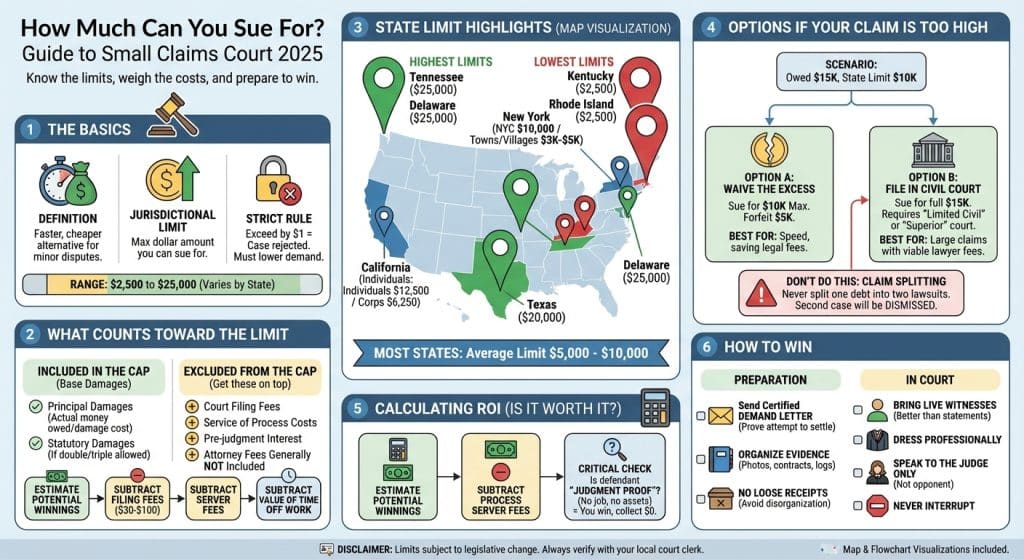
The amount you can sue for in small claims court typically ranges from **$2,500 to $25,000**, depending on the state. For example, Texas allows claims up to $20,000, while California limits individuals to $12,500 and businesses to $6,250. If your damages exceed the local limit, you must either waive the excess amount or file a formal lawsuit in civil court.
How Much Can You Sue For in Small Claims Court? (2025 Limits)
The amount you can sue for in small claims court varies significantly by state, typically ranging from $2,500 to $25,000. Small claims courts are designed to handle minor disputes quickly and inexpensively, without the need for complex legal representation. Because these courts are meant for smaller financial matters, every state sets a strict monetary cap, known as the "jurisdictional limit."
If your damages fall within this limit, small claims is often the fastest route to a judgment. However, if your claim exceeds the cap, you face a strategic choice: waive the extra money to keep the case simple, or file a formal civil lawsuit in a higher court.
The Difference Between Small Claims and Civil Court
The primary difference is procedure and complexity. In small claims court:
- Procedures are simplified: Rules of evidence are relaxed.
- Lawyers are often restricted: Some states (like California and Michigan) do not allow attorneys during the initial hearing.
- Costs are lower: Filing fees generally range from $30 to $100, compared to hundreds for civil court.
What Is the Most You Can Sue For in Small Claims?
The "jurisdictional limit" is the absolute maximum dollar amount a judge can award you. If you are asking for even one dollar more than this limit, the court may dismiss your case or force you to amend it.
Individual vs. Corporate Plaintiff Limits
In most states, the limit is the same regardless of who is suing. However, some jurisdictions distinguish between individuals and businesses to prevent corporations from clogging the docket with debt collection cases.
Example (California):
- Individuals: Can sue for up to $12,500.
- Businesses/Corporations: Can generally sue for only up to $6,250.
How Often Are Limits Updated?
State legislatures periodically adjust these limits to account for inflation. For instance, Texas increased its limit to $20,000 in 2020. Always verify the current limit with your local county clerk before filing, as outdated information online can lead to procedural errors.
Small Claims Court Limits by State
While limits vary by county in some jurisdictions, the following table provides a general baseline for major states as of 2025.
| State | Maximum Claim Limit | Notes |
|---|---|---|
| Texas | $20,000 | Justice of the Peace Courts handle these claims. |
| California | $12,500 | Lower limit ($6,250) applies to business plaintiffs. |
| Florida | $8,000 | Excludes costs, interest, and attorney fees. |
| New York | $10,000 (NYC) | Limits may be lower ($3,000–$5,000) in town/village courts. |
| Illinois | $10,000 | Specifically for small claims; higher amounts go to arbitration/civil. |
| Tennessee | $25,000 | One of the highest limits in the country (General Sessions). |
| Kentucky | $2,500 | One of the lowest limits in the U.S. |
How Does Small Claims Court Work in New York State?
New York operates slightly differently depending on your location. In New York City, Nassau, and Suffolk counties, the limit is $10,000. However, in many upstate City Courts, the limit is $5,000, and in Town or Village Courts, it can be as low as $3,000.
In NY small claims:
- You must sue the defendant in the county where they live, work, or have a business office.
- Corporations and partnerships generally cannot file commercial claims in standard small claims parts; they must use a specific Commercial Small Claims part.
- The court provides arbitrators as an alternative to judges to speed up the process.
Calculating Your Total Claim Amount
When determining if you fit the limit, you must calculate your "amount in controversy" carefully.
Do Filing Fees Count Toward the Limit?
Generally, no. The limit applies to the damages you are seeking (the money owed). Court costs (filing fees, service of process fees) are usually awarded on top of the judgment limit. For example, if the limit is $10,000, you can sue for $10,000 plus the $50 filing fee.
The Danger of ‘Splitting Claims’
You cannot split a single dispute into two separate lawsuits to get around the limit. This is prohibited by the doctrine of res judicata.
Example: If a contractor caused $15,000 in damage but the small claims limit is $10,000, you cannot file two separate $7,500 lawsuits. You must either sue for the full $15,000 in civil court or sue for $10,000 in small claims and permanently waive the remaining $5,000.
Is Taking Someone to Small Claims Court Worth It?
Before filing, you must weigh the potential recovery against the time and effort required. Winning a lawsuit is not the same as collecting money.
- Cost-Benefit Analysis: If someone owes you $500, but the filing fee is $100 and you have to take a day off work, it may not be financially viable.
- Collection Reality: The court does not collect the money for you. If the defendant is "judgment proof" (has no assets, no job, and no bank account), a piece of paper saying you won is worthless.
- Time Investment: You are responsible for locating the defendant, serving them with papers, and gathering evidence. This process can take months.
How to Make Sure You Win in Small Claims Court?
Success in small claims court depends on preparation, not legal jargon. Judges value organization and concrete proof over emotional arguments.
- Gather Irrefutable Evidence: Bring three copies of everything (one for you, one for the judge, one for the defendant). Key evidence includes signed contracts, text message logs, photos of property damage, and bank statements.
- Send a Demand Letter: Many states require you to prove you tried to resolve the dispute before suing. A certified demand letter serves as proof that you gave the defendant a chance to pay.
- Courtroom Etiquette:
- Address the judge, not the opponent.
- Do not interrupt.
- Keep your story chronological and stick to the facts.
What If Your Damages Exceed the Small Claims Limit?
If your claim is worth $30,000 but the small claims cap is $10,000, you have two primary options:
- Waive the Excess: You can sue in small claims for the maximum $10,000 and legally abandon your right to the remaining $20,000. This is often chosen when the cost of hiring a lawyer for civil court would eat up the difference anyway.
- File in Civil Court: You can file a limited or unlimited civil case in District or County Court. This allows you to sue for the full amount but usually requires strict adherence to evidence rules and formal pleading standards. At this level, hiring a civil litigation attorney is highly recommended to navigate discovery and trial procedures.
FAQs
What is the most you can sue for in small claims?
The maximum amount varies by state, ranging from $2,500 (e.g., Kentucky) to $25,000 (e.g., Tennessee). Common limits are $10,000 or $12,500. You cannot recover more than the jurisdictional limit, even if your actual damages are higher.
Is taking someone to small claims court worth it?
It is worth it if the defendant has assets to pay the judgment and the amount owed significantly exceeds the filing fees and time costs. If the defendant is ‘judgment proof’ (has no money or assets), winning the case may result in a moral victory but no financial recovery.
How to make sure you win in small claims court?
To maximize your chances, bring organized physical evidence (contracts, photos, receipts), send a formal demand letter before filing, and remain calm and respectful in court. Speak directly to the judge rather than arguing with the defendant.
How does small claims court work in New York state?
In New York, small claims limits are $10,000 in NYC and usually $3,000 to $5,000 in upstate towns. You must sue in the county where the defendant lives or works. The process is simplified, often using arbitrators to resolve disputes quickly.
Can I include attorney fees in my small claims lawsuit?
Generally, no. Small claims courts rarely award attorney fees unless a specific contract or statute explicitly allows for them. You usually can only recover your actual damages plus court filing costs.