

Table of contents
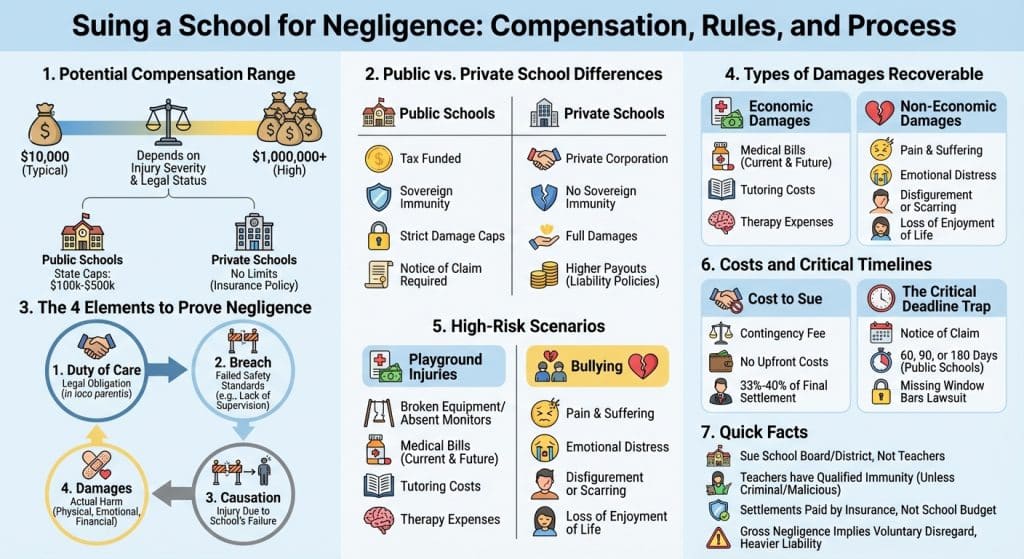
You can sue a school for negligence for amounts ranging from **$10,000 to over $1 million**, depending on the injury severity and school type. However, lawsuits against **public schools** are often limited by state damage caps (e.g., $100,000–$300,000), while **private schools** generally have no such caps and carry higher liability insurance policies.
How Much Can You Sue a School for Negligence? (The Short Answer)
There is no single fixed amount for suing a school, but settlements typically range from $10,000 for minor injuries to over $1 million for catastrophic events or wrongful death. The final compensation depends heavily on the severity of the injury, the cost of future care, and—most importantly—whether the school is public or private.
While private schools can be sued like any other business (often up to their insurance policy limits), public schools are government entities. This means they are often protected by sovereign immunity, which places strict legal caps on how much money you can recover, regardless of how severe the negligence was.
How much can you sue for negligence?
In general negligence cases, you can sue for the total value of your economic losses (medical bills, lost wages) plus non-economic damages (pain and suffering). However, against public schools, state laws often cap total damages. For example, some states limit payouts to $100,000 or $200,000 per incident, while private school lawsuits are generally limited only by the school’s liability insurance coverage, often exceeding $1 million.
The Major Limiting Factor: Sovereign Immunity & Damage Caps
The biggest obstacle in school negligence lawsuits is the doctrine of sovereign immunity. Historically, this legal concept prevented citizens from suing the government at all. Today, most states have waived this immunity partially through Tort Claims Acts, allowing lawsuits but imposing strict financial caps.
These caps vary significantly by state:
- Florida: Damages against government entities (including public schools) are typically capped at $200,000 per person and $300,000 per incident.
- Texas: Under the Texas Tort Claims Act, damages against units of local government are often capped at $100,000 per person.
- New York: While New York generally allows for broader liability, strict procedural rules (like the 90-day Notice of Claim) act as a barrier to recovery.
Can I sue the school board for negligence?
Yes, you can sue the school board for negligence, as the board is the legal entity responsible for district policies and employee actions. However, because the school board is a government body, the lawsuit is subject to the specific immunity laws and damage caps of your state. You generally sue the board itself rather than individual teachers, unless the teacher acted with malicious intent.
Calculating Your Claim: Types of Recoverable Damages
When determining how much a case is worth, attorneys calculate three specific categories of damages. If you are suing a private school, you may be entitled to all three. If suing a public school, punitive damages are rarely awarded.
Economic Damages
These are quantifiable financial losses that can be proven with receipts and expert testimony:
- Medical Expenses: Current hospital bills, physical therapy, and medication.
- Future Care: Estimated costs for long-term disability or counseling.
- Tuition Refunds: If the student must transfer schools due to the incident.
Non-Economic Damages
These cover the intangible impact of the negligence:
- Pain and Suffering: Physical pain endured during recovery.
- Emotional Distress: Anxiety, PTSD, or depression resulting from bullying or abuse.
- Loss of Enjoyment of Life: Inability to participate in sports or hobbies.
Punitive Damages
Punitive damages are designed to punish the defendant for gross negligence rather than compensate the victim. Note: Most states prohibit punitive damages against government entities (public schools) but allow them in lawsuits against private institutions.
Legal Requirements: What Are the 4 Things to Prove Negligence?
You cannot sue a school simply because an accident happened. To win a lawsuit, your attorney must prove the four elements of negligence existed at the time of the injury.
What are the 4 things to prove negligence?
To successfully sue for negligence, you must prove: (1) Duty of Care (the school had an obligation to keep the student safe); (2) Breach of Duty (the school failed to meet that standard); (3) Causation (the breach directly caused the injury); and (4) Damages (the victim suffered verifiable harm, such as physical injury or financial loss).
- 1. Duty of Care (In Loco Parentis): Schools act “in the place of the parent” while students are in their care. They must provide adequate supervision and a safe environment.
- 2. Breach of Duty: This occurs when a school fails to act as a prudent institution would. Example: Leaving a chemistry lab unlocked and unsupervised.
- 3. Causation: You must link the injury directly to the school’s failure. If a child trips over their own shoelaces, the school is likely not the cause.
- 4. Damages: There must be actual harm. A “near miss” usually does not qualify for a lawsuit.
Common School Negligence Scenarios and Case Values
The potential settlement value often correlates with the type of incident.
Bullying and Harassment
Schools can be liable if they knew about bullying and failed to intervene. Settlements here often focus on emotional distress and therapy costs. Values can range from $20,000 to $150,000 depending on the duration and severity.
Sports Injuries
While parents often sign waivers for sports, waivers do not excuse gross negligence (e.g., forcing a student to play with a concussion). These cases can reach high six figures if the injury ends a potential athletic career or causes permanent disability.
Sexual Abuse (Exceptions to Caps)
Many states have passed laws that remove damage caps and extend statutes of limitations for sexual abuse survivors. In these cases, settlements against schools frequently exceed $1 million due to the lifelong trauma involved.
The Cost and Process of Suing a School
Suing a school involves specific procedural hurdles that do not exist in standard personal injury cases.
How much does it cost to sue a school?
Most personal injury attorneys handle school negligence cases on a contingency fee basis. This means you pay $0 upfront. If you win, the lawyer takes a percentage of the settlement (typically 33% to 40%). If you do not win, you generally do not owe legal fees, though you may be responsible for filing costs depending on your agreement.
The ‘Notice of Claim’ Deadline
If suing a public school, you typically cannot just file a lawsuit. You must first file a Notice of Claim with the school district or municipality. This window is extremely short—often 60 to 90 days after the incident. Missing this deadline can permanently bar you from recovering any money, regardless of how severe the injury is.
FAQs
How much does it cost to sue a school?
Most personal injury attorneys handle school negligence cases on a contingency fee basis. This means you pay $0 upfront. If you win, the lawyer takes a percentage of the settlement (typically 33% to 40%). If you do not win, you generally do not owe legal fees.
How much can you sue for negligence?
In general negligence cases, you can sue for the total value of your economic losses (medical bills, lost wages) plus non-economic damages (pain and suffering). However, against public schools, state laws often cap total damages. For example, some states limit payouts to $100,000 or $200,000 per incident.
What are the 4 things to prove negligence?
To successfully sue for negligence, you must prove: (1) Duty of Care (the school had an obligation to keep the student safe); (2) Breach of Duty (the school failed to meet that standard); (3) Causation (the breach directly caused the injury); and (4) Damages (the victim suffered verifiable harm).
Can I sue the school board for negligence?
Yes, you can sue the school board for negligence, as the board is the legal entity responsible for district policies. However, because the school board is a government body, the lawsuit is subject to the specific immunity laws and damage caps of your state.