

Table of contents
The amount you can sue for after being punched typically ranges from **$2,500 to $15,000** for minor injuries (bruising, soft tissue damage) and **$15,000 to $50,000+** for moderate injuries like broken bones or dental damage. However, the actual payout is often limited by the attacker’s ability to pay or the availability of insurance coverage.
How Much Can You Sue for If Someone Punches You?
If you have been punched, kicked, or physically attacked, you have the right to seek compensation through the civil court system. While criminal charges punish the offender with jail time or fines paid to the state, a civil lawsuit is the only way for you to recover money for your medical bills, lost wages, and pain and suffering.
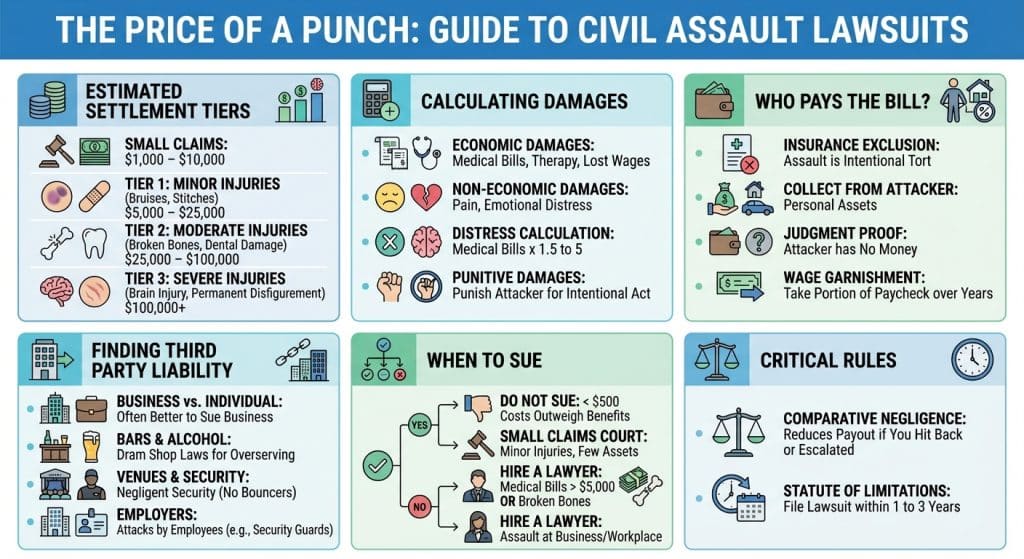
The potential settlement value of a punch varies drastically based on two main factors: the severity of your injuries and the financial assets of the person who hit you. While minor injuries may settle for $2,500 to $15,000, cases involving broken bones, dental reconstruction, or traumatic brain injuries can reach $50,000 to $100,000+.
However, winning a judgment is different from collecting it. This guide explains how damages are calculated and the specific challenges of suing an individual for assault and battery.
Can You Sue Someone for Money for Assaulting You?
Yes, you can sue someone for money for assaulting you, regardless of whether they face criminal charges. In the legal world, this is typically filed as an “intentional tort” claim for assault and battery.
- Assault: The threat or reasonable apprehension of immediate harm (e.g., someone swinging a fist at you).
- Battery: The actual physical contact that causes harm (e.g., the punch connecting with your face).
The Burden of Proof: Civil vs. Criminal
Many victims hesitate to sue because the police declined to press charges or the attacker was found “not guilty” in criminal court. You should not let this stop you. The burden of proof in civil court is lower.
In a criminal trial, the state must prove guilt “beyond a reasonable doubt.” In a civil lawsuit, you only need to prove your case by a “preponderance of the evidence.” This means you simply need to show that it is more likely than not (51% probability) that the defendant caused your injuries.
What Is the Average Settlement for Assault?
Because assault cases range from a simple black eye to life-altering brain injuries, a single “average” number is misleading. Instead, attorneys view these cases in tiers based on the actual damages incurred.
| Injury Severity | Estimated Settlement Range | Typical Injuries |
|---|---|---|
| Minor | $2,500 – $15,000 | Bruising, black eye, soft tissue soreness, minor cuts requiring no stitches. |
| Moderate | $15,000 – $50,000 | Broken nose, fractured jaw, dental damage (chipped teeth), stitches, concussion. |
| Severe | $50,000 – $100,000+ | Traumatic brain injury (TBI), loss of vision, permanent scarring/disfigurement, long-term nerve damage. |
How much compensation do you get for assault?
The final compensation amount depends on the “make whole” doctrine. The court aims to put you in the financial position you would have been in had the attack never happened. Key factors influencing the payout include:
- Medical Costs: ER visits, surgery, dental implants, and therapy.
- Lost Income: Days missed from work due to recovery or court appearances.
- Permanence: Will you have a scar on your face forever?
- Venue: Juries in certain jurisdictions may award higher pain and suffering damages than others.
Calculating Your Damages: What Goes Into the Number?
When an attorney drafts a demand letter, they categorize damages into three buckets: Economic, Non-Economic, and Punitive.
Economic Damages
These are objective, verifiable financial losses. If you paid a $500 co-pay at the ER and lost $1,000 in wages because you couldn’t work for a week, your economic damages are $1,500. This category also includes future medical needs, such as reconstructive dental work required months after the initial punch.
How much money is emotional distress worth?
Emotional distress (Non-Economic Damages) covers pain, suffering, humiliation, and PTSD. Since there is no receipt for pain, lawyers and insurance adjusters often use the Multiplier Method.
They take your total economic damages (medical bills) and multiply them by a number between 1.5 and 5, depending on severity.
- Example: If you have $5,000 in medical bills for a broken nose (moderate severity), a lawyer might argue for a 3x multiplier.
$5,000 (Medical) x 3 = $15,000 (Pain and Suffering)
Total Demand: $20,000.
Punitive Damages
Unlike car accidents, assault is intentional. Courts may award punitive damages specifically to punish the attacker for malicious behavior. While these can significantly increase the verdict amount, they are often difficult to collect if the defendant has no money.
The Collection Problem: Who Actually Pays?
Winning a lawsuit is easy; getting paid is hard. This is the single biggest hurdle in assault cases.
The ‘Judgment Proof’ Defendant
If the person who punched you has no job, no savings, and no assets, they are considered “judgment proof.” You can win a $100,000 verdict against them, but if they have $0, you will collect $0. You cannot get blood from a stone.
Does insurance cover assault?
Generally, no. Homeowners and renters insurance policies cover negligence (accidents), but they almost always contain an “Intentional Acts Exclusion.” If the defendant admitted to punching you on purpose, their insurance company will likely deny the claim, leaving the defendant personally liable.
Vicarious Liability: The Deep Pockets
Because individual attackers often lack funds, experienced attorneys look for third parties who may share liability:
- Bars and Nightclubs: If a bouncer used excessive force, the establishment is often liable. If the attacker was a patron who was over-served alcohol, you might have a “Dram Shop” claim against the bar.
- Employers: If an employee punched you while on the clock (e.g., a delivery driver or security guard), the employer may be vicariously liable.
- Negligent Security: If the assault happened in a parking lot or apartment complex with known security failures (broken lights, no gates), the property owner could be liable.
Defenses That Could Lower Your Payout
Even if you are the victim, the defense will try to reduce their liability by blaming you.
Mutual Combat
If evidence suggests you agreed to fight—such as stepping outside after an argument—a jury may view this as “mutual combat.” In some states, this bars you from recovering damages entirely.
Self-Defense
The defendant may claim you threatened them first. If a jury believes the defendant acted reasonably to protect themselves, you will lose the case.
Comparative Negligence
If you were 30% responsible for the escalation (e.g., you were shouting insults), your compensation may be reduced by 30%. If you are found to be more than 50% at fault, many states will prevent you from recovering anything.
Steps to Take Immediately After Being Punched
- File a Police Report: This is the most critical piece of evidence. It creates an official record of the event and the identity of the attacker.
- Document Injuries Immediately: Take clear photos of any swelling, cuts, or bruising. Bruises fade, but photos last forever.
- Get a Medical Evaluation: Go to urgent care or the ER. You need a medical record linking the physical trauma directly to the date and time of the assault.
- Preserve Evidence: Save text messages, social media posts, or witness contact info that proves the attack was unprovoked.
FAQs
What is the average settlement for assault?
There is no single average, but settlements generally fall into tiers: minor injuries (bruises) often settle between $2,500 and $15,000, while moderate injuries (broken bones, dental work) range from $15,000 to $50,000. Severe cases involving permanent damage can exceed $100,000.
How much compensation do you get for assault?
Compensation depends on your economic losses (medical bills, lost wages) and non-economic damages (pain and suffering). The total amount is also heavily influenced by the defendant’s financial assets and whether a third party (like a business or employer) shares liability.
How much money is emotional distress worth?
Emotional distress is typically calculated using a multiplier method, often 1.5 to 5 times the total amount of your medical bills. For example, if you have $5,000 in medical bills, a 3x multiplier would value your emotional distress at $15,000.
Can you sue someone for money for assaulting you?
Yes, you can file a civil lawsuit for assault and battery to recover monetary damages. This is a separate legal action from criminal charges, and you can sue even if the attacker was not convicted of a crime.
Is it worth suing someone who has no money?
Usually, no. If a defendant is ‘judgment proof’ (has no assets, savings, or insurance coverage), winning a lawsuit may result in a paper judgment that you cannot collect. Attorneys typically look for third-party liability (like a venue or employer) to ensure there is a source of recovery.