

Table of contents
You can sue for assault for amounts ranging from **$5,000 to over $1,000,000**, depending on injury severity and the defendant’s ability to pay. Minor injuries often settle between **$5,000 and $25,000**, while severe trauma or permanent damage can yield **$100,000+**. Compensation includes medical bills, lost wages, pain and suffering, and punitive damages.
How Much Can You Sue Someone for Assault? (The Short Answer)
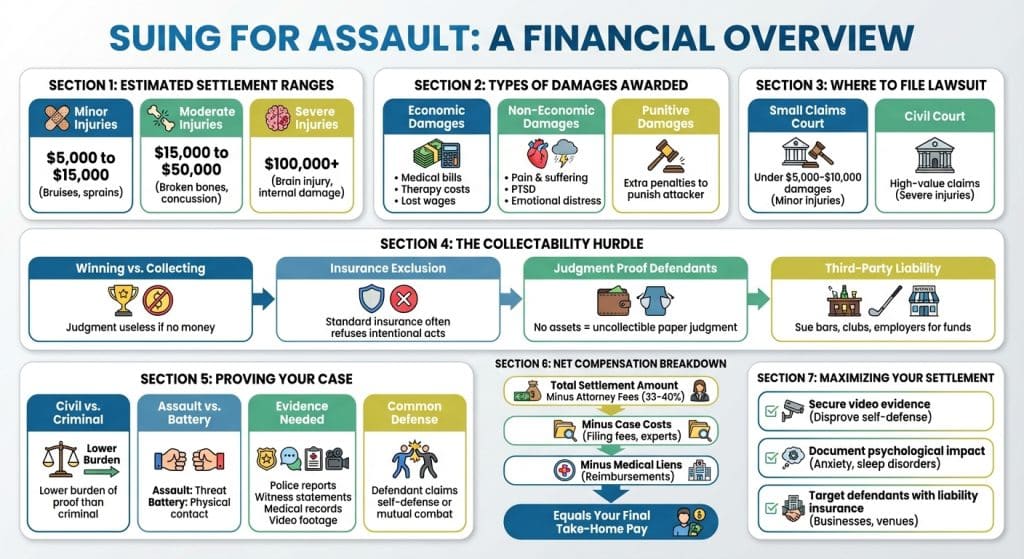
There is no single fixed price tag for an assault case, but settlement values typically range from $5,000 to over $1,000,000. The wide variance depends on two primary realities: the severity of your injuries and the defendant’s ability to pay.
In the United States legal system, you can file a lawsuit in either Small Claims Court or Civil Court:
- Small Claims Court: Best for minor injuries with low medical bills. States cap these damages (usually between $5,000 and $10,000). You generally do not need a lawyer.
- Civil Court: Necessary for severe injuries, broken bones, or complex cases involving negligent security. There is generally no cap on the amount you can sue for, allowing for six- or seven-figure demands.
Can you get money if you get assaulted?
Yes, you can get money if you get assaulted, provided you can prove liability and damages. While the police handle the criminal punishment (jail time), the civil court system is designed to make you whole financially. You are entitled to compensation for medical bills, lost wages, and pain and suffering. If the attack was particularly malicious, the court may also award punitive damages specifically to punish the attacker.
Average Settlement Amounts for Assault and Battery
Because assault cases often settle privately, public data can be skewed. However, legal trends indicate the following average settlement tiers based on injury severity.
How much compensation do you get for assault?
The compensation you get for assault correlates directly with the long-term impact of the injury. Insurance adjusters and juries look at “hard costs” (medical bills) and apply a multiplier for “soft costs” (pain and suffering).
| Injury Severity | Typical Settlement Range | Common Injuries |
|---|---|---|
| Minor | $5,000 – $25,000 | Bruises, sprains, soft tissue damage, minor lacerations. |
| Moderate | $25,000 – $100,000 | Broken bones, concussion, stitches, dental damage. |
| Severe / Catastrophic | $100,000 – $1,000,000+ | Traumatic brain injury (TBI), permanent disfigurement, organ damage. |
Factors That Determine Your Case Value
Calculating the exact value of a lawsuit involves adding up three distinct categories of damages.
How much money can I sue someone for assault?
You can sue for the total sum of your economic losses, non-economic suffering, and punitive penalties. Specifically, your demand letter will include:
- Economic Damages (Special Damages): These are objective financial losses. They include past and future medical bills, therapy costs, lost wages, and any property damage (e.g., broken glasses or phone).
- Non-Economic Damages (General Damages): These cover subjective harm. This includes physical pain, emotional distress, PTSD, humiliation, and loss of enjoyment of life. In severe assault cases, this often exceeds the economic damages.
- Punitive Damages: Unlike negligence cases (like car accidents), assault is an intentional tort. Juries are often willing to award extra money solely to punish the defendant for malicious behavior.
The ‘Judgment Proof’ Problem: Can the Defendant Pay?
The biggest hurdle in assault lawsuits is not proving the assault happened, but finding a source of funds. If you sue an individual who has no assets, you may win a “paper judgment”—a court order for millions that the defendant cannot pay.
To ensure you actually get paid, your attorney will look for insurance coverage or third-party liability:
- Homeowners or Umbrella Insurance: Sometimes covers the defendant, though “intentional acts” are often excluded from policies.
- Vicarious Liability: If the attacker was working at the time (e.g., a bouncer, security guard, or delivery driver), you may be able to sue their employer. Employers typically carry large liability insurance policies.
- Negligent Security: If the assault happened at a bar, club, or hotel, the venue might be liable for failing to provide adequate security.
Common Assault Scenarios and Lawsuits
The context of the fight often dictates who you sue and how much you can recover.
Can you sue someone if they punch you?
Yes, you can sue someone if they punch you. A punch constitutes “battery” (harmful physical contact). Even if the physical injury is minor, the act of being punched can justify compensation for humiliation and emotional distress. If the punch caused dental damage or a concussion, the case value increases significantly.
Assaults at Bars and Concert Venues
Alcohol-fueled violence is common. In these cases, you might sue the establishment under “dram shop” laws (if they served an intoxicated person) or for negligent security if they failed to break up the fight or screen for weapons.
Domestic Violence Civil Suits
Victims of domestic abuse can sue their abusers in civil court. This is separate from family court proceedings and can provide funds for medical care and relocating to a safe environment.
Criminal Restitution vs. Civil Lawsuit
Many victims assume that once the police are involved, the court will handle the money. This is rarely true.
Criminal Restitution is money a judge orders a convicted criminal to pay the victim. However, it is usually limited to direct out-of-pocket expenses (like medical deductibles) and does not account for pain and suffering. Furthermore, if the defendant goes to jail, they likely cannot pay restitution.
A Civil Lawsuit is the only way to secure full compensation for long-term trauma, lost earning capacity, and physical pain. You can win a civil lawsuit even if the defendant is found “not guilty” in criminal court, as the burden of proof is lower in civil cases.
How to File a Civil Assault Lawsuit
If you believe you have a viable case, take the following steps immediately to preserve your rights:
- Gather Evidence: Secure copies of the police report, photos of your injuries, and any video footage (CCTV or bystander cell phone video).
- Document Medical Treatment: Go to a doctor immediately. Medical records are the primary evidence used to justify the dollar amount of your lawsuit.
- Watch the Statute of Limitations: Every state has a deadline for filing personal injury lawsuits (often 2 years). If you wait too long, you lose your right to sue forever.
- Consult a Personal Injury Attorney: An attorney can run an asset check on the attacker to see if suing is financially worth your time or if there is an insurance policy to claim against.
FAQs
How much money can I sue someone for assault?
You can sue for the total cost of your medical bills, lost wages, and therapy, plus non-economic damages for pain and suffering. In severe cases involving malicious intent, you may also sue for punitive damages, which can push the total value into the hundreds of thousands of dollars.
How much compensation do you get for assault?
Compensation varies by injury severity. Minor soft-tissue injuries typically settle for $5,000 to $25,000. Moderate injuries like broken bones often range from $25,000 to $100,000, while catastrophic injuries involving brain damage or disfigurement can result in settlements exceeding $100,000.
Can you sue someone if they punch you?
Yes, being punched is a form of battery, and you can sue the attacker for damages. Even if the physical injury is minor, you may be entitled to compensation for medical costs, emotional distress, and humiliation caused by the attack.
Can you get money if you get assaulted?
Yes, the civil legal system allows assault victims to recover financial compensation from their attacker. This is separate from any criminal charges the attacker faces and is intended to cover your financial losses and emotional suffering.
Is it worth suing someone for assault if they have no money?
Suing someone with no assets and no insurance is often difficult because even if you win, you may not be able to collect the money. However, if the assault occurred at a business or workplace, you may be able to sue the company for negligence, which is more likely to result in a payout.