

Table of contents
Introduction
When a Houston car accident victim tells me they’ve been diagnosed with a “herniated disc” or “bulging disc,” I know their case just became more complicated—and potentially much more valuable.
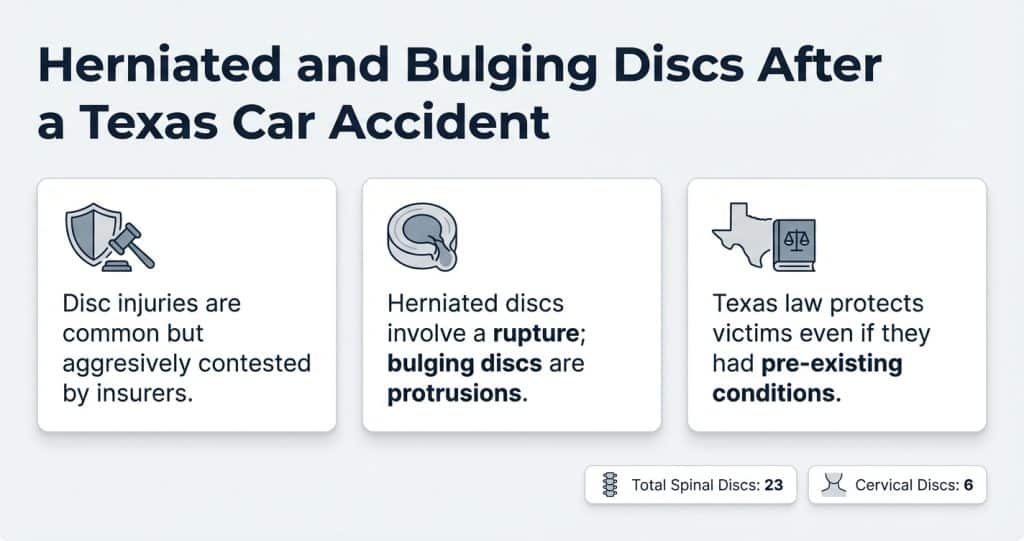
Disc injuries are among the most common serious injuries resulting from car accidents. They can cause debilitating pain that radiates from the spine into the arms or legs, limit your ability to work and enjoy daily activities, and require extensive treatment ranging from physical therapy to epidural injections to surgery. At their worst, disc injuries can cause permanent damage and lifelong limitations.
Disc injuries are also among the most aggressively contested injuries in personal injury claims. Insurance companies have developed sophisticated strategies to minimize disc injury claims. They may argue that:
-
Your disc problems were pre-existing conditions
-
MRI findings reflect normal aging
-
The forces involved in your accident could not have caused disc damage
Fighting back requires understanding what disc injuries really are, how car accidents cause them, how they are diagnosed and treated, and how to prove they deserve fair compensation under Texas law.
Understanding Spinal Disc Anatomy
To understand disc injuries and why they matter, it helps to understand how spinal discs function.
What Discs Are
Spinal discs are cushioning pads located between each vertebra in the spine. Each disc has two components:
-
Annulus fibrosus – a tough, fibrous outer layer made of concentric rings
-
Nucleus pulposus – a soft, gel-like center that absorbs shock
Together, these structures act as shock absorbers, allowing the spine to flex, bend, and twist while protecting the vertebrae.
Location in the Spine
The spine contains 23 intervertebral discs, distributed as follows:
-
Cervical spine (neck): 6 discs (C2–C7)
-
Thoracic spine (mid-back): 12 discs
-
Lumbar spine (lower back): 5 discs
Car accidents most commonly injure cervical and lumbar discs, where mobility is greatest and collision forces concentrate.
How Discs Function
Healthy discs:
-
Allow smooth movement between vertebrae
-
Distribute loads evenly across the spine
-
Prevent bone-on-bone contact
-
Protect the spinal cord and nerve roots
When discs are damaged, these functions are compromised, often resulting in pain and neurological symptoms.
Bulging Discs vs. Herniated Discs: Understanding the Difference
Although often used interchangeably, bulging discs and herniated discs are different conditions with different implications.
Bulging Disc
A bulging disc occurs when the disc extends beyond its normal boundary, similar to a hamburger patty extending past the bun. Key characteristics include:
-
The outer layer remains intact
-
No tear or rupture is present
-
May be caused by trauma or gradual degeneration
-
May or may not cause symptoms, depending on nerve compression
Herniated Disc
A herniated disc (also called a ruptured or slipped disc) involves:
-
A tear or rupture in the outer layer
-
Leakage of inner disc material
-
Compression of spinal nerves
Common symptoms include:
-
Radiating pain into arms or legs
-
Numbness or tingling
-
Muscle weakness
Herniations are generally considered more serious because the disc’s structural integrity has been compromised.
Overlapping Symptoms
Both conditions can cause:
-
Localized spine pain
-
Radiating nerve pain (radiculopathy)
-
Numbness or tingling
-
Muscle weakness
Symptom severity depends more on nerve compression than the specific disc diagnosis.
Why the Distinction Matters
Insurance companies often dismiss bulging discs as degenerative while treating herniations more seriously. In reality:
-
Both can be caused by trauma
-
Both can produce disabling symptoms
-
Both are compensable when caused by negligence
How Car Accidents Cause Disc Injuries
Car accidents generate forces that are particularly damaging to spinal discs.
Compression Forces
Collision forces compress the spine vertically, placing intense pressure on discs. This can:
-
Tear the outer disc layer
-
Cause weakened discs to rupture
Flexion and Extension Forces
Whiplash motions rapidly force the spine backward and forward, particularly in the neck. These movements can:
-
Stretch disc fibers
-
Tear the annulus fibrosus
-
Trigger herniation
Rotational Forces
Twisting during impact can shear disc fibers, especially where mobile and rigid spinal segments meet.
The Pre-Existing Condition Reality
Many people have disc degeneration without symptoms. An accident can convert a stable, asymptomatic disc into a painful, disabling injury.
Under Texas’s eggshell plaintiff doctrine, an at-fault driver is responsible for the full extent of injuries caused—even if the victim was more vulnerable due to pre-existing conditions.
Diagnosing Disc Injuries
Accurate diagnosis is critical for treatment and legal documentation.
Clinical Evaluation
Doctors assess symptoms and perform physical exams. Findings suggesting disc injury include:
-
Radiating pain along nerve pathways
-
Positive straight leg raise test (lumbar spine)
-
Positive Spurling test (cervical spine)
-
Sensory changes in specific nerve distributions
-
Muscle weakness
-
Diminished reflexes
MRI Imaging
MRI is the gold standard for diagnosing disc injuries. It can show:
-
Disc bulges and herniations
-
Nerve root compression
-
Spinal cord involvement
-
Migrated disc material
If symptoms suggest disc injury, MRI imaging is essential.
Other Diagnostic Tools
-
X-rays: show alignment and disc space narrowing
-
CT scans: detailed bone imaging
-
CT myelogram: evaluates nerve compression when MRI is unavailable
-
EMG and nerve conduction studies: objectively document nerve damage
Treatment Options for Disc Injuries
Treatment depends on severity and response to care.
Conservative Treatment
Initial treatment often includes:
-
Activity modification and rest
-
Physical therapy
-
Pain and anti-inflammatory medications
-
Muscle relaxants
-
Chiropractic care (when appropriate)
-
Epidural steroid injections
Surgical Treatment
If conservative care fails, surgery may be recommended, including:
-
Microdiscectomy
-
Laminectomy
-
Spinal fusion
-
Artificial disc replacement
Recovery Timeline
-
Conservative care: weeks to months
-
Surgical recovery: several months or longer
Careful documentation of symptoms, progress, and limitations is essential throughout recovery.
The Insurance Company Battle Over Disc Claims
Disc injury claims are routinely challenged.
Pre-Existing Condition Argument
Insurers search for prior complaints to claim your injury existed before the accident.
Your response should include:
-
Proof of normal function before the crash
-
Employment records
-
Testimony from family and coworkers
-
Medical records showing prior issues resolved
Aggravation of a pre-existing condition is fully compensable under Texas law.
Degenerative Disease Argument
Insurers claim MRI findings reflect normal aging.
Your response:
You were not symptomatic before the accident. The accident caused or significantly aggravated your condition.
Low-Impact Defense
Minimal vehicle damage is used to argue injuries were impossible.
Your response:
Medical research shows disc injuries can occur in low-speed collisions. Vehicle damage does not correlate reliably with injury severity.
Documenting Your Disc Injury Claim
Strong documentation is essential.
Medical Records Should Clearly Show:
-
Symptom onset after the accident
-
Objective exam findings
-
Diagnostic imaging results
-
Treatment history and response
-
Physician opinions on causation and prognosis
Establishing Pre-Accident Baseline
Use:
-
Prior medical records
-
Employment history
-
Witness statements
-
Activity and lifestyle evidence
Functional Limitations
Document:
-
Activities you can no longer perform
-
Work limitations
-
Daily assistance required
-
Lost hobbies or recreation
Expert Support
Strong cases often rely on:
-
Treating physicians
-
Independent medical experts
-
Medical illustrations
-
Biomechanical experts
Conclusion: Disc Injuries Deserve Fair Compensation
Herniated and bulging discs are serious injuries that can cause lasting pain, disability, and financial burden. When caused by negligence, they deserve full and fair compensation under Texas law.
Do not accept arguments that your injury is merely age-related or insignificant. Your spine affects every aspect of your life, and your claim should reflect that reality.
Insurance companies will fight hard to minimize your case. Proper medical care, thorough documentation, and experienced legal representation are critical to securing the compensation you deserve.
You didn’t ask for this injury. You deserve accountability and fair recovery.

About the Author
Chi Nguyen is a Houston personal injury attorney dedicated to helping accident victims understand their rights and receive fair compensation under Texas law. With extensive experience representing injured Texans, Attorney Nguyen combines legal expertise with a commitment to client education and empowerment.