
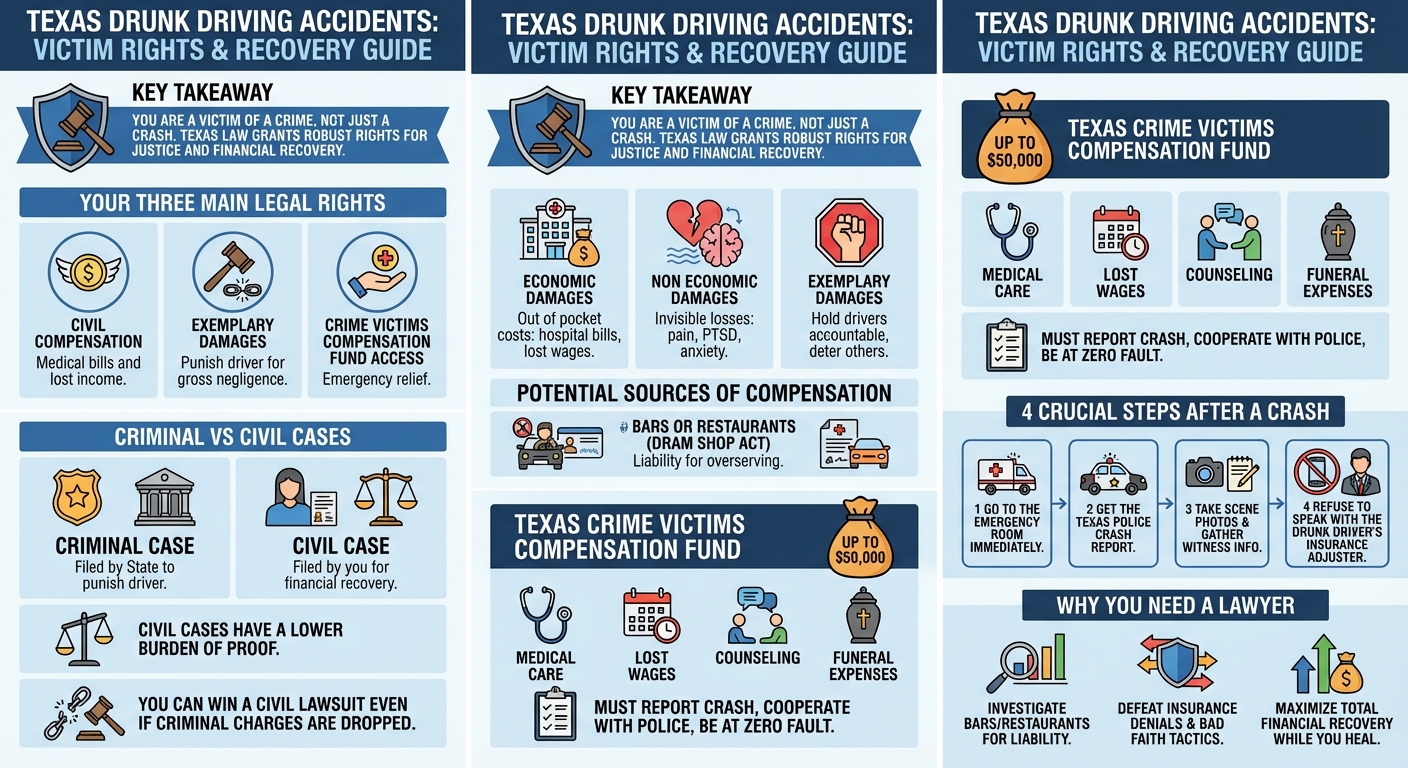
In Texas, drunk driving accident victims have the right to seek civil compensation for medical expenses, lost wages, and pain and suffering. Additionally, victims may pursue exemplary damages against the impaired driver and claim up to $50,000 from the state’s Crime Victims’ Compensation Fund.
What Are Your Legal Rights After a Drunk Driving Accident in Texas?
Being hit by a drunk driver is a traumatic experience that leaves victims dealing with severe injuries, mounting medical bills, and emotional distress. Under Texas law, you are not just a victim of a crash; you are a victim of a crime. This status grants you specific, robust legal rights designed to help you secure justice and financial recovery.
The Right to Pursue Civil Compensation
While the state handles the criminal prosecution of the intoxicated driver, you have the absolute right to file a civil personal injury claim. This allows you to seek financial compensation for the direct harm caused by the driver’s negligence, covering everything from hospital bills to lost income.
The Right to Seek Exemplary (Punitive) Damages
Because driving under the influence is considered gross negligence, Texas law allows drunk driving victims to pursue exemplary damages. Also known as punitive damages, these are not meant to compensate you for a specific loss, but rather to punish the drunk driver for their reckless behavior and deter others from making the same choice.
The Right to Access the Crime Victims’ Compensation Fund
Because a DWI crash is a violent crime, victims in Texas have the right to apply for financial assistance through the Texas Attorney General’s Crime Victims’ Compensation (CVC) Program. This fund provides a crucial safety net for victims facing immediate financial hardship.
Criminal vs. Civil Cases: Understanding the Difference
After a drunk driving accident, two separate legal proceedings usually take place. It is vital to understand how they differ and how they impact your recovery.
| Feature | Criminal Case | Civil Case |
|---|---|---|
| Purpose | To punish the driver for breaking Texas DWI laws. | To financially compensate the victim for their losses. |
| Who Files It? | The State of Texas (District Attorney). | The victim (usually through a personal injury lawyer). |
| Burden of Proof | Beyond a reasonable doubt. | Preponderance of the evidence (more likely than not). |
| Potential Outcome | Jail time, fines, license suspension. | Financial settlement or jury award for damages. |
The Criminal Case: Punishing the Drunk Driver
The criminal case focuses entirely on the state penalizing the driver. While the prosecutor may ask the judge to order criminal restitution, this rarely covers the full extent of a victim’s long-term medical needs or pain and suffering.
The Civil Case: Compensating the Victim
Your civil case is entirely separate from the criminal proceedings. It is your opportunity to demand full financial recovery from the driver’s insurance company or personal assets.
Why You Can Win a Civil Case Even if Criminal Charges Are Dropped
Because the burden of proof in a civil case (“preponderance of the evidence”) is much lower than in a criminal case (“beyond a reasonable doubt”), you can still win your civil lawsuit even if the drunk driver’s criminal charges are reduced, dismissed, or result in an acquittal.
Types of Compensation Available to Texas DWI Victims
Victims of impaired drivers often face catastrophic injuries. Texas law allows you to recover multiple types of damages to make you “whole” again.
Economic Damages: Medical Bills and Lost Wages
Economic damages reimburse you for out-of-pocket expenses. These include:
- Current and future medical expenses (surgeries, ER visits, physical therapy)
- Lost wages from time missed at work
- Loss of future earning capacity if you are permanently disabled
- Property damage to your vehicle
Non-Economic Damages: Pain, Suffering, and Mental Anguish
Non-economic damages compensate you for the invisible, subjective losses caused by the crash, such as:
- Physical pain and suffering
- Mental anguish, PTSD, and anxiety
- Loss of enjoyment of life
- Physical impairment or disfigurement
Exemplary Damages: Holding Drivers Accountable for Gross Negligence
As mentioned, exemplary damages are uniquely applicable in DWI cases. Juries frequently award these damages to send a strong message that drunk driving will not be tolerated in Texas communities.
Who Can Be Held Liable for a Drunk Driving Crash in Texas?
While the drunk driver is the primary at-fault party, Texas law allows victims to look beyond the driver to find other sources of liability and compensation.
The Impaired Driver and Their Insurance
The most direct route to compensation is filing a claim against the drunk driver’s auto insurance policy. However, drunk drivers often carry minimum limits that cannot fully cover severe injuries.
The Texas Dram Shop Act: Holding Bars and Restaurants Accountable
Under the Texas Dram Shop Act, a bar, restaurant, or liquor store can be held liable for your injuries if they sold alcohol to an obviously intoxicated person who presented a clear danger to themselves and others. Investigating where the driver was drinking before the crash is a critical part of maximizing your recovery. For the statutory test, the trained server defense, and the evidence that disappears first, see our full guide to Texas dram shop law.
Uninsured/Underinsured Motorist (UM/UIM) Coverage
If the drunk driver is uninsured or lacks enough coverage to pay for your damages, you can turn to your own Uninsured/Underinsured Motorist (UM/UIM) policy. This coverage steps in to bridge the financial gap without raising your insurance premiums.
The Texas Crime Victims’ Compensation Program
The Crime Victims’ Compensation (CVC) Program is a state fund that reimburses victims of violent crimes, including DWI crashes, for certain out-of-pocket expenses.
Eligibility Requirements for Drunk Driving Victims
To qualify, you must have been injured in a Texas DWI crash through no fault of your own, report the crime to law enforcement within a reasonable timeframe, and cooperate fully with the police and prosecutors.
What the Fund Covers (Up to $50,000)
The CVC fund can provide up to $50,000 to cover specific costs, including:
- Medical, hospital, and physical therapy expenses
- Loss of wages due to physical injuries
- Psychiatric care or counseling
- Funeral and burial expenses (in the event of a wrongful death)
How to Apply for Compensation
Applications must be submitted to the Texas Attorney General’s office. Because the process requires extensive documentation, many victims rely on their personal injury attorney to file the CVC application on their behalf while simultaneously pursuing a civil lawsuit.
Crucial Steps to Protect Your Rights After a DWI Crash
The actions you take immediately following a collision with an impaired driver can significantly impact the success of your civil claim.
Seek Immediate Medical Attention (Why You Should Never Skip the ER)
Your health is the top priority. Going to the emergency room immediately establishes a direct medical link between the crash and your injuries, preventing insurance companies from arguing that you were hurt elsewhere.
Obtain the Texas Peace Officer’s Crash Report
In a DWI case, the police report is a goldmine of evidence. It will contain the officer’s observations of the driver’s intoxication, field sobriety test results, and details of any arrests made at the scene.
Document the Scene and Gather Witness Info
If you are physically able, take photos of the vehicles, skid marks, and the surrounding area. Collect contact information from witnesses who may have seen the driver swerving before the crash or acting intoxicated afterward.
Avoid Speaking to the Drunk Driver’s Insurance Adjuster
Insurance adjusters are trained to minimize payouts. They may try to get you to provide a recorded statement or accept a lowball settlement before you understand the full extent of your injuries. Always route these communications through your attorney.
Why You Need a Texas Drunk Driving Accident Lawyer
DWI accident claims are far more complex than standard car accident cases. Having experienced legal representation ensures your rights are protected at every turn.
Investigating Dram Shop Liability
A skilled lawyer will subpoena credit card receipts, bar tabs, and surveillance footage to determine if a commercial establishment overserved the drunk driver, opening up an additional avenue for compensation.
Fighting Insurance Company Denials
Insurance companies sometimes try to deny coverage by claiming the drunk driver’s actions were “intentional” rather than “accidental.” An attorney knows how to defeat these bad-faith tactics and force the insurer to pay.
Maximizing Your Total Financial Recovery
From coordinating with the district attorney’s office to securing CVC funds and fighting for maximum exemplary damages in civil court, a dedicated Texas drunk driving accident lawyer will handle the legal heavy lifting so you can focus entirely on your physical and emotional recovery.
 Call (713) 747-7777