

Table of contents
Understanding Benign Mesothelioma: A Comprehensive Guide
Mesothelial tumors develop in the mesothelium, the thin layer of tissue that protects your internal organs. While most people associate these tumors with aggressive cancer, benign variants do exist.
The critical difference between benign and malignant growths lies in their behavior. Benign tumors are non-cancerous, localized, and do not spread (metastasize) to other parts of the body. Malignant tumors are aggressive, invasive, and potentially fatal.
This guide covers everything you need to know about benign mesothelioma, including how it differs from cancer, its various subtypes, diagnostic procedures, and what to expect during treatment.
What is a benign mesothelioma?
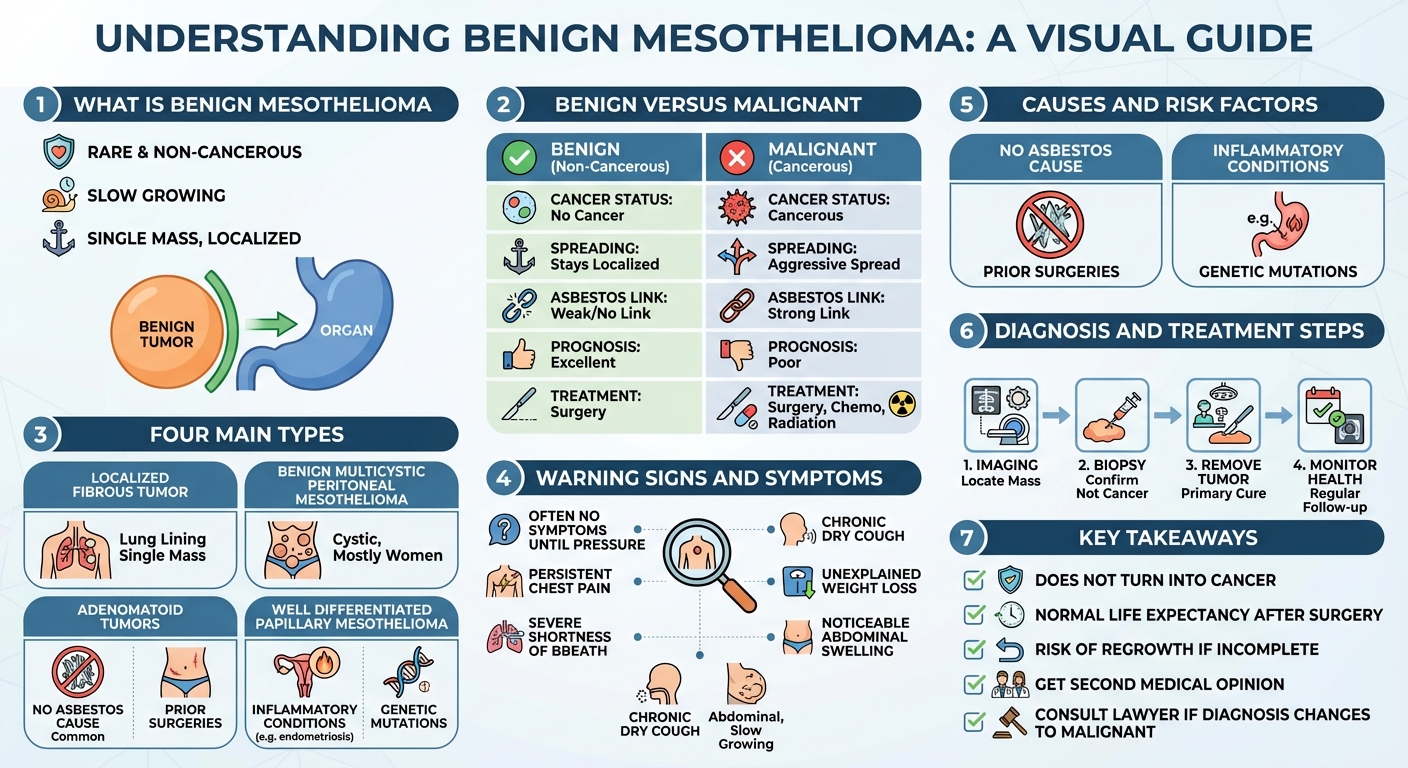
Benign mesothelioma is a rare, non-cancerous tumor originating in the mesothelial cells that line internal organs, most commonly the lungs or abdomen. Unlike its malignant counterpart, a benign mesothelioma grows slowly, typically forms a single localized mass, and does not spread to distant areas of the body.
These tumors generally grow at a very slow rate. Because they do not invade surrounding tissues, they push against organs as they expand rather than destroying them. They are most frequently found in the pleura (lung lining), the peritoneum (abdominal lining), and occasionally in the reproductive organs.
Benign vs. Malignant Mesothelioma: Key Differences
Understanding the distinction between benign and malignant mesothelioma is crucial for patients navigating a new diagnosis.
- Growth rate and metastasis: Benign tumors grow slowly and remain in one place. Malignant mesothelioma grows rapidly and spreads aggressively to nearby lymph nodes and distant organs.
- Connection to asbestos exposure: Malignant mesothelioma is heavily linked to asbestos exposure. In contrast, the connection between asbestos and benign mesothelioma is weak or entirely non-existent.
- Treatment approaches: Benign tumors are usually cured through surgical removal. Malignant cases require aggressive, multimodal treatments like chemotherapy, radiation, and complex surgeries.
| Feature | Benign Mesothelioma | Malignant Mesothelioma |
|---|---|---|
| Cancerous? | No | Yes |
| Spreads? | No (Localized) | Yes (Metastasizes) |
| Asbestos Link | Weak / None | Very Strong |
| Prognosis | Excellent | Poor |
Can benign mesothelioma become malignant?
Generally, true benign mesothelioma does not become malignant or turn into cancer. However, because these tumors are incredibly rare and complex, initial misdiagnoses can occur. While a benign tumor will not mutate into a malignant one, it can recur after surgery, making continuous medical monitoring essential.
Even though the tumor is non-cancerous, there is a risk of tumor recurrence after surgical removal. If a surgeon cannot remove the entire mass, the remaining cells may slowly grow back over time.
Because of this recurrence risk, doctors strongly recommend continuous medical monitoring. Routine imaging scans ensure that any regrowth is caught early before it can press against vital organs and cause complications.
Types of Benign Mesothelial Tumors
The term “benign mesothelioma” is often used as an umbrella term for several distinct non-cancerous growths.
Localized Fibrous Tumor of the Pleura
Historically misnamed as benign mesothelioma, this is a rare tumor that forms in the pleura. It usually grows as a single, solid mass. While mostly benign, a small percentage of these tumors can exhibit malignant behavior, requiring careful pathological review.
Benign Multicystic Peritoneal Mesothelioma (BMPM)
BMPM is a rare cystic tumor arising from the peritoneum (abdominal lining). It predominantly affects women of reproductive age and is often associated with a history of abdominal surgery, endometriosis, or pelvic inflammation. It has a high recurrence rate but does not spread.
Adenomatoid Tumors
These are the most common type of benign mesothelial tumors, typically found in the male and female reproductive tracts (such as the epididymis or uterus). They are small, harmless, and easily removed with surgery.
Well-Differentiated Papillary Mesothelioma (WDPM)
WDPM is a rare, slow-growing tumor that usually develops in the peritoneum but can also appear in the pleura or tunica vaginalis. It is generally considered benign, though some medical professionals classify it as a tumor of uncertain malignant potential.
What are 5 signs and symptoms of mesothelioma?
Five common signs and symptoms of mesothelioma include persistent chest pain, severe shortness of breath, a chronic dry cough, unexplained weight loss, and noticeable abdominal swelling. While malignant tumors cause severe symptoms rapidly, benign mesothelioma may remain asymptomatic until the tumor grows large enough.
Benign tumor symptoms differ significantly from malignant ones. Malignant mesothelioma causes systemic issues like fatigue, fever, and rapid weight loss. Benign tumors usually only cause localized discomfort when the mass physically presses against the lungs, stomach, or other internal structures.
You should seek immediate medical attention if you experience sudden difficulty breathing, sharp chest pain, or a rapidly expanding abdomen, as these can be signs of severe fluid buildup or a growing mass.
Causes and Risk Factors
The exact cause of benign mesothelial tumors remains largely unknown, but researchers have identified several potential risk factors.
Does asbestos cause benign mesothelioma?
The medical consensus is that asbestos exposure is not a primary cause of benign mesothelioma. While asbestos is the definitive cause of malignant mesothelioma, patients with benign tumors rarely have a history of asbestos exposure. The two conditions share a name due to the cells they originate from, not their underlying cause.
Other Potential Triggers
Risk factors for benign variants depend heavily on the subtype:
- Prior abdominal surgeries: Strongly linked to BMPM due to scar tissue and inflammation.
- Inflammatory conditions: Endometriosis and pelvic inflammatory disease increase the risk of certain benign abdominal tumors.
- Genetics: Some localized fibrous tumors are associated with specific genetic mutations, though they are not typically inherited.
Diagnosis and Treatment Options
Accurate diagnosis is the most critical step in managing a mesothelial tumor.
Diagnostic Imaging
Doctors typically begin with X-rays, CT scans, or MRIs to locate the tumor, determine its size, and see if it has invaded surrounding tissues. Benign tumors usually appear as well-defined, solitary masses.
The Importance of a Biopsy
Imaging alone cannot confirm if a tumor is benign or malignant. A biopsy—extracting a tissue sample for laboratory analysis—is absolutely necessary to rule out malignancy. Pathologists examine the cells under a microscope to confirm the exact tumor type.
Surgical Resection
Surgical resection is the primary and most effective treatment for benign mesothelioma. Because these tumors do not spread, completely removing the mass usually cures the patient. Chemotherapy and radiation are not required for true benign tumors.
What is the life expectancy of a person with mesothelioma?
The life expectancy of a person with mesothelioma depends heavily on whether the tumor is benign or malignant. Patients with benign mesothelioma generally have a normal life expectancy after successful surgical removal. In contrast, patients with malignant mesothelioma typically face a much shorter life expectancy, averaging 12 to 21 months.
Factors influencing recovery include the patient’s overall health, the size and location of the tumor, and whether the surgeon was able to remove the mass entirely with clear margins.
Follow-up care is critical. Even with a normal life expectancy, patients must attend regular check-ups to monitor for potential tumor recurrence, especially with subtypes like BMPM.
Next Steps: Medical Care and Legal Considerations
Receiving a diagnosis of any mesothelial tumor is overwhelming. Taking the right next steps protects both your health and your legal rights.
Why a Second Opinion is Crucial
Because benign mesothelioma is exceptionally rare, it is frequently misdiagnosed. Seeking a second opinion from a specialized cancer center ensures that a malignant tumor is not mistakenly classified as benign, which would dangerously delay life-saving treatment.
What to Do If Your Diagnosis Changes
If a second opinion or subsequent biopsy reveals that your tumor is actually malignant, your treatment plan will change drastically. You will need to explore aggressive therapies and investigate how you were exposed to asbestos.
Legal Options for Asbestos Exposure
If your diagnosis changes from benign to malignant, you may be entitled to financial recovery. Understanding your rights is essential. We encourage you to consult with a mesothelioma lawyer in Houston, Texas to explore your options. You can also review our guide on mesothelioma compensation to learn more about what you may receive to help cover medical bills and secure your family’s future.