
Table of contents
Here’s something that shocks most of my clients: sometimes the insurance company that treats you worst isn’t the other driver’s insurer. It’s your own.
After years of paying premiums, you expect your insurance company to be on your side when you need them. You’ve held up your end of the bargain—making payments month after month, year after year. When you finally have a claim, you expect them to hold up theirs.
But I’ve seen firsthand how insurers can turn on their own policyholders—delaying claims, denying benefits, and forcing people to fight for coverage they’ve already paid for.
What Is “Bad Faith” and Why Does It Matter?
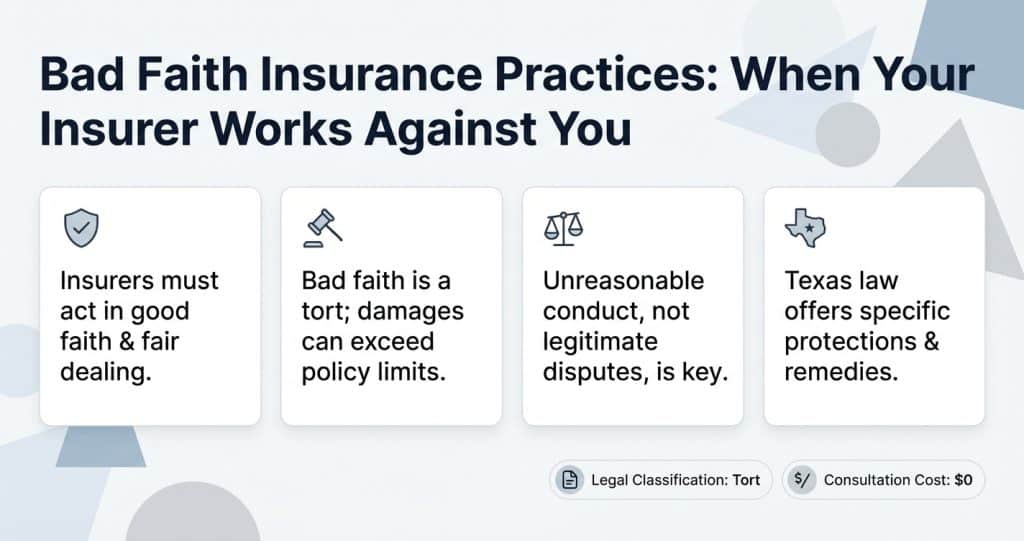
Every insurance policy contains an implied promise: the company will deal with you fairly and honestly. This isn’t just good business practice—it’s a legal obligation called the “implied covenant of good faith and fair dealing.”
When an insurance company breaks that promise—when they unreasonably deny or delay your legitimate claim—that’s bad faith.
Bad faith isn’t just making a mistake. Insurance companies can legitimately dispute claims they have reasonable questions about. They can investigate, ask for documentation, and even deny claims they genuinely believe aren’t covered.
But when they deny claims without proper investigation, ignore evidence that supports coverage, delay payment without justification, or use deceptive tactics to avoid paying what they owe—they’ve crossed a line.
The distinction matters because the legal consequences are different. A legitimate dispute over coverage results in a breach of contract—if you win, you get your policy benefits. But bad faith is a tort, meaning you can potentially recover additional damages beyond just the policy limits, including attorney fees, consequential damages, and sometimes punitive damages.
Warning Signs of Bad Faith
Through my practice, I’ve learned to recognize the patterns that suggest bad faith:
- Unreasonable delays without explanation. Your claim sits for months with no progress. Phone calls go unreturned. Requests for documentation seem endless—and when you provide what they asked for, they ask for something else.
- In legitimate claims handling, there should be steady progress. Investigations have timelines. Decisions get made. If your claim is just sitting there with no movement and no explanation, something is wrong.
- Denial without investigation. The insurance company rejects your claim without gathering the facts that would support it. They don’t interview witnesses. They don’t review all the medical records. They don’t consult experts when expertise is needed.
- Insurance companies are supposed to conduct prompt, thorough, and objective investigations before denying claims. A denial that comes too quickly, or that ignores obvious evidence, is a red flag.
- Moving goalposts. Every time you provide what they asked for, they ask for something else. The claim never seems to move forward. This “nickel and diming” approach is designed to wear you down until you give up.
- Misrepresenting policy terms. They tell you something isn’t covered when it actually is, or they add requirements that don’t exist in your policy. Sometimes they quote policy language that doesn’t even appear in the actual document.
- Lowball offers paired with release demands. They offer a fraction of what your claim is worth while requiring you to sign away all future claims. This forces you to choose between accepting an inadequate payment and getting nothing at all.
- Threatening language. Some adjusters will imply that pursuing your claim will lead to negative consequences—your premiums will increase, you’ll be dropped, you’ll be investigated for fraud. This kind of intimidation is inappropriate and potentially illegal.
- Using your desperation against you. If the insurance company knows you’re in financial distress because of the very event they should be covering, and they use that desperation to extract a lower settlement, that’s bad faith.
- Tactics I’ve Seen Insurance Companies Use Against Their Own Policyholders
Let me share some specific tactics I’ve encountered:
- The vanishing adjuster. Your claim gets reassigned repeatedly, each new adjuster needing to “get up to speed.” This musical chairs approach serves to delay resolution and frustrate claimants. Some companies do this intentionally and systematically.
- The fabricated coverage dispute. The company creates a coverage question where none legitimately exists, then uses that “dispute” as justification for not paying. They might misread the policy, ignore clear language, or invent requirements that aren’t there.
- The biased investigation. Instead of investigating objectively, they only look for evidence that supports denial. They hire “experts” known for producing insurance-friendly opinions. They ignore or discount evidence that supports the claim.
- The cooperation trap. They demand cooperation with investigation, then claim the policyholder failed to cooperate in some technical way—even when the policyholder did everything reasonable. They use this alleged failure to justify denial.
- The soft denial. They don’t explicitly deny coverage but instead send vague letters implying there might not be coverage, then do nothing. The claim just sits there, neither approved nor denied, while time passes.
- The rescission threat. They threaten to cancel the policy retroactively based on alleged misrepresentations in the application—often minor or irrelevant issues—as leverage to reduce what they pay on a claim.
Your Rights as a Policyholder
You have a contractual right to the benefits you paid for. You have a legal right to be treated fairly. And in Texas, when insurers act in bad faith, policyholders have remedies.
Under Texas law, you may be able to recover:
The policy benefits you were wrongfully denied. Consequential damages caused by the denial (like additional expenses you incurred). Attorney fees spent pursuing your rightful benefits. Court costs. In egregious cases, punitive damages designed to punish particularly bad conduct.
These potential remedies give policyholders leverage. Insurance companies know that bad faith practices, if proven, can cost them far more than simply paying the claim would have.
Documenting Bad Faith
If you believe your insurance company is acting in bad faith, documentation is critical:
- Keep records of every communication. Save emails and letters. Take notes during phone calls, including the date, time, who you spoke with, and what was said. Note when calls go unreturned.
- Track the timeline. When did you submit your claim? When did they acknowledge it? What have they requested, and when? What have they done in response to your submissions? A clear timeline can reveal unreasonable delays.
- Get things in writing. Whenever possible, communicate in writing so you have a record. If an adjuster makes a promise or representation over the phone, send a follow-up email confirming what was said.
- Gather evidence of your compliance. If they claim you failed to cooperate or provide documentation, you want proof that you did everything they asked.
- Document your damages. If the delay or denial is causing you additional harm—financial hardship, additional expenses, lost opportunities—keep records of that harm.
What To Do If You Suspect Bad Faith
If you believe your insurance company is treating you unfairly:
- Keep paying your premiums. Don’t give them an excuse to cancel your policy for nonpayment. Continue holding up your end of the contract even as you dispute their conduct.
- Put your complaints in writing. Send a letter outlining your concerns about how your claim has been handled. This creates a record and sometimes prompts action.
- Request a supervisor. If the adjuster isn’t being responsive, escalate. Ask to speak with their supervisor or the claims manager.
- File a complaint with the Texas Department of Insurance. This regulatory body oversees insurance companies in Texas and can intervene in bad faith situations.
- Consult with an attorney. An experienced attorney can evaluate whether you have a bad faith claim and what remedies might be available. Many bad faith situations are resolved once an attorney gets involved, because insurance companies know the potential exposure.
When Insurance Companies Fight Fair
I want to be clear: not every claim denial is bad faith. Not every delay is improper. Insurance companies do have legitimate reasons to investigate claims, ask questions, and sometimes deny coverage.
A denial isn’t bad faith just because you disagree with it. If the insurance company conducted a reasonable investigation, applied the policy language fairly, and reached a conclusion that’s at least arguably supported by the facts—even if you think they’re wrong—that’s probably not bad faith.
The difference is in the reasonableness and good faith of their conduct. Did they try to find coverage or try to avoid it? Did they investigate thoroughly or look only for reasons to deny? Did they treat you as a policyholder they have obligations to, or as an adversary to be defeated?
The Bottom Line
You pay insurance premiums for protection. When you need that protection, your insurance company is supposed to be on your side. When they’re not—when they delay, deny, and deceive—you have rights.
Don’t assume that because they’re a big company and you’re just one policyholder, you have no recourse. Bad faith laws exist precisely to protect policyholders from insurance company misconduct.
If your own insurance company is stonewalling your claim, you don’t have to accept it. Document everything, escalate appropriately, and consider getting help. What they’re doing may not just be frustrating—it may be illegal.

About the Author
Chi Nguyen is a Houston personal injury attorney dedicated to helping accident victims understand their rights and receive fair compensation under Texas law. With extensive experience representing injured Texans, Attorney Nguyen combines legal expertise with a commitment to client education and empowerment.