

Table of contents
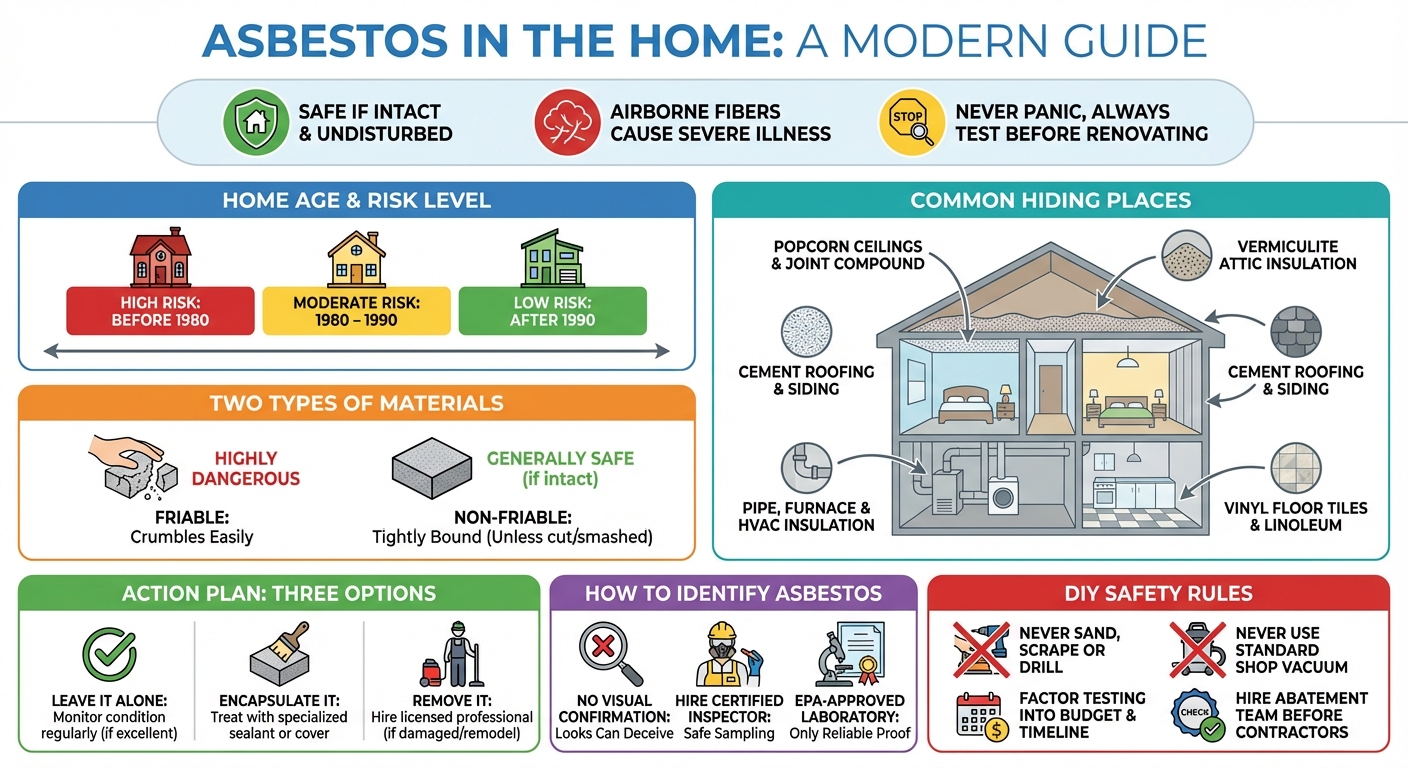
Asbestos in houses is generally safe if the materials are in good condition and left undisturbed. However, if you are planning renovations or notice damaged materials like peeling floor tiles, crumbling pipe insulation, or cracking popcorn ceilings, you should hire a certified professional to test and safely remove the asbestos.
Understanding Asbestos in Residential Properties
Asbestos is a naturally occurring mineral that was once celebrated in the construction industry for its exceptional heat resistance, tensile strength, and insulating properties. For decades, it was woven into the fabric of American homebuilding. Today, discovering asbestos in houses is a common concern for homeowners and buyers alike.
However, the mere presence of asbestos is not necessarily a cause for panic. According to the EPA, asbestos materials that are intact and in good condition do not pose an immediate health hazard. The true danger lies in airborne asbestos fibers, which can cause severe respiratory illnesses, including mesothelioma and asbestosis, when inhaled over time.
What houses are more likely to have asbestos?
Houses built before 1980 are highly likely to contain asbestos, as it was widely used in construction materials for its fire resistance and durability. Homes built between 1980 and 1990 have a moderate risk, while newer construction built after 1990 rarely contains asbestos materials.
High Risk: Homes Built Before 1980
If your home was constructed before the EPA began heavily regulating asbestos in the late 1970s, you should assume it contains some asbestos. During this era, asbestos was a standard ingredient in everything from insulation to flooring adhesives.
Moderate Risk: Homes Built Between 1980 and 1990
While the use of asbestos declined sharply after 1980, existing inventories of asbestos-containing products were still legally sold and installed throughout the decade. Therefore, homes built or remodeled during the 1980s still carry a moderate risk of containing the mineral.
Low Risk: Newer Construction
Homes built after 1990 are generally considered low risk. While a few specific products (like certain roofing materials) legally contained trace amounts of asbestos for a longer period, modern residential construction is largely asbestos-free.
Common Places Asbestos is Found in Homes
Because of its versatility, asbestos was mixed into thousands of different building materials. Here are the most common places it hides in older homes:
Vinyl Floor Tiles and Linoleum Backing
Older 9×9 inch vinyl floor tiles are notorious for containing asbestos. Additionally, the mastic (adhesive) used to glue these tiles down, as well as the paper backing on older sheet linoleum, frequently contain asbestos fibers.
Popcorn Ceilings and Drywall Joint Compound
Textured acoustic ceilings, commonly known as “popcorn ceilings,” applied before the mid-1980s often contain asbestos. It was also routinely mixed into drywall joint compound (mud) to make it easier to spread and more fire-resistant.
Vermiculite Attic Insulation
Vermiculite is a pebble-like, lightweight insulation material. While vermiculite itself is not asbestos, the majority of vermiculite used in US homes came from a mine in Libby, Montana, which was heavily contaminated with naturally occurring asbestos.
Cement Roofing Shingles and Exterior Siding
Asbestos-cement siding (often resembling rigid, brittle wood shingles) and roofing materials were incredibly popular for their durability and fireproofing. These materials are generally safe unless they are cracked, broken, or aggressively power-washed.
Pipe, Furnace, and HVAC Insulation
Older homes with steam radiators or gravity furnaces often feature asbestos insulation. This typically looks like corrugated paper or a thick, white, plaster-like wrap surrounding pipes and ductwork.
How do I know if there’s asbestos in my house?
You cannot definitively identify asbestos just by looking at it. The only way to know if there is asbestos in your house is to hire a certified asbestos inspector to take physical samples of the suspected materials and have them analyzed in an EPA-approved laboratory.
Visual Clues vs. Laboratory Testing
While certain visual clues—like 9×9 floor tiles or white, corrugated pipe wrap—can raise suspicions, they are not proof. Many non-asbestos materials look identical to asbestos-containing ones. Only polarized light microscopy (PLM) or transmission electron microscopy (TEM) performed by a lab can confirm its presence.
Hiring a Certified Asbestos Inspector
If you suspect asbestos, hire a licensed professional. A certified inspector will safely extract small samples without contaminating your home. They will also provide a detailed report outlining the location, condition, and recommended action plan for any asbestos found.
Can you still live in a house that has asbestos?
Yes, you can safely live in a house that has asbestos. As long as the asbestos-containing materials are in good condition and left undisturbed, they do not pose a health risk. The danger only arises when the material is damaged, releasing toxic fibers into the air.
The Difference Between Friable and Non-Friable Asbestos
- Friable Asbestos: Materials that can be easily crumbled or reduced to powder by hand pressure (e.g., old pipe insulation, popcorn ceilings). These are highly dangerous because they release fibers easily.
- Non-Friable Asbestos: Materials where the asbestos is tightly bound within a solid matrix (e.g., vinyl floor tiles, cement siding). These are generally safe unless cut, sanded, or smashed.
Everyday Living vs. Active Renovations
Walking on intact asbestos floor tiles or sleeping under an undisturbed popcorn ceiling is safe. However, the risk changes dramatically if you decide to remodel. Tearing up floors, knocking down walls, or scraping ceilings can instantly turn a safe environment into a hazardous one.
What happens if asbestos is found in my house?
If asbestos is found in your house, you generally have three options: leave it undisturbed if it is in good condition, encapsulate it with a specialized sealant to prevent fiber release, or hire a licensed abatement professional to safely remove and dispose of the hazardous material.
Option 1: Leave It Undisturbed (Management in Place)
If the material is in excellent condition, the EPA recommends leaving it alone. You can monitor it periodically for signs of wear, water damage, or degradation.
Option 2: Encapsulation or Sealing
Encapsulation involves treating the material with a specialized sealant that binds the asbestos fibers together. Alternatively, you can enclose it—for example, by installing new flooring directly over intact asbestos vinyl tiles, effectively trapping the hazard.
Option 3: Professional Asbestos Removal (Abatement)
If the material is damaged, friable, or in the way of a planned renovation, it must be removed. This should only be done by a licensed asbestos abatement contractor who will use negative air pressure machines, specialized HEPA vacuums, and proper protective gear to safely extract and dispose of the material.
Safety Tips for Homeowners and DIY Renovators
If you own an older home, you must approach DIY projects with caution to avoid accidental exposure.
Activities to Avoid (Sanding, Scraping, Drilling)
Never perform the following actions on suspected asbestos materials:
- Do not sand, scrape, or drill into floor tiles, siding, or textured ceilings.
- Do not use a standard shop vacuum to clean up debris in an older home, as it will blow microscopic asbestos fibers right back into the air.
- Do not track dust from a remodeling zone into the rest of the house.
Planning a Safe Remodel in an Older Home
Before swinging a sledgehammer, factor asbestos testing into your renovation budget and timeline. If testing comes back positive, hire an abatement team to clear the area before your general contractors begin their work. Treating asbestos with respect and caution is the best way to keep your home safe for years to come.