
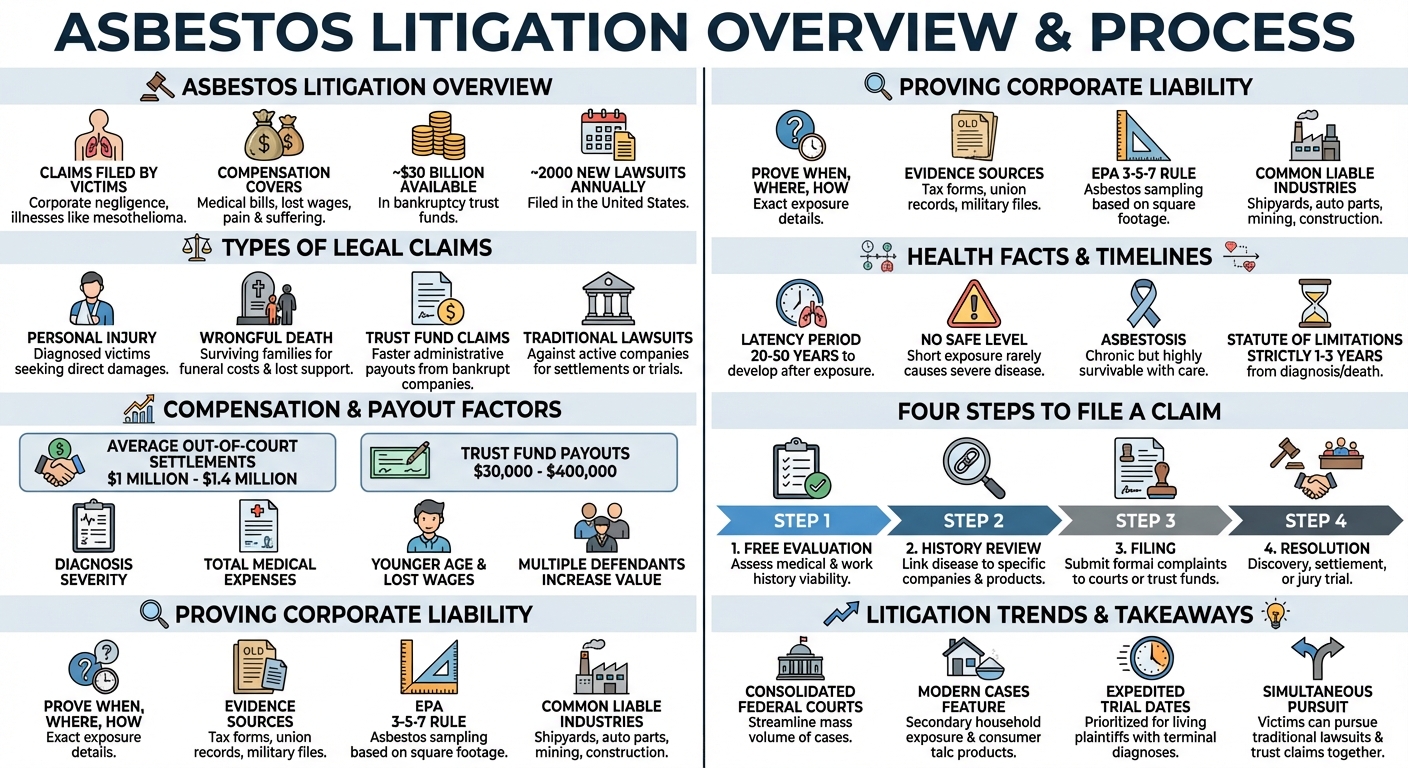
Asbestos cases are legal claims filed by individuals who developed illnesses like mesothelioma or asbestosis due to corporate negligence. Victims can seek compensation through personal injury lawsuits, wrongful death claims, or asbestos bankruptcy trust funds to cover medical bills, lost wages, and pain and suffering.
Understanding Asbestos Cases and Litigation Trends
Asbestos cases represent one of the longest-running and most complex areas of mass tort litigation in United States history. For decades, workers and consumers were exposed to toxic asbestos fibers, leading to severe illnesses like mesothelioma, lung cancer, and asbestosis. Today, victims and their families continue to seek justice and compensation from the corporations that failed to warn them of these deadly risks.
The History of Asbestos Lawsuits (MDL 875)
The surge of asbestos litigation began in the 1970s when the medical community definitively linked asbestos exposure to mesothelioma. To handle the overwhelming volume of federal cases, the courts established Multidistrict Litigation 875 (MDL 875) in the Eastern District of Pennsylvania. This consolidation streamlined pretrial proceedings for hundreds of thousands of personal injury and wrongful death claims, setting the legal groundwork for how modern asbestos cases are litigated.
How Asbestos Bankruptcy Trusts Work
Faced with mounting legal liabilities, dozens of major asbestos manufacturers filed for Chapter 11 bankruptcy. However, the courts required these companies to establish asbestos bankruptcy trust funds to compensate current and future victims. Today, there is an estimated $30 billion available across various active trusts. Claimants can seek compensation directly from these trusts without having to go through a lengthy trial.
Recent Trends in Asbestos Litigation (2024-2025)
Recent data indicates that nearly 2,000 new mesothelioma lawsuits are filed annually in the U.S. Current trends show a shift toward secondary exposure cases—where family members were exposed to asbestos fibers brought home on a worker’s clothing—and claims involving contaminated consumer products, such as talcum powder. Courts are also prioritizing expedited trial dates for living plaintiffs with terminal diagnoses.
Types of Asbestos Lawsuits and Claims
Choosing the right legal avenue depends on the victim’s diagnosis, exposure history, and whether the responsible companies are still in business.
Personal Injury Claims for Mesothelioma
If you have been diagnosed with an asbestos-related disease, you can file a personal injury lawsuit against the manufacturers, distributors, or employers responsible for your exposure. These cases seek damages for medical expenses, lost income, and physical pain and suffering.
Wrongful Death Claims for Surviving Family
When a victim passes away from an asbestos-related illness, their surviving family members or estate representatives can file a wrongful death lawsuit. This type of claim helps families recover costs related to funeral expenses, outstanding medical bills, and the loss of financial and emotional support.
Asbestos Trust Fund Claims vs. Traditional Lawsuits
Trust fund claims are filed against bankrupt companies and generally offer a faster, administrative path to compensation based on a scheduled payment grid. Traditional lawsuits are filed against solvent (currently operating) companies and may go to trial or end in a negotiated settlement. Many victims pursue both avenues simultaneously to maximize their financial recovery.
Asbestos Settlements and Compensation
Securing fair compensation is the primary goal of any asbestos case, providing crucial financial stability for victims undergoing expensive medical treatments.
How much are asbestos claims worth?
The average asbestos claim is worth between $1 million and $1.4 million if settled out of court, while trust fund payouts typically range from $30,000 to $400,000. Trial verdicts can yield significantly higher amounts, sometimes reaching tens of millions, depending on the severity of the illness and documented exposure.
Factors Influencing Your Settlement Amount
- Diagnosis Severity: Mesothelioma and lung cancer cases generally yield higher settlements than non-malignant conditions like pleural plaques.
- Medical Expenses: The total cost of surgeries, chemotherapy, and ongoing care.
- Age and Lost Wages: Younger plaintiffs who lose decades of earning potential often receive larger awards.
- Number of Defendants: Cases involving multiple liable companies often result in higher cumulative compensation.
Largest Asbestos Lawsuit Settlements in the US
Jury verdicts and high-profile settlements have occasionally reached staggering figures to punish gross corporate negligence. Notable examples include a $250 million verdict for an Indiana steel mill worker and a $190 million award for New York naval shipyard workers. While these are exceptional cases, they highlight the legal system’s willingness to hold negligent corporations accountable.
Proving Exposure and Corporate Liability
The success of an asbestos case hinges on proving exactly when, where, and how the plaintiff was exposed to asbestos, and linking that exposure to specific corporate entities.
What is the 3 5 7 rule for asbestos sampling?
The 3-5-7 rule is an EPA guideline for sampling suspected asbestos-containing surfacing materials. Inspectors must take at least three samples from areas under 1,000 square feet, five samples for areas between 1,000 and 5,000 square feet, and seven samples for areas larger than 5,000 square feet to ensure accurate testing.
Gathering Employment, Union, and Military Records
Because asbestos illnesses take 20 to 50 years to develop, documenting historical exposure is critical. Attorneys work with investigators to gather old W-2s, union dispatch records, military service records, and coworker testimonies to build a timeline of exposure. This evidence is crucial for identifying which asbestos products were present at specific job sites.
List of Common Companies Sued in Asbestos Cases
Thousands of companies have faced asbestos litigation. Some of the most frequently sued industries and entities include:
- Shipyards and maritime companies
- Automotive parts manufacturers (brakes and clutches)
- Construction material suppliers (insulation, drywall, roofing)
- Industrial boiler and valve manufacturers
- Mining and refining operations
Health Impacts: Medical Viability for a Case
A confirmed medical diagnosis is the cornerstone of any asbestos lawsuit. Understanding the health impacts and legal timelines is vital for a successful claim.
Will 30 minutes of asbestos exposure hurt you?
While there is no universally safe level of asbestos exposure, a single 30-minute incident is highly unlikely to cause severe diseases like mesothelioma or asbestosis. These illnesses typically develop after years of heavy, continuous occupational exposure. However, any inhalation of asbestos fibers technically carries a minimal long-term health risk.
Has anyone survived asbestosis?
Yes, many people survive for decades with asbestosis. While it is a chronic, non-reversible lung disease caused by inhaled asbestos fibers, it is not a cancer. With proper medical care, oxygen therapy, and lifestyle changes like quitting smoking, patients can effectively manage their symptoms and enjoy a normal lifespan.
Understanding the Statute of Limitations After Diagnosis
Every state has a statute of limitations that strictly dictates how long you have to file a claim. For asbestos cases, the “clock” typically starts ticking on the date of diagnosis (for personal injury) or the date of death (for wrongful death), not the date of exposure. This window is usually between one and three years, making prompt legal action essential.
How to File an Asbestos Claim
Navigating the legal system can feel overwhelming, but experienced asbestos attorneys handle the heavy lifting. The process generally follows four key steps.
Step 1: Getting a Free Case Evaluation
The process begins with a free, no-obligation consultation with a specialized asbestos law firm. During this meeting, attorneys will assess the viability of your case based on your medical diagnosis and preliminary work history.
Step 2: Medical and Work History Review
If you have a valid claim, your legal team will collect your medical records to confirm the diagnosis. They will also conduct deep-dive interviews and research to pinpoint exactly which asbestos products you were exposed to and which companies manufactured them.
Step 3: Filing the Lawsuit or Trust Claim
Your attorney will formally file the complaint in the appropriate court system or submit the necessary paperwork to the relevant asbestos bankruptcy trusts. If you are critically ill, your lawyer can petition the court to expedite the trial date.
Step 4: Discovery, Settlement, or Trial
During the discovery phase, both sides exchange evidence. The vast majority of asbestos cases are resolved through negotiated settlements before ever reaching a courtroom. However, if a fair settlement cannot be reached, your legal team will present your case to a judge and jury to secure a verdict.
 Call (713) 747-7777