

Table of contents
Introduction
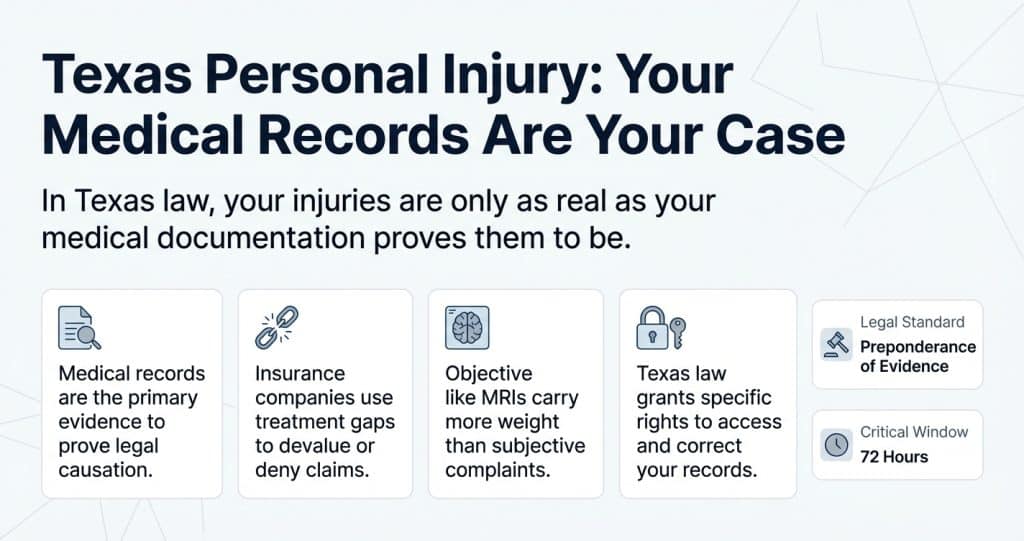
In Texas personal injury law, there’s an uncomfortable truth that most accident victims don’t understand until it’s too late: your injuries are only as real as your medical records say they are.
You can be in excruciating pain every day. You can be unable to work, unable to sleep, unable to enjoy the activities that once gave your life meaning. You can know with absolute certainty that the car accident caused your suffering. But if your medical records don’t document that suffering clearly, consistently, and thoroughly, you’ll struggle to prove your case and recover fair compensation.
I’ve seen this play out countless times in my Houston personal injury practice. Clients with genuine, serious injuries watch their claims get devalued or denied because their medical documentation was incomplete, inconsistent, or poorly timed. Meanwhile, clients who understood the importance of building a strong medical record—who communicated clearly with their doctors, followed treatment recommendations, and documented their symptoms consistently—recover fair compensation for their injuries.
This guide explains how medical documentation works in Texas personal injury claims, why it matters so much, and how to work with your healthcare providers to ensure your records accurately reflect the reality of your injuries.
Why Medical Records Matter Under Texas Law
Texas personal injury law requires plaintiffs to prove their claims by a “preponderance of the evidence”—meaning you must show it’s more likely than not that the defendant’s negligence caused your injuries and damages. Medical records are your primary evidence for meeting this burden.
Proving Causation: To recover damages in Texas, you must prove that the defendant’s negligence caused your injuries. This causation element requires medical evidence connecting your symptoms and diagnoses to the accident. Medical records documenting that your symptoms began after the accident, that your diagnoses are consistent with the accident mechanism, and that your treating physicians believe the accident caused your condition are essential to establishing causation.
Fighting Insurance Company Defenses: Defense attorneys and insurance adjusters will aggressively challenge your claimed injuries. They’ll argue your problems are pre-existing conditions that have nothing to do with the accident. They’ll claim you’re exaggerating or malingering. They’ll suggest your symptoms are psychological rather than physical, or that something other than the accident caused your current condition.
Your medical records are your shield against these attacks. Consistent documentation of your symptoms, diagnoses, treatment, and progress creates a paper trail that’s difficult to dispute. Records showing that you had no neck pain before the accident but developed severe cervical symptoms immediately after—and that those symptoms have persisted despite treatment—tell a compelling story that defense arguments can’t easily overcome.
Calculating Damages: Medical records establish multiple categories of your damages. Past medical expenses are calculated directly from your treatment records and bills. Future medical needs are projected based on your treatment history, current condition, and prognosis documented by your physicians. Pain and suffering damages are supported by documentation of your symptoms, functional limitations, and the impact of your injuries on your daily life.
Texas Civil Practice and Remedies Code Section 41.0105 limits recovery of medical expenses to amounts actually paid or incurred, making accurate medical billing documentation essential to maximizing this component of your damages.
The Treatment Gap Problem
Insurance companies scrutinize the timing of your medical care with particular intensity. Gaps in treatment can devastate your claim, giving adjusters ammunition to argue you weren’t really injured or that your current problems have a different cause.
The Initial Treatment Gap: If you wait days or weeks after the accident to seek medical treatment, the defense will argue your injuries either weren’t caused by the accident or aren’t serious. They’ll suggest that if you were really hurt, you would have sought immediate medical attention. They’ll speculate that something else happened during the gap period that actually caused your current problems—you slept wrong, you lifted something heavy, you had a pre-existing condition that flared up.
As discussed in our article about emergency room visits, seeking immediate medical attention after an accident is essential. A 24-hour gap is problematic. A 72-hour gap is worse. A week-long gap can be devastating to your claim.
Treatment Continuity Gaps: Once you begin treatment, continuity matters enormously. If you see a doctor three times in the first month after your accident, then disappear for two months, then return complaining of continued pain, that gap raises serious questions. The insurance company will argue: “If the plaintiff was really suffering during those two months, why didn’t she seek treatment? She must have gotten better—and her current complaints must be from something else.”
Discharge and Return: If a doctor discharges you from care, indicating you’ve reached maximum improvement or no longer need treatment, returning weeks or months later with new or worsening complaints is particularly problematic. The discharge suggests you were recovering or recovered. The later complaints look suspicious—like you’re trying to build a claim rather than seeking genuine medical care.
Legitimate Gap Explanations: Sometimes treatment gaps have legitimate explanations. You couldn’t get an appointment with a specialist for six weeks. Your insurance authorization was delayed. You had a family emergency that prevented you from attending appointments. You couldn’t afford treatment and were waiting to see if you’d recover on your own.
If you have gaps in treatment, document the reasons. Tell your doctor why you were absent from care so the explanation appears in your medical records. A documented explanation is far better than an unexplained gap.
Communicating With Your Doctors
Your medical records are created from what you tell your healthcare providers. How you communicate with your doctors directly affects the strength of your documentation.
Describe All Symptoms Thoroughly: Don’t minimize your symptoms to be polite, stoic, or to avoid seeming like a complainer. If your neck hurts, your back hurts, you have headaches, you’re having trouble sleeping, you’re experiencing anxiety about driving, and you’re struggling to concentrate at work—say all of that, every time you see a medical provider.
Symptoms you don’t mention don’t get documented. Undocumented symptoms are much harder to prove later. The insurance company will argue: “If the plaintiff was really having headaches, why didn’t she mention them to her doctor? They’re not in the records because they didn’t exist.”
Be Specific About Your Symptoms: Vague descriptions like “it hurts” or “I don’t feel good” don’t create strong medical records. Specific descriptions do. Instead of “my back hurts,” try: “I have constant, aching pain in my lower back, usually around a 6 out of 10 in severity, that gets worse when I sit for more than 30 minutes and radiates into my left leg when I stand up.”
Specific descriptions help doctors assess your condition accurately, order appropriate tests, and create detailed records that support your claim.
Connect Your Symptoms to the Accident: Make sure your doctors clearly understand that your symptoms began after the accident. Don’t assume they know or remember. Each time you see a provider, reinforce the connection: “These symptoms started right after my car accident on January 15th. I didn’t have any of these problems before the collision.”
This clear timeline in your medical records establishes the causation that Texas law requires you to prove.
Report Changes in Your Condition: If your symptoms change—whether improving, worsening, or developing in new ways—tell your doctor. Improvement should be documented because it shows you’re following treatment and making progress. Worsening is important because it affects your treatment plan and the value of your claim. New symptoms may indicate developing conditions that need evaluation.
Be Honest About Pre-Existing Conditions: If you had prior problems with the same body part that’s now injured, tell your doctors. Trying to hide pre-existing conditions almost always backfires badly. Insurance companies will obtain your prior medical records and discover the history you tried to conceal. Your credibility will be destroyed.
Instead, be upfront. Good doctors can distinguish between chronic conditions and acute injuries. They can document how the accident aggravated your pre-existing condition, which is compensable under Texas law. Honesty preserves your credibility while allowing accurate documentation of the accident’s impact.
Describe Functional Limitations: Tell your doctors how your injuries affect your daily life. Don’t just say “my shoulder hurts.” Explain: “I can’t lift my two-year-old daughter because of my shoulder pain. I can’t reach the top shelves in my kitchen. I can’t sleep on my right side anymore. I had to stop playing tennis, which I did twice a week before the accident.”
These functional descriptions support pain and suffering damages and help quantify how the accident has diminished your quality of life.
Objective Findings: What Carries Weight
Not all medical documentation carries equal weight with insurance companies, defense attorneys, and juries. Understanding what’s considered persuasive helps you focus on building the right evidence.
Objective vs. Subjective Evidence: Medical findings are generally categorized as either “objective” or “subjective.” Objective findings are things the doctor can observe, measure, or verify through testing—muscle spasm visible on examination, limited range of motion measured with a goniometer, positive MRI findings showing a herniated disc, abnormal nerve conduction study results. Subjective findings are things only you can report—pain, discomfort, difficulty concentrating, emotional distress.
Insurance companies discount subjective complaints while giving significant weight to objective findings. This isn’t entirely fair—pain is real even when it doesn’t show on an MRI—but it’s the reality of how claims are evaluated.
Imaging Studies: X-rays, MRIs, and CT scans provide objective evidence of injury that’s difficult to dispute. A herniated disc visible on MRI is hard for the insurance company to deny. A fracture shown on X-ray is undeniable proof of injury. These objective findings corroborate your subjective complaints.
However, imaging has important limitations. Many soft tissue injuries—muscle strains, ligament sprains, some types of nerve damage—don’t show on imaging. And many people have degenerative changes on imaging that cause no symptoms. The presence or absence of imaging findings must be interpreted in context.
Physical Examination Findings: When doctors conduct physical examinations, they document objective findings such as muscle spasm (tightness they can feel), tenderness (pain response to palpation), reduced range of motion, neurological deficits like abnormal reflexes, diminished sensation, or muscle weakness, swelling or inflammation, and gait abnormalities.
Make sure your doctors are conducting thorough examinations and documenting what they find—both positive findings that support your complaints and negative findings that help establish your baseline.
Functional Testing: Physical therapists and other providers often perform functional testing that quantifies your limitations. Range of motion measurements, grip strength testing, functional capacity evaluations, and similar assessments provide objective data supporting your claims about limitations.
Consistency Between Complaints and Findings: Perhaps most important is consistency between what you report and what doctors find on examination. If you complain of severe low back pain but have full, pain-free range of motion on exam, that inconsistency undermines your credibility. If your complaints match the clinical findings—you report severe back pain and demonstrate limited, painful motion with visible muscle guarding—that consistency is persuasive.
The Medical Narrative
Beyond individual visit notes, your complete medical record tells a story—a narrative of your injury, treatment, and recovery (or lack thereof). Understanding how this narrative develops helps you ensure it accurately reflects your experience.
The Beginning: Your initial medical records after the accident should clearly document what happened: you were in a motor vehicle accident on a specific date, the accident occurred in a specific way (rear-ended at a stoplight, T-boned at an intersection), and you experienced specific symptoms beginning immediately or shortly after the collision. This establishes the starting point of your injury narrative.
The Diagnosis Phase: Early medical records should document the diagnostic process—the examinations, imaging studies, and other tests that led to your diagnoses. Clear documentation of how doctors reached their conclusions strengthens the causation argument.
The Treatment Course: Your treatment records should show a logical progression: initial evaluation, diagnosis, treatment plan, ongoing care, response to treatment, and adjustments when treatment isn’t working. Gaps in this progression, or treatment that seems random or unfocused, can undermine your claim.
The Current State: Your current medical records should accurately reflect your present condition. If you’ve recovered completely, that should be documented. If you have ongoing symptoms and limitations, those should be clearly reflected. If you’ve reached “maximum medical improvement”—the point where further recovery isn’t expected—but have permanent limitations, that should be stated explicitly.
The Prognosis: For claims involving future damages, you need documentation of your expected future condition. Will you need ongoing medical treatment? Future surgery? Continuing physical therapy? Are your limitations permanent? Will your condition worsen over time? These questions about prognosis should be addressed in your medical records, ideally by specialists qualified to render such opinions.
Obtaining and Reviewing Your Records
You have the right to your medical records under Texas law. Exercise that right actively throughout your treatment and claim process.
Texas Health and Safety Code Rights: Under Chapter 181 of the Texas Health and Safety Code, healthcare providers must furnish copies of your medical records within 15 business days of receiving your written request. They may charge reasonable fees for copying—up to $25 for the first 20 pages and specified amounts for additional pages, plus actual costs of postage.
What Records to Request: Request complete records from every provider who has treated you for accident-related conditions. This includes emergency room records and ambulance/EMS run reports, hospital admission records if you were hospitalized, primary care physician records, specialist records from orthopedists, neurologists, pain management doctors, and others, physical therapy and chiropractic records, imaging studies and radiology reports, laboratory results, pharmacy records documenting prescriptions, and mental health records if you’ve received psychological treatment.
Review Everything Carefully: Read your records thoroughly. Look for inaccuracies in the documented history. Did the doctor accurately record what you told them? Are there statements attributed to you that you didn’t make? Did symptoms you reported get documented?
Look for internal inconsistencies. Does one provider’s note contradict another’s? Are there discrepancies in the timeline or symptom descriptions that could be exploited by the defense?
Look for helpful documentation that supports your claim—clear causation statements, detailed symptom descriptions, objective findings, functional limitation assessments, prognosis opinions.
Correcting Medical Record Errors: Under Texas law, you can request corrections to inaccurate medical records. Healthcare providers must consider your request within 15 business days. If they agree an error exists, they must correct it. If they disagree, you have the right to add a written statement of disagreement that becomes part of your permanent record.
Don’t hesitate to request corrections for factual errors. Your medical records will follow you throughout your claim and potentially into litigation—errors should be corrected as soon as they’re identified.
Working With Your Attorney on Medical Documentation
Your personal injury attorney plays a crucial role in medical documentation strategy.
Comprehensive Record Collection: Your attorney will gather all relevant medical records, often identifying sources you might have forgotten or not realized were important. This includes prior medical records that establish your pre-accident baseline, records from all accident-related treatment, employment records documenting work limitations, and pharmacy records showing medication history.
Expert Record Review: Attorneys experienced in personal injury law know what to look for in medical records. They identify strengths to emphasize, weaknesses to address, and potential problems to resolve before the insurance company exploits them.
Medical Provider Communication: While your attorney cannot tell your doctors what to write, they can ensure your providers understand the importance of thorough documentation and can request clarification or supplementation when records are incomplete.
Medical Expert Coordination: In complex cases, attorneys work with medical experts—doctors hired to review your case and provide opinions. These experts can interpret your medical records, provide causation opinions, assess your prognosis, and testify about the nature and extent of your injuries.
Narrative Development: Your attorney helps construct the narrative of your injury claim—what happened, what it has caused, and what your future holds. Medical records provide the foundation for this narrative, but presenting them effectively requires legal expertise.
Conclusion: Documentation Equals Recovery
In Texas personal injury law, your medical records are quite literally your case. They establish that you were injured, that the accident caused your injuries, and that you’ve suffered damages deserving compensation. Without strong medical documentation, even legitimate claims fail.
Building strong documentation requires attention from the very beginning of your treatment. Seek immediate medical care after your accident. Communicate thoroughly and specifically with your healthcare providers about your symptoms and limitations. Follow treatment recommendations consistently. Review your records for accuracy and request corrections when needed.
The insurance company assigned to your claim will scrutinize every page of your medical records, looking for inconsistencies, gaps, and contradictions to exploit. A well-documented medical history withstands that scrutiny. A poorly documented one crumbles under examination.
Take your medical care seriously—both for your health and for your legal claim. Be honest with your doctors. Be thorough in describing your symptoms and limitations. Be consistent in attending appointments and following treatment recommendations. And review your records to ensure they accurately tell the story of your injury.
Your medical records are your voice in the legal process when you’re not in the room. They speak for you to insurance adjusters reviewing your file, to defense attorneys looking for weaknesses, to mediators evaluating your claim, and potentially to juries deciding your case.
Make sure your records speak clearly, accurately, and persuasively. Your recovery depends on it.

About the Author
Chi Nguyen is a Houston personal injury attorney dedicated to helping accident victims understand their rights and receive fair compensation under Texas law. With extensive experience representing injured Texans, Attorney Nguyen combines legal expertise with a commitment to client education and empowerment.