

Table of contents
Introduction
Every week, I meet with Houston accident victims who made the same mistake: they didn’t go to the emergency room after their collision. They felt okay at the scene. They didn’t want to make a fuss. They figured they’d see how they felt in the morning.
Now they’re dealing with serious injuries—and an insurance company that claims those injuries couldn’t have been caused by the accident because they didn’t seek immediate medical attention.
This is one of the most costly mistakes you can make after a Texas car accident. The decision to skip the emergency room can reduce your claim value by tens of thousands of dollars, or even result in a complete denial of benefits you’re legally entitled to receive.
I’ve watched clients with legitimate, serious injuries struggle to prove their cases because they waited too long to seek medical care. I’ve seen insurance adjusters use treatment gaps to deny claims that should have been straightforward. And I’ve seen the frustration on clients’ faces when they realize that a single decision—made in the confusing moments after an accident—has complicated their entire case.
Let me explain why skipping the emergency room can devastate your claim under Texas law, and what the medical and legal realities actually are.
The Adrenaline Deception: Why You Cannot Trust How You Feel
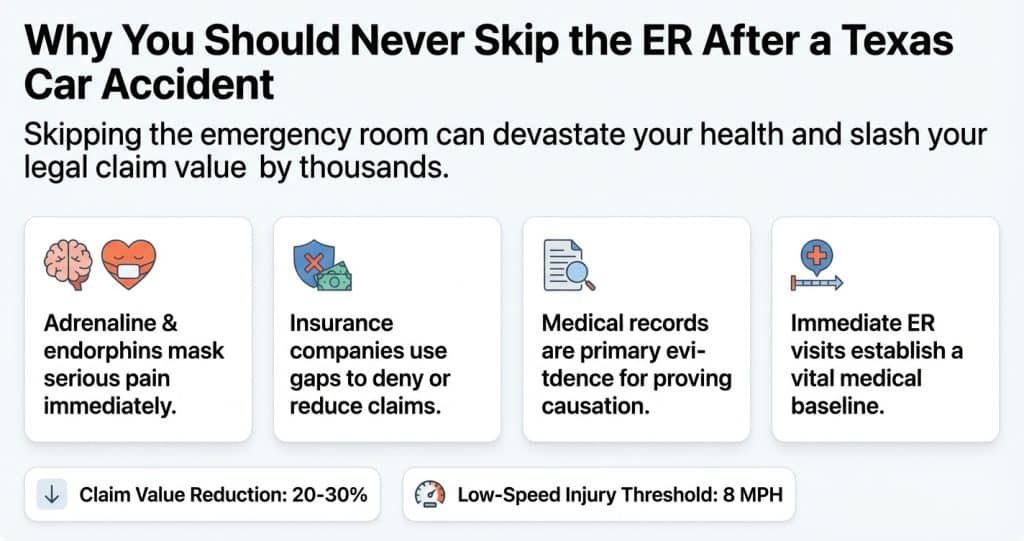
When you’re involved in a car accident, your body initiates a powerful stress response that evolved over millions of years to help humans survive dangerous situations. Adrenaline floods your system. Endorphins—your body’s natural painkillers—surge through your bloodstream. Your heart races, your senses sharpen, and your brain focuses entirely on survival and immediate threats.
This biochemical response is incredibly useful for escaping danger. Our ancestors needed to flee predators or fight enemies even when injured. The ability to ignore pain in the moment was a survival advantage.
The problem is, this same response is terrible for assessing whether you’ve been injured in a car accident.
Studies have shown that adrenaline can mask pain for hours after a traumatic event. The stress hormones flooding your body suppress pain signals, reduce inflammation perception, and create a false sense of wellbeing. People have walked around on broken bones without realizing it. Accident victims have suffered internal bleeding without feeling significant pain until it became life-threatening. Concussion symptoms often don’t appear for 24-72 hours after the initial trauma.
I had a client who refused ambulance transport at the scene of a Houston highway collision. She felt fine—just a little shaken up. The paramedics offered to take her to the hospital, but she declined. She drove herself home, took a shower, and went to bed thinking she’d escaped serious injury.
Two days later, she could barely turn her head. The pain was excruciating. An MRI revealed two herniated discs in her cervical spine that would eventually require surgical intervention. But because she didn’t seek immediate medical care, the insurance company spent months arguing her injuries were pre-existing or caused by something other than the accident. Her case, which should have been straightforward, became a battle.
The lesson is simple but critical: you cannot accurately assess your own injuries immediately after an accident. Your body’s protective mechanisms prevent it. The only way to know if you’re injured is to let medical professionals examine you with proper diagnostic tools.
The Medical Documentation Problem Under Texas Law
From a legal perspective, your medical records are your case. They create an official, contemporaneous record of your injuries and their connection to the accident. Without that documentation, proving causation—one of the essential elements of any Texas personal injury claim—becomes exponentially harder.
Texas Civil Practice and Remedies Code requires personal injury plaintiffs to prove four elements: duty, breach, causation, and damages. The causation element requires you to demonstrate that the defendant’s negligence actually caused your injuries. Medical records from immediately after the accident are the most powerful evidence of causation you can have.
When you skip the ER and show up at a doctor’s office three days later complaining of neck pain, several problems emerge under Texas law.
First, there’s no medical documentation connecting your symptoms to the accident at the time it happened. The defense will argue that this gap creates reasonable doubt about whether the accident actually caused your injuries.
Second, the insurance company will argue that something else could have caused your injuries during those three days. You could have slept wrong. You could have lifted something heavy. You could have had a pre-existing condition that flared up. Without immediate documentation, they have room to create alternative explanations.
Third, the gap in treatment suggests to insurance adjusters, defense attorneys, and potentially jurors that your injuries weren’t serious enough to warrant immediate medical attention. If you were really hurt, they’ll argue, you would have gone to the hospital.
Insurance adjusters are trained to look for gaps in treatment. They use computer algorithms—programs like Colossus—that automatically reduce claim values when there’s a delay between the accident and first medical treatment. A 72-hour gap can reduce your claim’s calculated value by 20-30%. A week-long gap can be even more devastating to your recovery.
The emergency room visit creates what medical professionals call a “baseline.” It documents your condition immediately after the accident—before anything else could have contributed to or worsened your injuries. That baseline becomes the foundation for everything that follows in your treatment and your legal claim.
Injuries That Don’t Show Immediate Symptoms
Many accident-related injuries have delayed onset of symptoms. Understanding these conditions helps explain why immediate medical evaluation is so critical, even when you feel fine at the scene.
Whiplash and Soft Tissue Injuries: The classic car accident injury, whiplash occurs when your head is thrown forward and backward rapidly during a collision. The soft tissues of the neck—muscles, ligaments, tendons—are stretched or torn. Symptoms including neck pain, stiffness, headaches, dizziness, and shoulder pain often don’t appear until 24-72 hours after the collision. By then, without initial documentation, the insurance company has ammunition to dispute that the accident caused your condition.
Concussions and Traumatic Brain Injuries: Even “mild” traumatic brain injuries can have serious, long-lasting consequences. Symptoms like confusion, memory problems, difficulty concentrating, mood changes, sleep disturbances, and persistent headaches may develop gradually over days or weeks. Research published in medical journals shows that collisions at speeds as low as eight miles per hour can generate five times the force of gravity on the human head—more than enough to cause brain injury.
Internal Bleeding: Internal injuries can be life-threatening and may not cause significant pain initially. Abdominal trauma from seatbelt compression or steering wheel impact can result in slow internal bleeding that becomes dangerous hours after the accident. Symptoms may be subtle at first—mild abdominal discomfort, slight dizziness—before suddenly becoming severe.
Herniated Discs: Spinal disc injuries often present with delayed symptoms. The initial trauma may cause a small tear or bulge in the disc’s outer layer that worsens over time, especially with continued activity. By the time severe pain develops—often radiating into the arms or legs—it may be days after the accident. Without initial documentation, connecting the herniation to the collision becomes difficult.
Psychological Trauma: Post-traumatic stress disorder, anxiety, and depression frequently develop days or weeks after an accident. Emergency room documentation of the traumatic event helps establish the foundation for later psychological treatment and compensation for mental health impacts.
Emergency room physicians are trained to look for these delayed-onset injuries. They know what questions to ask and what tests to run based on the mechanism of injury. A thorough ER evaluation can identify problems you don’t even know you have—and create the documentation you’ll need later.
The Legal Impact of Skipping the ER in Texas
Texas courts have consistently recognized that gaps in medical treatment can negatively impact personal injury claims. While there’s no bright-line rule automatically disqualifying claims with treatment gaps, the practical impact on claim value is significant and well-documented.
Comparative Evidence Arguments: When you don’t seek immediate treatment, you give the insurance company powerful comparative evidence to use against you. Their attorneys will argue to adjusters, mediators, and juries: “If the plaintiff was really injured, why didn’t she go to the emergency room? Why did she wait three days to seek treatment? Obviously, her injuries couldn’t have been that serious—or they weren’t caused by this accident at all.”
This argument resonates with juries because it appeals to common sense reasoning. It’s hard to overcome, even when the delayed-symptom explanation is medically sound. Jurors who have never experienced a serious car accident may not understand how adrenaline masks pain or how injuries can develop over time.
The Eggshell Plaintiff Doctrine: Texas follows the “eggshell plaintiff” rule, meaning defendants take plaintiffs as they find them. If you have a pre-existing condition that makes you more vulnerable to injury, the defendant is still liable for the full extent of your damages. But this doctrine only helps if you can prove the accident caused or aggravated your condition. Without immediate documentation, distinguishing between pre-existing problems and accident-related injuries becomes nearly impossible—and the insurance company will exploit that ambiguity.
Mitigation of Damages: Under Texas law, plaintiffs have a duty to mitigate their damages. This means taking reasonable steps to minimize the harm caused by the accident, including seeking appropriate medical treatment. Failing to get prompt medical care can be characterized as a failure to mitigate, potentially reducing your recovery even if liability is clear.
Expert Testimony Challenges: In litigation, you’ll typically need medical expert testimony to establish causation between the accident and your injuries. Medical experts are much more comfortable—and much more persuasive to juries—when they can point to emergency room records documenting your condition immediately after the accident. Without that baseline documentation, their causation opinions become more vulnerable to challenge on cross-examination.
What the Emergency Room Visit Actually Accomplishes
Understanding what happens during an emergency room evaluation helps explain why it’s so valuable for both your health and your legal claim.
Triage and Initial Assessment: Emergency room staff immediately assess your condition upon arrival, documenting vital signs, visible injuries, and your description of symptoms. This creates a time-stamped record of your physical state within hours of the accident—evidence that’s difficult to dispute later.
Diagnostic Testing: Based on your symptoms and the accident mechanism, ER physicians may order imaging studies—X-rays to check for fractures, CT scans to evaluate head injuries or internal bleeding, or MRIs to assess soft tissue damage. These objective findings are powerful evidence that doesn’t depend on your subjective reports.
Physical Examination: The physician conducts a thorough examination, documenting range of motion limitations, areas of tenderness, neurological findings like reflexes and sensation, and other objective signs of injury. Everything they observe becomes part of your permanent medical record.
Symptom Documentation: Everything you tell the ER staff about your symptoms gets documented in real-time. This creates a contemporaneous record of your complaints—far more credible than recollections offered weeks or months later when your memory has faded and litigation has begun.
Treatment and Recommendations: The ER visit generates treatment recommendations and follow-up instructions. These create a roadmap for your continued care and establish that medical professionals believed your condition warranted further attention.
The Medical-Legal Connection: Perhaps most importantly, the ER records establish, in medical professionals’ own words, that you were in an accident and presented with certain symptoms at a specific time. This documentation becomes the foundation for all future medical treatment and legal arguments about causation.
Common Excuses for Skipping the ER (And Why They Don’t Hold Up)
I’ve heard every reason for skipping the emergency room. None of them justify the risk to your health or your legal claim.
“I felt fine at the scene.” As discussed above, you cannot reliably assess your own injuries immediately after a traumatic event. Adrenaline and endorphins mask pain. Serious injuries—including life-threatening ones—can have delayed symptoms. Feeling fine means nothing in the immediate aftermath of an accident.
“I didn’t want to waste anyone’s time.” Your health is not a waste of anyone’s time. Emergency rooms exist precisely for situations like car accidents. If you were in a collision with enough force to potentially cause injury, that’s exactly the situation emergency medicine is designed to address. Medical professionals would rather examine you and find nothing than have you develop serious complications because you didn’t seek care.
“I didn’t have health insurance or couldn’t afford it.” Under federal law—the Emergency Medical Treatment and Labor Act (EMTALA)—emergency rooms cannot refuse to evaluate and stabilize you based on inability to pay. You will receive care regardless of insurance status. Additionally, if someone else was at fault for the accident, their insurance will ultimately pay your medical bills as part of your claim. And Texas law allows personal injury plaintiffs to recover all reasonable and necessary medical expenses, meaning these costs can be recovered from the at-fault driver.
“I didn’t want my insurance rates to go up.” Using your health insurance for legitimate medical care after an accident should not significantly impact your rates—particularly if you weren’t at fault. More importantly, the damage you do to your legal claim by skipping the ER far exceeds any potential insurance rate increase. You’re risking tens of thousands of dollars in compensation to avoid a hypothetical small rate adjustment.
“I was too shaken up and just wanted to go home.” This is understandable but dangerous. The desire to return to normalcy after a traumatic event is powerful. But your emotional state isn’t a reliable guide for medical decision-making. Call a family member to meet you at the hospital. Have a friend drive you to the ER. But don’t go home without medical evaluation.
“The other driver said it wasn’t necessary” or “The other driver offered to pay out of pocket.” The other driver has every incentive to discourage you from creating documentation of the accident and your injuries. They may be hoping the whole thing goes away quietly. Don’t take medical advice—or legal advice—from the person who just hit you.
What to Do at the Emergency Room to Protect Your Claim
If you’re reading this before going to the ER—or if you can share this with someone who’s just been in an accident—here’s how to maximize the value of your emergency room visit for both your health and your legal claim.
Tell Them Everything: Don’t minimize your symptoms to be polite or stoic. Don’t say “I’m probably fine” or “it’s just a little sore.” Describe every symptom you’re experiencing, no matter how minor it seems. Headache, dizziness, nausea, neck stiffness, back pain, anxiety, difficulty concentrating, ringing in your ears—all of it. What doesn’t get documented doesn’t exist for legal purposes.
Explain How the Accident Happened: Tell the medical staff how the accident occurred. Were you rear-ended at a stoplight? Hit from the side at an intersection? Was it a high-speed highway collision or a low-speed parking lot fender-bender? Did you hit your head on anything? Did the airbags deploy? Was there significant vehicle damage? This information helps them identify likely injuries and order appropriate tests.
Mention Any Pre-Existing Conditions: If you have prior medical issues—especially anything involving the neck, back, or head—tell the ER staff. This might seem counterintuitive, but being upfront about pre-existing conditions is essential. It helps establish an accurate baseline and allows medical professionals to document whether the accident aggravated existing conditions. Hiding pre-existing conditions backfires badly when the insurance company discovers them later.
Follow All Discharge Instructions: The ER will give you discharge instructions including follow-up recommendations, activity restrictions, medications, and warning signs to watch for. Follow these instructions carefully. If they say see your primary care doctor in 2-3 days, do it. If they say return to the ER if certain symptoms develop, return if those symptoms develop. Following medical advice strengthens your claim; ignoring it undermines your credibility.
Keep All Documentation: Get copies of your discharge paperwork, including diagnostic results, treatment provided, and follow-up instructions. Keep them in a safe place. These documents are crucial evidence that you may need months or years later.
If You’ve Already Skipped the ER: What to Do Now
If you’re reading this after already deciding not to go to the emergency room, it’s not too late to take action—but you need to move quickly.
See a Doctor Immediately: Get to your primary care physician, an urgent care center, or yes, even the emergency room as soon as possible. The longer you wait, the worse the gap problem becomes. A 24-hour gap is better than a 72-hour gap. A 72-hour gap is better than a week-long gap.
Explain Everything: When you see a medical provider, explain exactly what happened: the accident, why you didn’t seek immediate care (you felt okay, you were in shock, you didn’t realize you were injured), and when your symptoms began or worsened. This creates documentation of the timeline that may help explain the gap.
Document Your Symptoms: If you haven’t already, start a written journal documenting your symptoms, their severity, and how they’re affecting your daily life. Note when symptoms first appeared and how they’ve progressed.
Consult an Attorney: A treatment gap complicates your case but doesn’t necessarily doom it. An experienced Houston personal injury attorney can evaluate your situation, advise you on building the strongest possible case despite the gap, and help you understand what your claim may be worth. Most consultations are free.
Be Honest: Whatever you do, don’t lie about the timeline or try to backdate when you first experienced symptoms. Medical records are discoverable in litigation, and inconsistencies will destroy your credibility. Work with the facts you have, even if they’re not ideal.
Conclusion: The ER Visit Is Non-Negotiable
After a car accident in Texas, going to the emergency room isn’t optional—it’s essential. The medical evaluation protects your health by identifying injuries you may not yet feel. The documentation protects your legal rights by establishing the connection between the accident and your injuries.
Yes, ER visits are expensive and time-consuming. Yes, you might feel like you’re overreacting. Yes, you might sit in a waiting room for hours only to be told you’re fine. But the cost of skipping the ER—in terms of both health outcomes and claim value—is far higher than any inconvenience.
If you’ve been in an accident in Houston, go to the emergency room. Do it immediately, not tomorrow. Do it even if you feel fine. Do it even if the accident seemed minor. Do it even if the other driver tells you it’s not necessary. Your future self—and your personal injury claim—will thank you.
Under Texas law, you have rights as an accident victim. But those rights only matter if you can prove your injuries were caused by someone else’s negligence. The emergency room visit is the first and most important step in building that proof.
Don’t let adrenaline, inconvenience, cost concerns, or the other driver’s assurances convince you otherwise. Get to the emergency room. Your health and your legal rights both depend on it.

About the Author
Chi Nguyen is a Houston personal injury attorney dedicated to helping accident victims understand their rights and receive fair compensation under Texas law. With extensive experience representing injured Texans, Attorney Nguyen combines legal expertise with a commitment to client education and empowerment.