

Table of contents
Not every case settles. Sometimes the insurance company simply won’t pay fair value, and you have to decide: accept their inadequate offer or file a lawsuit?
That decision shouldn’t be made lightly. Litigation is expensive, time-consuming, emotionally draining, and uncertain. But it’s also sometimes the only path to fair compensation for injuries that weren’t your fault.
After years of taking cases through the litigation process, I want to share what I tell clients when we’re facing that choice—the realities of litigation that you need to understand before committing to it.
Understand What You’re Getting Into
Filing a lawsuit isn’t just paperwork. It’s a commitment that can stretch over a year or more—sometimes much more. Before you decide to litigate, understand what that commitment involves.
Discovery is intensive. Both sides have the right to obtain information from the other. This means:
- Written interrogatories—detailed questions you must answer under oath. These take time to prepare and require careful thought. Defense attorneys craft questions designed to elicit damaging admissions, and your answers become part of the permanent record.
- Document requests—demands for medical records, employment records, tax returns, communications related to the accident, and more. Gathering and producing these documents is burdensome, and everything you produce will be scrutinized for anything helpful to the defense.
- Depositions—you’ll be questioned under oath by the defense attorney, sometimes for hours. This is one of the most important moments in your case. How you present yourself, how you handle difficult questions, and whether you remain consistent with prior statements can make or break your claim.
- Expert witnesses are expensive. In most cases, you’ll need medical experts to testify about your injuries, their cause, your treatment, and your prognosis. Expert witnesses charge substantial fees—often hundreds of dollars per hour for review time, report preparation, deposition testimony, and trial testimony. These costs add up quickly.
- The timeline is unpredictable. Courts are backlogged. Motions take time to decide. Discovery deadlines get extended. Settlement conferences get postponed. A case that you hope will resolve in a year might stretch to two years or more.
- Your life becomes an open book. Litigation means the defense can dig into your past. Medical records going back years. Employment history. Prior claims or lawsuits. Social media posts. Anything they think might be relevant to your credibility or your injuries becomes fair game.
The Defense Will Find Your Weaknesses
I tell every client: if your case has problems, the defense will find them. That’s what they’re paid to do.
Once litigation begins, experienced defense attorneys will search methodically for every vulnerability in your case:
Medical record inconsistencies. If you told the ER you felt fine but told your doctor the next week you were in agony, they’ll exploit that inconsistency. If different doctors documented different symptoms, they’ll use that to suggest you’re not reliable.
Gaps in treatment. If you stopped physical therapy for two months in the middle of your recovery, they’ll argue you must have felt better. If you didn’t seek treatment for a week after the accident, they’ll suggest you weren’t really hurt that badly.
Pre-existing conditions. The defense will obtain your medical records going back years, looking for any prior complaint similar to your current symptoms. Even an offhand mention of back stiffness five years ago becomes a potential defense.
Social media activity. That photo of you smiling at a family gathering? Evidence you’re not really suffering. The check-in at a restaurant? Proof you’re more mobile than you claim. Defense attorneys routinely comb through plaintiffs’ social media looking for anything inconsistent with claimed injuries.
Prior claims or lawsuits. If you’ve made insurance claims before, they’ll argue you’re litigation-happy. If you’ve ever filed a lawsuit for anything, they’ll suggest you’re the type of person who sues at the drop of a hat.
Your deposition. Defense attorneys are skilled at asking questions that lead plaintiffs into problematic answers. They’ll ask the same thing multiple ways, hoping you’ll give inconsistent responses. They’ll ask about details you don’t remember clearly, then use your uncertainty against you. They’ll ask leading questions that trap you into admissions you didn’t intend to make.
Whatever weaknesses exist in your case will be exploited to the maximum extent possible. You need to know what those weaknesses are before you file suit, and you need to be prepared to address them.
Some Cases Get Weaker in Litigation
Here’s something that surprises people: litigation doesn’t always strengthen your position. Sometimes it weakens it.
Your treating doctor might not perform well in deposition. Doctors who are excellent clinicians aren’t necessarily effective witnesses. They may be unclear in their explanations, easily flustered by aggressive questioning, or unable to support their opinions under cross-examination.
Witnesses may not remember things the way you do. The co-worker who saw you limping after the accident? In deposition, maybe they only vaguely remember you mentioning some discomfort. The friend who was going to testify about how the injury changed your life? Under oath, they qualify everything and help the defense more than they help you.
Discovery may reveal unhelpful facts. Documents you forgot about or didn’t think were relevant might turn up and create problems. The defense might find evidence you didn’t know existed.
The defense expert will be impressive. Their doctor will be experienced, articulate, and credible. Their accident reconstructionist will have impressive credentials. These professionals testify for a living—they know how to persuade.
The insurance company didn’t refuse to settle because they thought your case was strong. They refused because they saw weaknesses and bet that litigation would expose them. Sometimes they’re right.
But Some Cases Need to Be Tried
With all those caveats, sometimes litigation is the right choice:
When the insurance company is being unreasonable. Some companies consistently undervalue claims and refuse to offer fair settlements regardless of case strength. The only way to get fair value from these companies is to show you’re willing to go all the way.
When the offer is insulting. If the gap between what they’re offering and what your case is worth is enormous, settling may not be an option. Sometimes the only realistic path to fair compensation is through a verdict.
When you’ve done everything right and they won’t move. If your case is well-documented, your injuries are real, and you’ve presented the claim professionally—and they still won’t pay fair value—litigation may be your only recourse.
When the principle matters. Some clients, after being treated dismissively by the insurance company for months, want their day in court regardless of the financial calculation. They want the defendant to answer for what happened. That’s a legitimate reason to litigate, as long as you understand the costs and risks.
I’ve had cases settle on the courthouse steps when the adjuster finally believed I would actually pick a jury. I’ve had verdicts that exceeded our last demand by substantial amounts. Sometimes fighting is the only option, and sometimes fighting works.
What Litigation Actually Looks Like
If you decide to file suit, here’s roughly how it unfolds:
- Pleadings (1-2 months). You file a complaint; the defendant files an answer. The basic positions are established.
- Written discovery (3-6 months). Both sides exchange interrogatories and document requests. You answer their questions; they answer yours. Documents are gathered and produced.
- Depositions (6-12 months from filing). You’ll be deposed. The defendant’s representative may be deposed. Expert witnesses get deposed. These are pivotal moments that often define how the case ultimately resolves.
- Motions practice. Various disputes arise during litigation. The defense might move to exclude certain evidence or dismiss certain claims. You might need to compel them to produce documents they’re withholding. These motions take time to brief and argue.
- Mediation. Most courts require mediation before trial. A neutral mediator tries to help the parties reach settlement. Many cases resolve at this stage.
- Trial preparation. If mediation fails, you prepare for trial. Witnesses are organized, exhibits are prepared, opening and closing statements are drafted. This is intensive work.
- Trial (typically 3-5 days for a personal injury case). Finally, you get your day in court. Witnesses testify, evidence is presented, arguments are made. Then the jury decides.
- Post-trial. Even after a verdict, the losing side might appeal. Collection of judgments can take additional time.
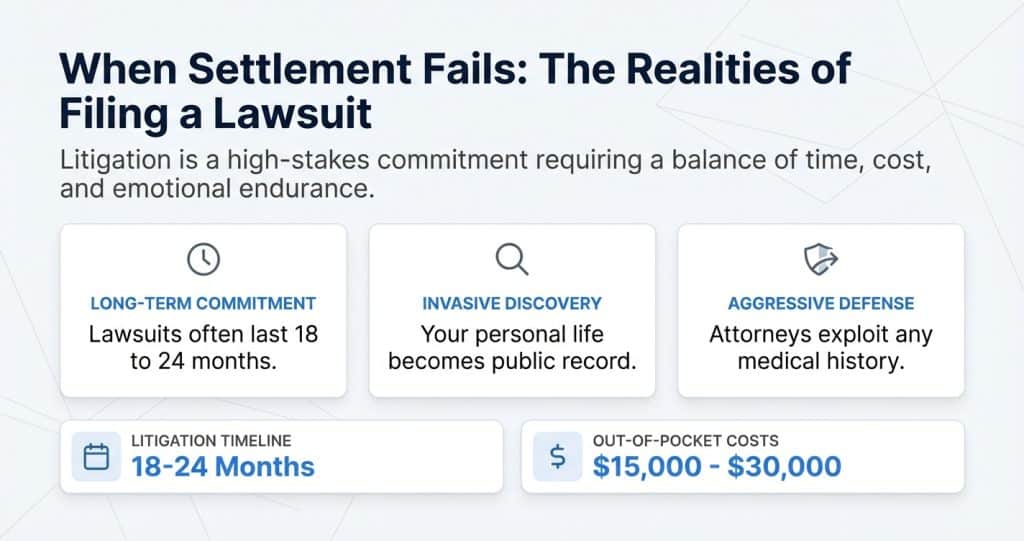
This entire process typically takes 18-24 months, often longer. It requires sustained engagement from you throughout.
The Costs of Litigation
Litigation is expensive. Before filing, understand the financial implications:
- Out-of-pocket costs. Filing fees, deposition transcript costs, expert witness fees, exhibit preparation, jury fees. In a moderately complex personal injury case, these costs can easily reach $15,000-$30,000 or more.
- Opportunity costs. The time you spend dealing with litigation—attending depositions, meeting with your attorney, preparing for trial—is time you’re not spending on other things.
- Emotional costs. Litigation is stressful. Having your life scrutinized, your credibility questioned, your injuries doubted—it takes a toll. Some plaintiffs find the process re-traumatizing.
- Risk costs. You might lose. You might win less than the offer you turned down. You might win but face a lengthy appeal. Uncertainty has its own price.
These costs need to be weighed against the potential benefits of a successful outcome.
Making the Decision
So how do you decide whether to litigate?
Start with honest case assessment. What are your case’s strengths and weaknesses? What’s the realistic range of possible outcomes? How would a neutral person view the facts?
Compare the offer to realistic value. Not what you wish your case was worth, but what similar cases actually settle and verdict for. Is the gap worth fighting over?
Consider your risk tolerance. Some people can’t stomach uncertainty. Others are willing to gamble for a better outcome. There’s no wrong answer—just know yourself.
Factor in time and stress. Is the potential additional recovery worth a year or more of your life? Only you can answer that.
Get experienced advice. An attorney who has tried cases can help you realistically evaluate whether litigation makes sense. Be wary of attorneys who push litigation when settlement is the better choice—and equally wary of those who want to settle when fighting is appropriate.
The Bottom Line
Filing a lawsuit is a serious decision with real consequences. It’s expensive, time-consuming, and uncertain. But it’s also sometimes necessary.
If the insurance company won’t pay fair value through negotiation, litigation may be your only path to appropriate compensation. Understanding what that path involves—the discovery, the depositions, the expenses, the risks—helps you make an informed choice.
Whatever you decide, go in with clear eyes. Know what you’re fighting for and what you’re risking. And commit fully once you decide—halfway litigation serves no one.

About the Author
Chi Nguyen is a Houston personal injury attorney dedicated to helping accident victims understand their rights and receive fair compensation under Texas law. With extensive experience representing injured Texans, Attorney Nguyen combines legal expertise with a commitment to client education and empowerment.