

Table of contents
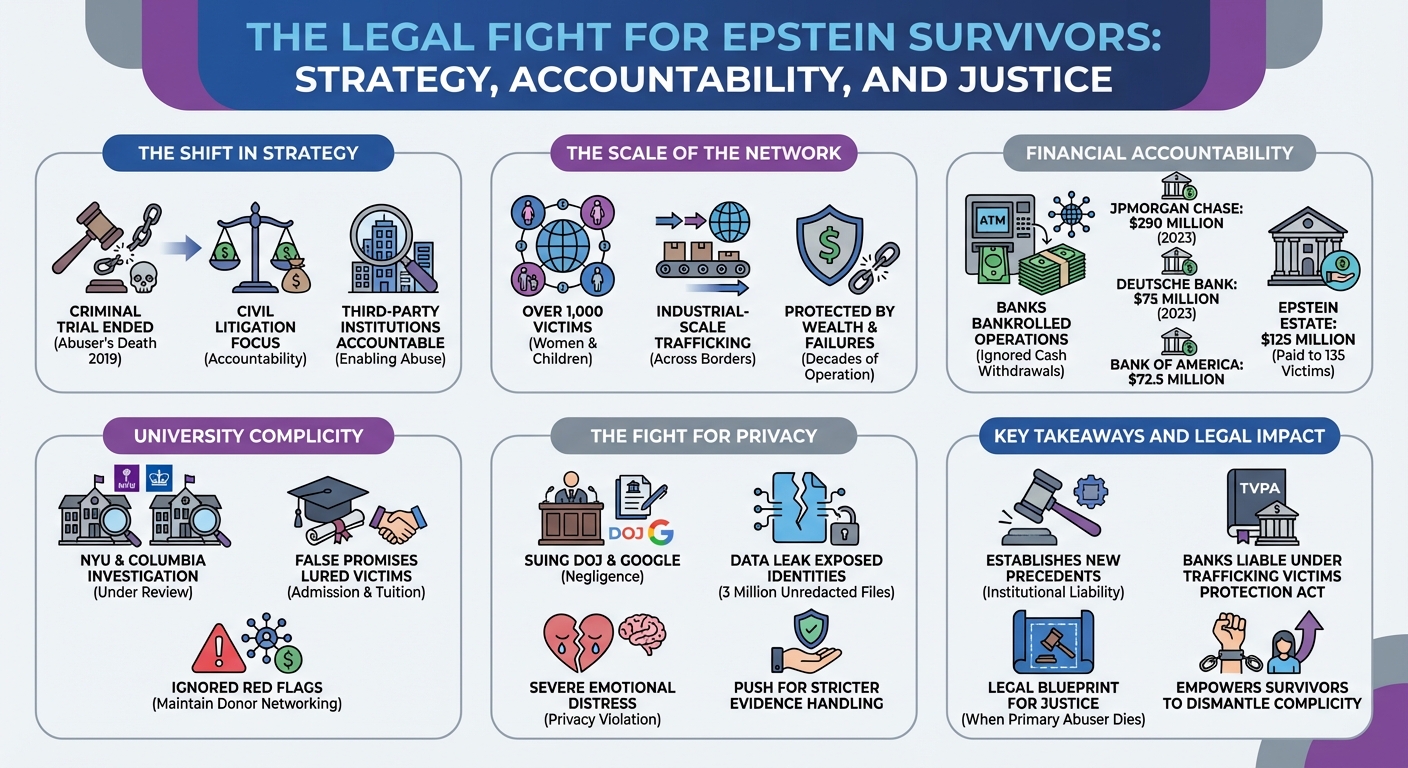
The legal fight for the victims of Jeffrey Epstein focuses on holding third-party enablers accountable following his death. With over 1,000 identified survivors, ongoing civil litigation targets financial institutions, universities, and government agencies for their roles in facilitating the abuse or failing to protect survivor anonymity.
The Legal Fight for Jeffrey Epstein’s Victims: Settlements and Accountability
When Jeffrey Epstein died in his jail cell in 2019, the criminal justice system lost its primary target. For the victims of Epstein, this meant an abrupt end to the possibility of a criminal trial. However, the fight for justice did not stop; it shifted. Survivors and their legal teams pivoted toward civil litigation, focusing on the complex network of third-party enablers who facilitated, financed, and ignored the sex trafficking ring.
Today, the legal strategy centers on holding powerful institutions accountable. By targeting banks, universities, and government agencies, survivors are establishing new legal precedents for third-party liability in institutional abuse cases.
The Scale of the Abuse: Understanding the 1,000+ Survivors
The true scope of Epstein’s trafficking network is staggering. While early indictments focused on a smaller group of Jane Does, recent survivor testimonies and legal disclosures reveal a much larger operation.
Recent Revelations on the Scope of the Trafficking Ring
Advocates and survivors now estimate that Epstein victimized over 1,000 women and children. Survivors like Danielle Bensky have publicly emphasized this number to highlight the industrial scale of the abuse. The trafficking ring operated across multiple states and countries, relying on a sophisticated recruitment system where vulnerable minors were lured, exploited, and silenced.
How the System Protected the Abuser for Decades
Epstein evaded meaningful consequences for decades due to systemic failures. Wealth, political connections, and high-powered legal defense teams allowed him to secure a highly controversial non-prosecution agreement in 2008. The system prioritized the protection of a wealthy financier over the safety of minors, ignoring glaring red flags and allowing the abuse to continue for another decade.
Major Financial Settlements for Epstein Victims
Financial institutions played a crucial role in sustaining Epstein’s operations. By processing massive cash withdrawals and ignoring internal compliance warnings, banks effectively bankrolled the trafficking ring. Civil lawsuits have forced these institutions to pay hundreds of millions of dollars in restitution.
The Recent $72.5 Million Bank of America Settlement
In a major recent development, Bank of America agreed to a $72.5 million settlement to resolve claims brought by Epstein survivors. The lawsuit alleged that the bank provided the financial infrastructure necessary for the trafficking operation to function, failing to act on suspicious activity reports.
Previous Accountability: JPMorgan Chase and Deutsche Bank
The Bank of America settlement follows massive payouts from other global financial institutions. These settlements were largely driven by claims under the Trafficking Victims Protection Act (TVPA).
| Financial Institution | Settlement Amount | Year of Settlement |
|---|---|---|
| JPMorgan Chase | $290 Million | 2023 |
| Deutsche Bank | $75 Million | 2023 |
| Bank of America | $72.5 Million | 2026 |
How the Epstein Victims’ Compensation Program (EVCP) Worked
Before the major bank settlements, the Epstein Victims’ Compensation Program (EVCP) was established as an independent, voluntary claims resolution process funded by the Epstein estate. The program was designed to provide a confidential, non-adversarial alternative to traditional litigation. Before concluding its operations, the EVCP paid out over $125 million to more than 135 eligible claimants.
Ongoing Litigation: The DOJ Data Leak and Privacy Lawsuits
The legal battles for Epstein survivors extend beyond financial restitution. Protecting their identities and privacy remains a critical and ongoing fight.
Why Survivors Are Suing the US Government and Google
Recently, victims filed a lawsuit against the US Department of Justice and Google. The litigation stems from the DOJ’s publication of more than 3 million files related to the case. Survivors allege that this massive data release improperly exposed their identities, violating their right to privacy and causing severe emotional distress.
The Impact of the 3 Million File Release on Victim Anonymity
Anonymity is a cornerstone of recovery for many survivors of sexual abuse. The release of these unredacted or poorly redacted files has forced many victims back into the public eye against their will. The lawsuit argues that the government acted negligently in its handling of highly sensitive evidence.
Protecting Survivor Identities in High-Profile Abuse Cases
This lawsuit underscores a critical flaw in how the justice system handles evidence in high-profile sex trafficking cases. Legal advocates are using this litigation to push for stricter federal guidelines on data redaction and the handling of survivor information by tech platforms and government agencies.
Institutional Complicity: Universities and Financial Enablers
Beyond banks, educational institutions are now facing intense scrutiny for their alleged roles in Epstein’s recruitment network.
House Judiciary Findings on NYU and Columbia University
Recent letters from House Judiciary Democrats have highlighted deeply troubling allegations regarding New York University (NYU) and Columbia University. Survivors have revealed that Epstein leveraged his relationships with these prestigious institutions to lure victims, falsely promising them admission and tuition assistance in exchange for compliance.
How Institutions Ignored Red Flags to Maintain Relationships
The investigations suggest that these universities ignored clear warning signs about Epstein’s behavior. Driven by the prospect of lucrative donations and high-society networking, institutional leaders turned a blind eye. This complicity highlights how prestige and wealth can insulate abusers from institutional oversight.
What These Cases Mean for Survivors of Institutional Abuse
The ongoing litigation surrounding the victims of Epstein is reshaping the landscape of personal injury and civil rights law, particularly regarding institutional abuse.
Setting Legal Precedents for Third-Party Liability
These lawsuits are cementing the legal framework required to hold third parties liable. By successfully suing banks under the TVPA, survivors have proven that institutions cannot claim ignorance when their services are used to facilitate human trafficking.
Pursuing Justice When the Primary Abuser Evades Trial
Epstein’s death could have been the end of the story. Instead, the subsequent civil suits provide a blueprint for other survivors whose abusers die, flee, or otherwise evade criminal conviction. It proves that justice can still be extracted from the network that enabled the abuse.
How Civil Litigation Empowers Survivors
Ultimately, civil litigation has given Epstein’s victims a voice and a mechanism for accountability. Through depositions, public filings, and financial settlements, survivors are dismantling the systems that protected their abuser, ensuring that the enablers pay a heavy price for their complicity.