
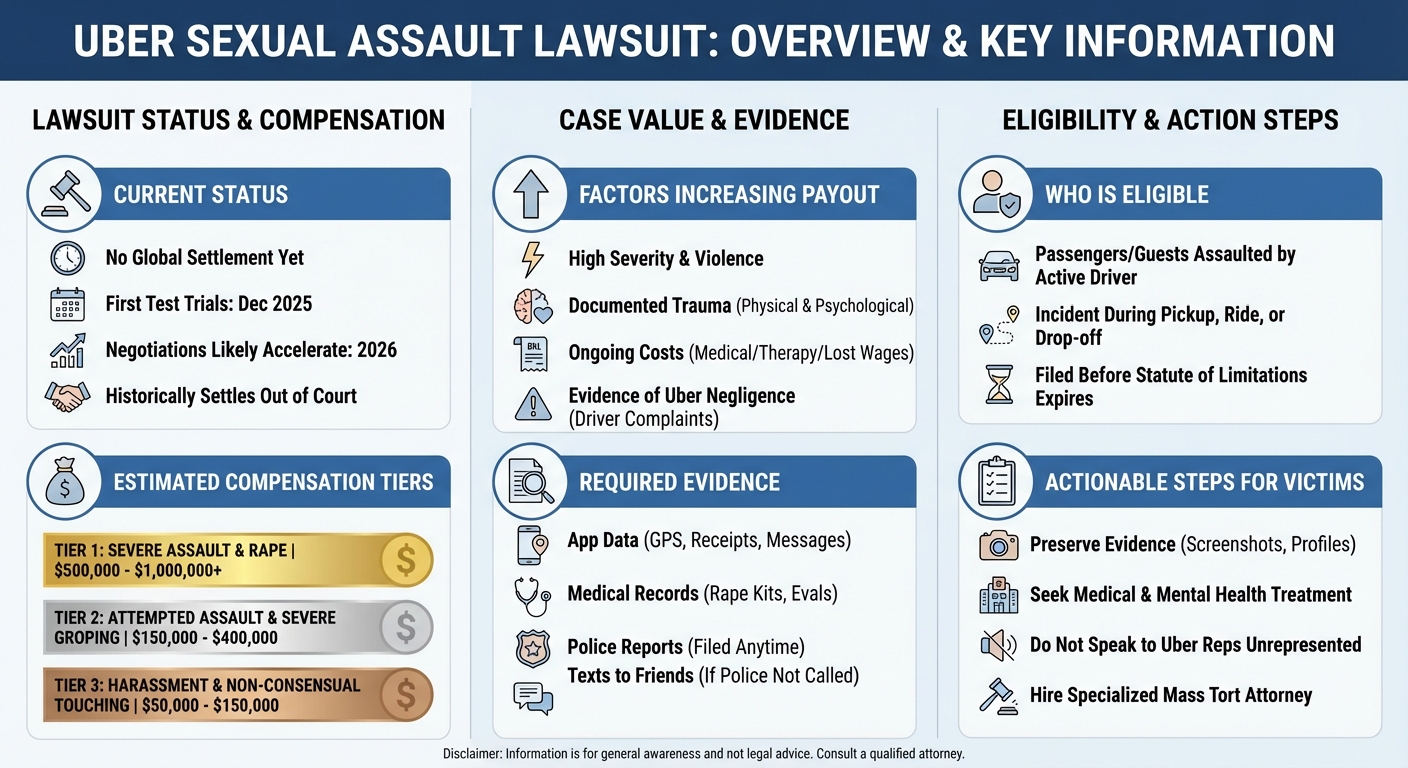
While there is no finalized global settlement yet, estimated Uber sexual assault lawsuit payouts range from $50,000 to over $1,000,000 per person. Compensation is divided into tiers: Tier 1 (severe assault) averages $500,000+, Tier 2 (attempted assault) averages $150,000-$400,000, and Tier 3 (harassment) averages $50,000-$150,000.
Uber Sexual Assault Lawsuit Settlement Amounts: What Victims Need to Know
Survivors of sexual assault and harassment during Uber rides are seeking justice and financial compensation through a nationwide mass tort. With thousands of claims consolidated into multidistrict litigation (MDL), victims and their families are closely monitoring the potential payout values. While our main Uber lawsuit page covers the broader legal updates, this guide focuses specifically on estimated settlement amounts, compensation tiers, and the financial factors that will dictate your potential payout.
How much is the Uber sexual assault settlement?
There is currently no finalized global Uber sexual assault settlement, but total payouts could eventually reach hundreds of millions of dollars. Projected individual settlements range from $50,000 to over $1,000,000, depending on the severity of the assault. Final amounts will depend heavily on the upcoming 2025 bellwether trials.
Projected Global Settlement vs. Individual Payouts
In mass torts, a “global settlement” refers to a large sum of money the defendant agrees to pay to resolve the majority of claims. However, this money is not divided equally. Instead, a settlement matrix or tier system is established. Each plaintiff’s individual payout is calculated based on the specific facts of their case, ensuring that those who suffered the most severe trauma receive the highest compensation.
How much will I get from the Uber settlement per person?
How much you will get from the Uber settlement per person depends on your specific injury tier. Estimated payouts are $500,000 to $1,000,000+ for severe assaults, $150,000 to $400,000 for attempted assaults, and $50,000 to $150,000 for harassment. Your exact compensation relies on documented evidence and trauma.
| Settlement Tier | Type of Incident | Estimated Payout Range |
|---|---|---|
| Tier 1 | Severe Assault and Rape | $500,000 – $1,000,000+ |
| Tier 2 | Attempted Assault and Severe Groping | $150,000 – $400,000 |
| Tier 3 | Harassment and Non-Consensual Touching | $50,000 – $150,000 |
Tier 1: Severe Assault and Rape (Estimated $500,000 – $1,000,000+)
Cases involving completed rape, severe physical violence, or kidnapping fall into the highest compensation tier. Because these incidents result in profound, lifelong psychological and physical trauma, juries and settlement matrices award maximum damages. In cases with egregious negligence by Uber (such as ignoring prior complaints about the driver), payouts could easily exceed $1 million.
Tier 2: Attempted Assault and Severe Groping (Estimated $150,000 – $400,000)
This tier covers attempted sexual assault, forced kissing, and severe, non-consensual groping. While the physical injuries may be less severe than Tier 1, the emotional distress, PTSD, and violation of trust are highly compensable. Documentation of therapy and psychological impact plays a major role in maximizing these claims.
Tier 3: Harassment and Non-Consensual Touching (Estimated $50,000 – $150,000)
Tier 3 includes claims of verbal sexual harassment, indecent exposure, and brief non-consensual touching. Even without severe physical injury, victims are entitled to compensation for the emotional distress and breach of safety experienced during the ride.
Factors That Determine Your Settlement Value
No two cases are exactly alike. Lawyers and settlement administrators will look at several key variables to place your claim in the appropriate tier.
Severity and Nature of the Assault
The specific actions of the driver are the primary driver of settlement value. The law assigns higher financial damages to more invasive and violent acts.
Documented Psychological and Physical Trauma
Compensation is directly tied to the damages you can prove. This includes medical bills, costs for ongoing trauma therapy, lost wages if you were unable to work, and non-economic damages for pain and suffering.
Strength of Evidence (Police Reports, App Data, Medical Records)
- App Data: GPS tracking, ride receipts, and in-app messages proving the driver and passenger were together.
- Medical Records: Rape kit results, hospital records, and psychological evaluations.
- Police Reports: Official documentation of the incident, even if filed days or weeks later.
Punitive Damages Potential
If evidence shows Uber knew a driver had a history of sexual misconduct but allowed them to continue driving, a jury may award punitive damages to punish the company. This threat often forces defendants to offer higher out-of-court settlements.
Does Uber usually settle out of court?
Yes, Uber usually settles out of court to avoid public trials, negative publicity, and unpredictable jury verdicts. In past civil cases, the company has frequently utilized confidential settlement agreements. However, in this mass tort, Uber may wait until the first bellwether trials conclude to establish baseline settlement values.
The Role of Bellwether Trials in Forcing a Settlement
The first bellwether trial is scheduled for December 2025. These “test trials” help both sides see how juries react to the evidence. If juries award massive verdicts to the plaintiffs, Uber will face immense pressure to offer a generous global settlement to resolve the remaining thousands of cases out of court.
Confidentiality Agreements and Past Uber Settlements
Historically, Uber has required victims to sign non-disclosure agreements (NDAs) in exchange for settlement money. While laws in some states have changed to prevent forced NDAs in sexual assault cases, out-of-court settlements remain Uber’s preferred method for handling these liabilities quietly.
Who is eligible for Uber lawsuit?
You are eligible for the Uber lawsuit if you were a passenger who experienced sexual assault, harassment, or abuse by a driver while using the Uber app. Eligibility requires proving the incident occurred during an active ride and filing your claim within your state’s specific statute of limitations.
Criteria for Passengers and Riders
To qualify, you must show that you were a user of the platform (or a guest of a user) and that the perpetrator was an active Uber driver at the time of the incident. The assault must have occurred during the ride, during pickup, or immediately after drop-off.
The Importance of the Statute of Limitations
Every state has a strict deadline, known as the statute of limitations, for filing a civil lawsuit. If you miss this window, you lose your right to compensation forever. Because these deadlines vary wildly by state (ranging from one year to several years), it is critical to consult a lawyer immediately.
What If I Didn’t Report It to the Police Immediately?
You can still file a lawsuit even if you did not call the police right away. Trauma often delays reporting. Your lawyer can use alternative evidence, such as Uber ride receipts, texts to friends, and therapy records, to substantiate your claim.
Timeline: When Will the Uber Lawsuits Settle?
Mass torts take time. Currently, the litigation is in the discovery phase.
Key MDL Dates and Settlement Projections
With the first bellwether trial set for late 2025, a global settlement is unlikely to occur before 2026. If the initial trials result in large plaintiff victories, settlement negotiations will likely accelerate in early to mid-2026.
How to Maximize Your Potential Compensation
Taking the right steps early can significantly impact the value of your claim.
Steps to Protect Your Claim Today
- Preserve Evidence: Screenshot your Uber ride history, driver profile, and any communications.
- Seek Treatment: Establish a medical and psychological record of the trauma.
- Do Not Speak to Uber’s Insurance Unrepresented: Their goal is to minimize your payout.
Why You Need a Specialized Mass Tort Lawyer
Mass tort litigation against a tech giant requires immense resources. A specialized attorney understands how to navigate the MDL process, properly value your claim within the tier system, and fight for the maximum possible settlement without charging you upfront fees.
 Call (713) 747-7777