

Table of contents
Introduction
After a Houston car accident, one document carries enormous weight with insurance companies, defense attorneys, and juries: the police report. Insurance adjusters treat it as authoritative. Defense attorneys cite it extensively. Juries view it as an official, unbiased record of what happened.
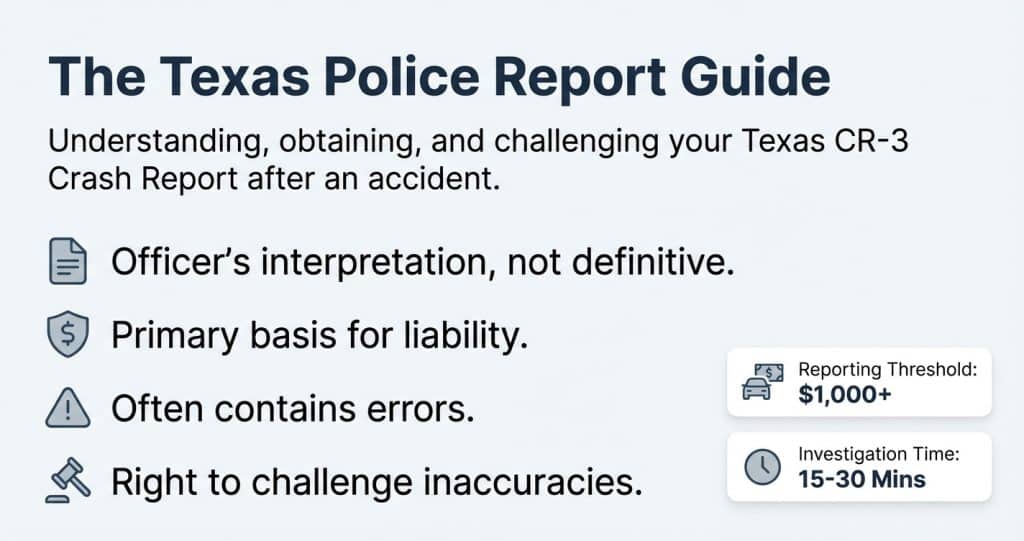
But here’s what most accident victims don’t understand: the police report is not a neutral, definitive account of your accident. It’s one officer’s interpretation, created after the fact, based on limited information gathered in a brief investigation. Sometimes the report is accurate and helpful. Sometimes it contains errors, omissions, or conclusions that can devastate your claim.
Understanding what the police report actually is—and what it isn’t—helps you use it effectively when it supports your case while challenging inaccuracies when it doesn’t. This guide explains the anatomy of a Texas police report, how to obtain yours, how to read it critically, and what to do when the report gets things wrong.
What the Texas CR-3 Crash Report Contains
Texas law requires peace officers to investigate and report motor vehicle accidents involving injury, death, or property damage exceeding $1,000. Given how expensive vehicle repairs are today, virtually every accident with any meaningful damage meets this threshold. The standard report form is called the CR-3, and understanding its components helps you evaluate your own report.
Crash Identification and Location: The first section of the report identifies when and where the accident occurred. This includes the date and time of the crash, the county and city where it happened, the specific street names and nearest intersection or address, GPS coordinates if available, and whether the accident occurred in an intersection, on a highway, in a parking lot, or elsewhere. Accuracy here matters—if the report says the accident occurred at Main and First when it actually happened at Main and Second, that error could affect witness identification or surveillance footage searches.
Unit Information: Each vehicle involved in the accident is assigned a “unit” number. This section records detailed information about each vehicle including year, make, model, and color, license plate number and state, vehicle identification number (VIN), registered owner information, insurance company and policy number, and driver information including name, address, date of birth, and driver’s license number.
Driver Information: For each driver, the report documents license status (valid, expired, suspended), any apparent impairment (alcohol, drugs), whether seatbelts were worn, and whether airbags deployed. If the officer suspects impairment, this section may note field sobriety test results or blood alcohol content.
The Narrative: This is the officer’s written description of how the accident occurred based on their investigation. It’s the most subjective—and often most influential—section of the report. The narrative typically describes what each driver was doing before the collision, how the collision occurred, what happened after impact, and the officer’s understanding of why the accident happened. Because this section reflects the officer’s interpretation, it’s where errors and biases most commonly appear.
The Diagram: Officers create a diagram showing the positions of vehicles before, during, and after the collision. The diagram includes lane positions and direction of travel for each vehicle, the estimated point of impact, final resting positions of vehicles, relevant road features like traffic signals, stop signs, and lane markings, and any skid marks or debris patterns. These diagrams are sketches, not engineering drawings, and may not be precisely to scale.
Contributing Factors: Texas CR-3 reports include checkboxes for contributing factors the investigating officer believes caused or contributed to the accident. Common factors include failed to yield right of way, disregarded traffic signal or stop sign, unsafe speed, improper lane change or turn, followed too closely, distracted driving including cell phone use, fatigued or asleep, and under influence of alcohol or drugs. The officer may check multiple factors for one or both drivers. These assessments significantly influence how insurance companies evaluate liability.
Injuries: The report documents whether anyone was injured and the apparent severity using standard classifications ranging from “not injured” through “possible injury,” “non-incapacitating injury,” “incapacitating injury,” to “killed.” The officer’s injury assessment is based on observation at the scene and may not reflect the true severity of injuries that haven’t yet manifested symptoms.
Citations Issued: If the officer issued any traffic citations, they’re noted in the report. A citation is strong evidence of fault, though not conclusive proof. Conversely, the absence of a citation doesn’t mean the driver wasn’t at fault—officers sometimes decline to issue citations even when violations clearly occurred.
Witness Information: Contact information for witnesses interviewed by the officer should be recorded. However, officers don’t always identify or document all witnesses, and some witnesses may leave the scene before police arrive.
What the Police Report Gets Wrong
Police officers are trained professionals doing difficult jobs under challenging conditions. But they’re not infallible—and they face significant limitations when investigating accident scenes that can lead to errors in their reports.
Officers Arrive After the Fact: The most fundamental limitation is that the investigating officer didn’t witness your accident. They arrive after the collision has occurred and must reconstruct what happened based on physical evidence that may have been disturbed, statements from involved parties who have strong incentives to shade the truth in their favor, their training and experience with similar accidents, and limited time to conduct a thorough investigation. The report represents the officer’s best interpretation of available evidence, not firsthand observation of the event.
Limited Investigation Time: Houston police respond to dozens of accidents every day. Unless your accident involves serious injury, death, or significant criminal activity, the investigating officer likely spent 15-30 minutes at the scene. That’s not much time for a thorough investigation. Officers must balance competing demands—directing traffic, securing the scene, interviewing parties, documenting evidence, clearing the roadway—all under time pressure. Detailed investigation often isn’t possible.
Statement Reliability: Officers rely heavily on statements from the involved drivers. But accident victims are often in shock, confused about exactly what happened, or simply mistaken in their recollections. Drivers may also shade their statements—consciously or unconsciously—to avoid liability. The officer has no reliable way to determine who’s telling the truth when accounts conflict.
Diagram Inaccuracies: Accident diagrams are quick sketches created at the scene, not precise engineering drawings. They may not accurately represent distances, angles, vehicle sizes, or positions. Details that seem minor—the exact lane position of a vehicle, the precise location of the point of impact—can matter significantly in determining fault.
Missing Witnesses: Officers may not identify all witnesses to the accident. Witnesses who saw everything may drive away before police arrive. Pedestrians may leave the area. The officer has no way to know these witnesses existed, so they’re not documented in the report.
Incomplete Physical Evidence: Officers document obvious physical evidence—skid marks, debris, vehicle damage—but may miss subtle evidence. They may not notice a traffic signal malfunction. They may not realize a sight obstruction contributed to the accident. They may not document evidence that requires technical expertise to recognize.
Officer Bias: Like all humans, police officers can have unconscious biases. Studies have shown that factors like vehicle types, driver demographics, accident locations, and which driver is more cooperative or articulate can influence officer assessments—even when officers are trying to be fair and objective.
I’ve handled numerous cases where the police report confidently assigned fault to my client—and we proved through independent investigation, expert analysis, and witness testimony that the officer’s conclusions were completely wrong. The report matters, but it’s not the final word on what happened.
How to Obtain Your Police Report in Texas
Obtaining your accident report is straightforward once you know where to look.
Texas Department of Transportation (TxDOT): For accidents investigated by Texas Department of Public Safety troopers or reported to TxDOT, you can order reports through the TxDOT Crash Records Information System (CRIS) at cris.dot.state.tx.us. Reports cost $6.00 for certified copies or $4.00 for non-certified copies. You can search by date, location, or your name.
Houston Police Department: For accidents investigated by HPD within Houston city limits, contact the Houston Police Department Records Division. Reports can be requested online through the HPD website, by mail with a written request and payment, or in person at the Records Division office. Allow 10-15 business days for processing. There’s a small fee for copies.
Harris County Sheriff’s Office: For accidents in unincorporated Harris County investigated by sheriff’s deputies, contact the Sheriff’s Office Records Bureau. Procedures and fees are similar to HPD.
Suburban Police Departments: If your accident occurred in a Houston suburb—Katy, Sugar Land, The Woodlands, Pasadena, Pearland, Cypress, and dozens of others—contact that city’s police department directly. Each municipality has its own records request process.
Timeline Expectations: Texas law gives officers 10 days to file crash reports after investigating an accident. Reports are typically available to the public within 2-3 weeks of the accident date, though complex accidents involving serious injury or criminal charges may take longer.
Multiple Agency Response: In some accidents, multiple agencies respond—for example, both Houston Police and Texas DPS might investigate a highway accident within city limits. Make sure you obtain reports from all investigating agencies.
Reading Your Report Critically: What to Look For
When you receive your police report, review it carefully and critically. Don’t assume everything in it is accurate.
Verify Basic Information: Start by checking that basic facts are correct. Is your name spelled correctly? Is your address accurate? Is your vehicle information—year, make, model, license plate—correct? Is your insurance information accurate? Errors in basic information suggest the report may have other inaccuracies and should make you look more carefully at everything else.
Read the Narrative Carefully: The officer’s narrative is the most important—and most subjective—section. Read it multiple times. Does it accurately describe what happened from your perspective? Are there statements attributed to you that you didn’t make or that are taken out of context? Does it accurately capture what the other driver did? Are there factual errors about the sequence of events?
Examine Contributing Factors: Review which contributing factors the officer checked for each driver. Do you agree with these assessments? If the officer marked “failure to control speed” for the other driver but didn’t mark “disregarded traffic signal” when the other driver ran a red light, that omission matters. If the officer marked a contributing factor for you that you believe is incorrect, note your objection.
Analyze the Diagram: Compare the diagram to your memory of the accident. Are the vehicle positions before impact shown correctly? Is the point of impact in the right location? Are the final resting positions accurate? Are traffic controls—signals, stop signs, lane markings—shown correctly? Diagram errors can significantly affect liability analysis.
Check Witness Information: Are all witnesses you’re aware of listed in the report? Did the officer miss anyone? If you gave the officer witness contact information that doesn’t appear in the report, that’s a documentation failure. Missing witnesses can sometimes be tracked down if you have independent information about who was at the scene.
Review Citations: Note whether any citations were issued to either driver. If you were cited, understand that this affects—but doesn’t conclusively determine—liability. If the other driver was cited, this supports your claim. If no citations were issued despite clear violations, note that discrepancy.
Scrutinize Statements Attributed to You: Pay particular attention to any statements the report attributes to you. If you’re quoted as saying something you didn’t say, or if your words are taken out of context, document your objection immediately. These attributed statements can be used against you.
Challenging Inaccurate Police Reports
What do you do when the police report contains errors that could hurt your case? Texas law provides several mechanisms for addressing inaccuracies.
Supplemental Statements: You have the right to submit a supplemental statement to the investigating agency. This statement doesn’t change the original report, but it adds your corrections, clarifications, or objections to the official record. Put your supplemental statement in writing, be specific about what you believe is inaccurate, and explain what actually happened.
Formal Correction Requests: For clear factual errors—your name is misspelled, the vehicle description is wrong, the accident location is incorrect—you can request corrections through the investigating agency. Agencies will typically correct obvious clerical errors. However, they generally won’t change interpretive elements like the officer’s narrative or fault assessments based on your disagreement.
Litigation Strategy: In personal injury litigation, police reports are not automatically admissible as evidence. They’re hearsay—an out-of-court statement offered to prove the truth of what it asserts. Your attorney can challenge the report’s admissibility or, if it’s admitted, present evidence contradicting the officer’s conclusions. Witness testimony, accident reconstruction experts, surveillance footage, and other evidence can overcome an unfavorable police report.
Officer Depositions: In litigation, the investigating officer can be subpoenaed and deposed—questioned under oath by attorneys. During deposition, officers sometimes acknowledge limitations in their investigations, uncertainty about their conclusions, or factors they didn’t consider. A skilled attorney knows how to effectively question officers about their reports and expose weaknesses in their analysis.
Independent Investigation: Your attorney can conduct an independent investigation that may reveal facts the officer missed or got wrong. This can include locating and interviewing additional witnesses the officer didn’t find, obtaining surveillance footage from nearby businesses or traffic cameras, hiring accident reconstruction experts to analyze physical evidence, reviewing the other driver’s cell phone records for evidence of distraction, obtaining the other driver’s driving history, and examining maintenance records if vehicle defects contributed to the accident. This independent evidence can directly contradict an unfavorable police report.
When the Police Report Helps Your Case
Police reports aren’t always problematic—when accurate, they can be your strongest evidence.
Clear Fault Assessment: If the officer clearly assigns fault to the other driver, notes specific traffic violations, or issues citations, this strongly supports your claim. Insurance adjusters give significant weight to officer assessments. A report stating “Unit 2 [the other driver] failed to yield right of way and struck Unit 1 [you] in the intersection” is powerful evidence.
Documented Traffic Violations: If the report documents that the other driver ran a red light, violated a stop sign, was speeding, made an illegal turn, or committed other violations, this evidence supports your claim even if no citation was issued. The officer’s contemporaneous observation carries significant weight.
Injury Documentation: The officer’s observation that you appeared injured, complained of pain, or were transported to the hospital by ambulance creates official documentation supporting your injury claim. This contemporaneous record is difficult for insurance companies to dispute.
Witness Contact Information: Even if the officer didn’t get detailed witness statements, having names and contact information for witnesses is valuable. Your attorney can follow up with these witnesses to obtain more complete accounts of what they observed.
Physical Evidence Documentation: The officer’s documentation of physical evidence—skid marks, debris patterns, vehicle damage, road conditions—preserves evidence that might otherwise be lost. This documentation can support accident reconstruction analysis.
Admissions by the Other Driver: If the other driver made admissions to the investigating officer—”I didn’t see the light change,” “I was checking my phone,” “I thought I could make it through the intersection”—these statements may be documented in the report and can be powerful evidence of fault.
The Police Report and Insurance Claims
Understanding how insurance companies use police reports helps you navigate the claims process.
Initial Liability Assessment: Insurance adjusters typically order the police report early in their investigation. The report heavily influences their initial liability determination, which then affects every subsequent decision about your claim. A report favorable to the other driver will result in lowball settlement offers or outright denials. A report favorable to you smooths the path to fair compensation.
Computerized Claim Evaluation: Insurance companies use software programs like Colossus to evaluate claims. These programs give significant weight to police report data, including contributing factors checked by the officer, citations issued, and the officer’s fault assessment. An unfavorable police report can automatically reduce your claim’s evaluated value.
Settlement Negotiations: During settlement negotiations, adjusters will cite the police report to support their positions. If the report favors you, use it. If the report is unfavorable, be prepared to explain why it’s inaccurate and present contrary evidence.
Litigation Implications: If your claim proceeds to litigation, the police report becomes a key document that both sides will reference. Your attorney needs to know its contents intimately and be prepared to support favorable findings while challenging unfavorable ones.
Not Legally Binding: Despite its influence, the police report does not legally bind anyone. Courts can—and do—reach conclusions that differ from officer assessments. Insurance companies can be persuaded by other evidence. The report matters significantly, but it’s one piece of evidence among many, not the definitive final word on fault.
Conclusion: The Report Matters, But Truth Matters More
The police report is one of the most important documents in your accident claim. It influences insurance adjusters, shapes litigation strategy, and can sway juries. Treating it seriously is essential.
But the report isn’t infallible. Officers make mistakes. Investigations have limitations. Reports can be challenged with better evidence.
Obtain your police report promptly after your accident. Review it carefully and critically. Document any inaccuracies you identify. Understand that while the report is influential, it’s not conclusive—the truth of what happened matters more than what any single document says.
If your police report contains errors or reaches unfavorable conclusions, don’t despair. An experienced Houston personal injury attorney knows how to work with difficult reports: gathering independent evidence, deposing officers about their investigation, and presenting alternative narratives supported by facts that reflect what actually happened.
The police report is important evidence. But evidence can be challenged, contradicted, and overcome. Document your own evidence at the scene, preserve everything, and let the facts—all the facts, not just what one officer wrote in a report—speak for themselves.
Under Texas law, you’re entitled to fair compensation when someone else’s negligence causes you harm. A flawed police report is an obstacle, not a dead end. With the right evidence and the right legal representation, the truth can prevail.

About the Author
Chi Nguyen is a Houston personal injury attorney dedicated to helping accident victims understand their rights and receive fair compensation under Texas law. With extensive experience representing injured Texans, Attorney Nguyen combines legal expertise with a commitment to client education and empowerment.