
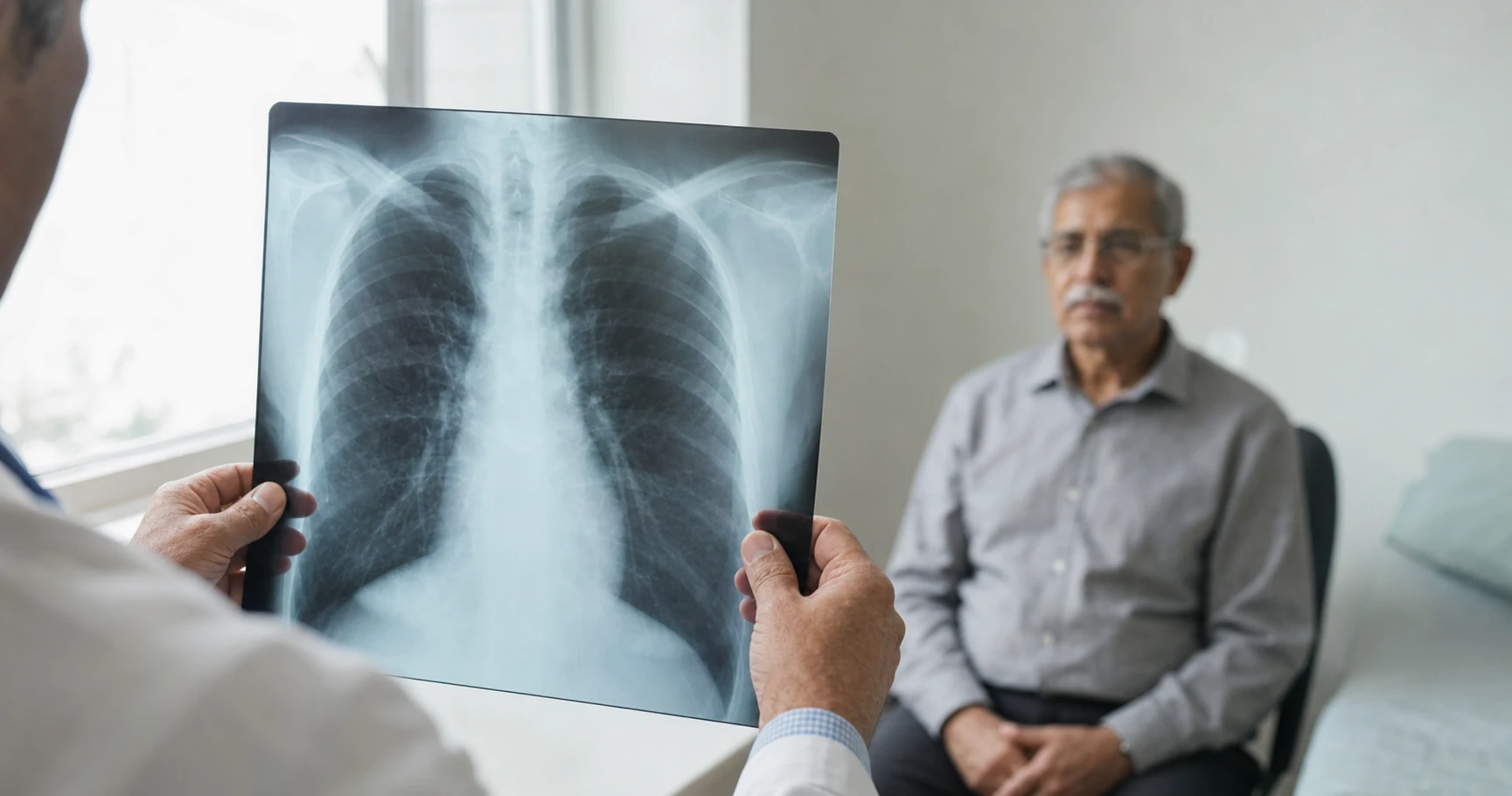
Yes, but only small amounts, and only from asbestos bankruptcy trusts: a Texas lawsuit over pleural plaques alone does not get past the state's asbestos screening law. In the claim documents of three large trusts we read, the lowest level of non-cancer asbestos disease pays a flat $300 to $600, and the next level pays about $400 to $750 after each trust's payment percentage.
More money is available only when plaques come with measured loss of lung function, or when a more serious disease develops. This page explains what pleural plaques are, what the trusts pay, why Texas courts dismiss plaque-only lawsuits and what to do if a scan shows plaques. It is current as of November 23, 2026.
At a glance: pleural plaques and compensation
| Question | Answer |
|---|---|
| What pleural plaques are | Patches of thickened tissue on the lining around the lungs, left by past asbestos exposure. |
| Symptoms | Usually none. |
| Do they turn into cancer? | No, but they mark exposure that carries a higher cancer risk. |
| Texas lawsuit over plaques alone | Dismissed without a doctor's report showing asbestos-related lung impairment on breathing tests. |
| Trust payment, lowest level | $300 to $600, flat, at the W.R. Grace, Armstrong and Manville trusts. |
| Trust payment, next level | About $400 to $750 after each trust's payment percentage. |
| With measured lung impairment | About $1,048 to $2,258 at the same trusts. |
| More than one trust? | Yes. Each trust that made products you were exposed to is a separate claim. |
What are pleural plaques?
Pleural plaques are "well-circumscribed areas of thickening, usually located bilaterally on the parietal pleura," the lining on the inside of the chest wall, according to the CDC's Agency for Toxic Substances and Disease Registry. They are the most common sign of asbestos exposure; the CDC reports the highest rate, 58%, in insulation workers.
They take a long time to appear. The Merck Manual puts the time from exposure to plaques at generally 20 years or more. Many people learn they have plaques by accident, on a chest X-ray or CT scan done for something else.
Do pleural plaques cause symptoms or turn into cancer?
Usually they cause no symptoms. The CDC says plaques "are usually asymptomatic, though they can cause small reductions in lung function," and in rare cases, under 1%, they cause chest pain. Diffuse pleural thickening, a wider scarring of the lining, is different and can restrict breathing.
Plaques do not turn into cancer. They are a marker: Merck calls them "a marker of significant asbestos exposure" and advises monitoring for other asbestos diseases. Large French studies of exposed workers found people with plaques had a higher risk of mesothelioma and of dying from lung cancer than exposed workers without them (J Natl Cancer Inst, 2013; Am J Respir Crit Care Med, 2014). That is why regular checkups with a lung doctor matter.
How much do asbestos trusts pay for pleural plaques?
Asbestos trusts group non-cancer claims into disease levels. Plaques on both lungs plus a qualifying work history usually fit the first two levels; the third level also requires breathing tests showing restriction. Here is what three trusts' own claim documents show:
| Trust | Level I (flat payment) | Level II: value, then payment | Level III, with lung impairment |
|---|---|---|---|
| W.R. Grace (30.1%, notice of April 17, 2025) | $300 | $2,500 value, $752.50 paid | $7,500 value, $2,257.50 paid |
| Armstrong World Industries (10.8%, March 28, 2025) | $400 | $3,700 value, $399.60 paid | $9,700 value, $1,047.60 paid |
| Manville (5.1%, trust filing of July 2025) | $600 | $12,000 value, $612.00 paid | $25,000 value, $1,275.00 paid |
How to read it:
- Level I is a flat "cash discount payment" that is not reduced by the payment percentage. It requires a diagnosis of bilateral asbestos-related non-cancer disease and exposure to that company's products before 1982.
- Level II needs the same diagnosis, which at these trusts can be bilateral pleural plaques, plus more exposure: for example, six months of work exposure to that company's products before 1982 and five years of total work exposure to asbestos.
- Level III adds breathing tests: total lung capacity below 80% of predicted, or forced vital capacity below 80% with a normal FEV1/FVC ratio.
The Grace trust also has a level for severe, disabling pleural thickening valued at $50,000, which pays $15,050 at 30.1%. Payment percentages change, sometimes upward, so check each trust's current notice before you rely on these numbers. Because each trust is a separate claim, a worker exposed to several companies' products can file with each one. For how trust payouts work in general, see asbestos trust fund payouts.
Can you sue for pleural plaques in Texas?
Not for plaques alone. Since 2005, Texas has required anyone suing over a non-cancer asbestos injury to serve a physician's report that, among other things, shows "asbestos-related pulmonary impairment as demonstrated by pulmonary function testing," such as a forced vital capacity or total lung capacity below 80% of predicted (Civil Practice and Remedies Code section 90.003). Without that report, a defendant can move to dismiss, and the court must grant the motion (section 90.007).
Two parts of the same law protect people with plaques:
- The dismissal is "without prejudice," so you can sue later if impairment or a cancer develops (section 90.007).
- For an asbestos injury, the two-year deadline does not start on a plaques diagnosis. It starts on the earlier of death or the day a qualifying report is served on a defendant (section 16.0031).
The report rules do not apply to trust claims: the law says it does not affect anyone's ability to meet a trust's own claim criteria (section 90.011).
Does workers' compensation cover pleural plaques in Texas?
It is an open question. Texas workers' compensation covers an occupational disease, defined as a disease from work "that causes damage or harm to the physical structure of the body" (Labor Code section 401.011). We found no Texas ruling on whether plaques with no symptoms meet that test. Workers' comp is also optional for most Texas employers, and much asbestos exposure happened decades ago at companies that no longer exist, so the trusts are usually the practical route.
What should you do if a scan shows pleural plaques?
- Keep the imaging report and ask for the images themselves.
- See a lung specialist for breathing tests and a plan for regular checkups.
- Write down your work history: employers, job sites, ships and plants, years, and the products you remember. Trust claims turn on proof of exposure.
- Check trust deadlines. Each trust sets its own filing rules, often tied to state law.
- Ask a lawyer before accepting any payment whether it limits a later claim if your diagnosis changes.
Talk to a lawyer about asbestos exposure
A lawyer can match your work history to the trusts that may owe you and file each claim with the right proof. If you or a family member has a more serious diagnosis, see mesothelioma and asbestos settlement amounts. Contact The Nguyen Law Firm or call (713) 747-7777 for a free case review, or learn about our Houston personal injury lawyers.
This article provides general information, not legal or medical advice. Trust values and payment percentages come from each trust's documents and change over time; the information here is as of November 23, 2026.
 Call (713) 747-7777