
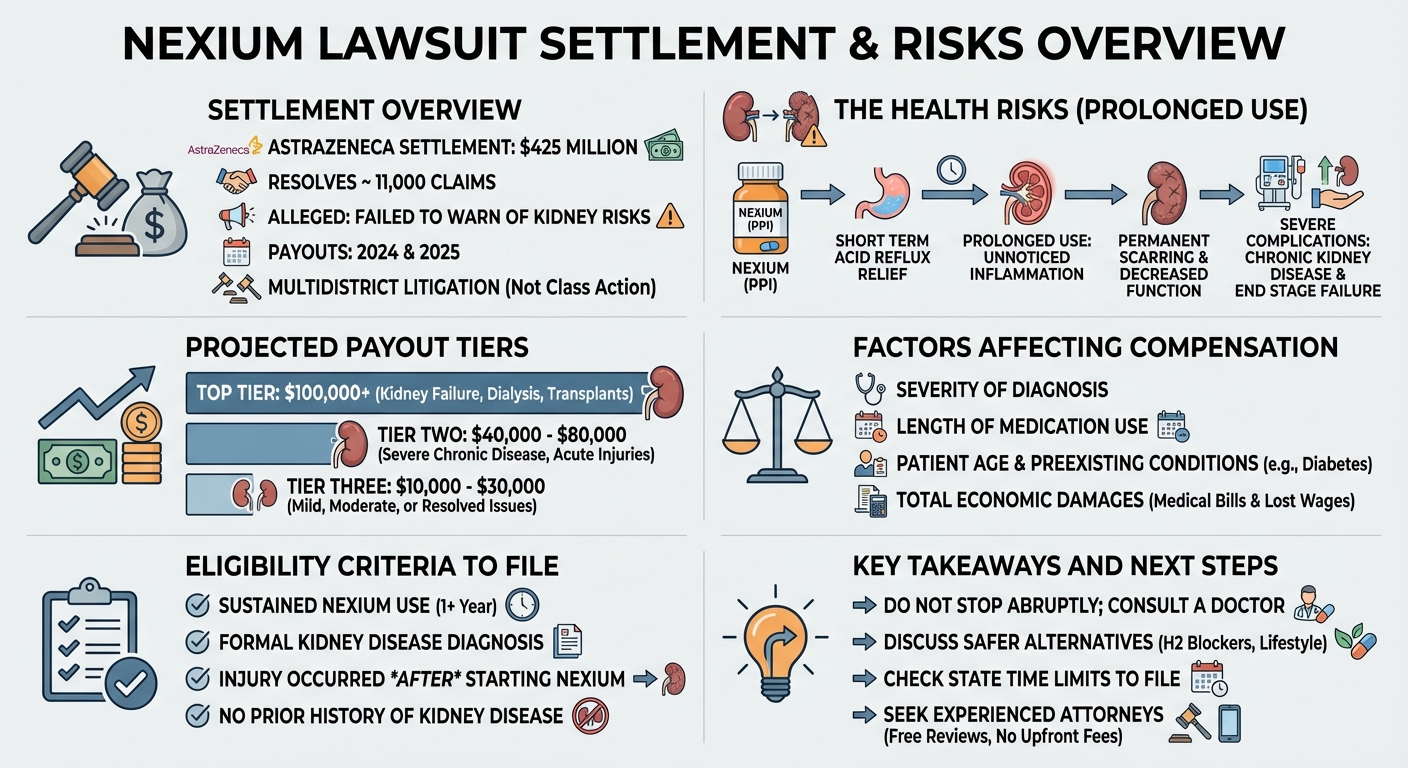
In late 2023, AstraZeneca agreed to a $425 million settlement to resolve thousands of Nexium and Prilosec lawsuits. Plaintiffs alleged these proton pump inhibitors caused severe kidney damage. Top-tier settlement payouts for severe chronic kidney disease or renal failure are estimated to reach $100,000 or more per individual case.
2025 Nexium Lawsuit Updates: The $425 Million Settlement
For years, patients relying on the popular heartburn medication Nexium have pursued legal action against its manufacturer, AstraZeneca. Plaintiffs allege the company failed to adequately warn consumers about the severe risks of kidney damage associated with prolonged use of Proton Pump Inhibitors (PPIs).
AstraZeneca’s Global Settlement Agreement
In October 2023, AstraZeneca announced a massive $425 million settlement to resolve product liability litigations related to Nexium and Prilosec. This global agreement covers approximately 11,000 claims consolidated in the multidistrict litigation (MDL) in New Jersey, as well as cases in Delaware state court. While AstraZeneca did not admit wrongdoing, this settlement provides a clear path to compensation for victims who suffered severe renal injuries.
When will the Nexium lawsuit be settled?
The global Nexium lawsuit settlement was officially announced by AstraZeneca in October 2023 for $425 million. While the overarching agreement is finalized, individual settlement payouts are expected to be processed and distributed to qualified plaintiffs throughout 2024 and 2025, depending on court administration and specific plaintiff agreements.
Projected Nexium Settlement Amounts and Payout Tiers
Because the Nexium litigation is an MDL rather than a traditional class action, settlement amounts are not distributed equally. Instead, compensation is determined using a tiered system based on the severity of the plaintiff’s injuries.
Top-Tier Kidney Damage Claims (Estimated $100,000+)
Plaintiffs in the top settlement tier have suffered the most catastrophic injuries. These cases typically involve end-stage renal disease (ESRD), kidney failure requiring dialysis, or patients who have undergone a kidney transplant. Based on historical mass tort data for similar injuries, these top-tier claims are estimated to settle for $100,000 to $150,000 or more.
Tier 2 and Tier 3 Settlements
Lower tiers compensate individuals with less severe, though still life-altering, kidney issues.
- Tier 2 (Estimated $40,000 – $80,000): Patients diagnosed with severe Chronic Kidney Disease (CKD) who do not yet require dialysis, or those who suffered severe Acute Kidney Injury (AKI) requiring hospitalization.
- Tier 3 (Estimated $10,000 – $30,000): Patients with mild to moderate CKD or acute interstitial nephritis that was treated and resolved without long-term permanent damage.
Key Factors Affecting Your Compensation
Several variables will influence where a claim falls within the payout tiers:
- Severity of Diagnosis: The exact medical diagnosis (e.g., CKD stage, AKI, renal failure).
- Duration of Use: How long the patient took Nexium before the injury occurred.
- Age and Health History: The plaintiff’s age at the time of injury and the presence of pre-existing conditions (like diabetes or hypertension) that could complicate causation.
- Economic Damages: The total cost of medical bills, lost wages, and out-of-pocket expenses.
Nexium Side Effects: Kidney Damage and Renal Failure
Nexium (esomeprazole) is a Proton Pump Inhibitor designed to reduce stomach acid. While effective for short-term relief of gastroesophageal reflux disease (GERD), long-term use has been linked to severe renal complications.
The Link Between PPIs and Chronic Kidney Disease (CKD)
Multiple medical studies, including research published in the Journal of the American Society of Nephrology, have demonstrated a significant correlation between prolonged PPI use and an increased risk of developing Chronic Kidney Disease. The medication can cause repeated, unnoticed bouts of acute inflammation in the kidneys (acute interstitial nephritis), which eventually leads to permanent scarring and decreased kidney function over time.
Why can’t you take Nexium long-term?
Taking Nexium long-term significantly increases the risk of severe side effects, including chronic kidney disease, acute interstitial nephritis, bone fractures, and severe magnesium deficiency. The FDA strongly recommends using proton pump inhibitors for only short durations to prevent these potentially irreversible and life-threatening health complications.
Eligibility: Who Can Still File a Nexium Claim?
Although a major settlement has been reached, some individuals who recently discovered their injuries may still have legal options depending on their state’s statute of limitations.
Criteria for Filing a PPI Lawsuit
To qualify for a Nexium kidney damage lawsuit, plaintiffs generally need to meet the following criteria:
- Documented Use: Proof of taking Nexium (prescription or over-the-counter) for a sustained period (usually at least one year).
- Qualifying Diagnosis: A formal medical diagnosis of Chronic Kidney Disease (CKD), Acute Kidney Injury (AKI), Acute Interstitial Nephritis (AIN), or End-Stage Renal Disease.
- Timing: The kidney injury must have occurred after starting Nexium.
- Lack of Pre-existing Conditions: No prior history of kidney disease before taking the medication.
Is there a class action lawsuit against Nexium?
While frequently referred to as a class action, Nexium lawsuits are actually consolidated into a multidistrict litigation (MDL). This legal structure allows plaintiffs to pool resources for pretrial discovery, but each case remains individual. Victims receive settlements based on their specific kidney injuries rather than a flat, divided payout.
Managing Acid Reflux: Health and Medical Considerations
If you are currently taking Nexium and are concerned about the legal and medical updates regarding kidney damage, it is crucial to explore safe alternatives.
What is a safer alternative to Nexium?
Safer alternatives to Nexium include H2 blockers like Pepcid (famotidine) or Tagamet (cimetidine), which effectively reduce stomach acid with a significantly lower risk of kidney damage. Additionally, lifestyle modifications such as dietary adjustments, weight management, and elevating your head during sleep can naturally manage acid reflux.
Discussing Medication Changes with Your Doctor
Never stop taking a prescribed medication abruptly without medical supervision. Rebound acid hypersecretion can occur if PPIs are stopped suddenly. Consult your gastroenterologist or primary care physician to create a tapering plan and transition to safer alternatives or lifestyle interventions.
How to Choose a Nexium Lawsuit Attorney
Navigating a mass tort claim requires specialized legal expertise. If you believe you have a valid claim, selecting the right representation is critical.
Why Experience in Mass Torts Matters
Mass tort litigations involving pharmaceutical giants like AstraZeneca are incredibly complex. You need a law firm with a proven track record in multidistrict litigation, access to top medical experts, and the resources to fight for maximum compensation in the appropriate settlement tier.
Free Case Evaluations and Contingency Fees
Top-rated Nexium lawsuit attorneys operate on a contingency fee basis. This means you pay zero upfront costs. The law firm only collects a legal fee if they successfully secure a settlement or jury verdict on your behalf. Most firms offer free, no-obligation case evaluations to review your medical records and determine your eligibility.
 Call (713) 747-7777