

Table of contents
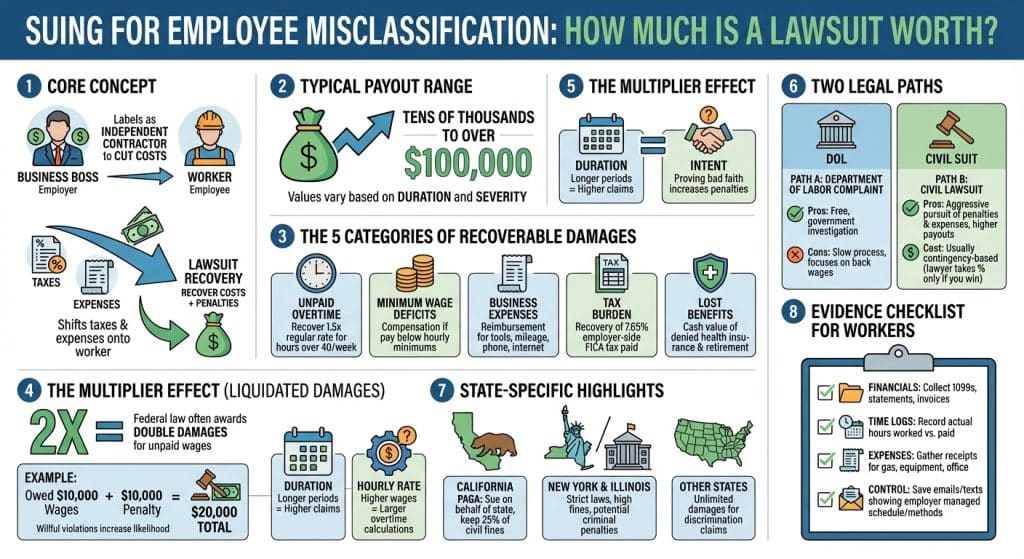
You can sue an employer for misclassification to recover unpaid overtime, minimum wage differentials, and reimbursement for business expenses. Under federal law, you are often entitled to “liquidated damages,” which doubles the amount of unpaid wages owed. Settlements typically range from $5,000 to over $100,000, depending on the duration of employment and lost benefits.
How Much Can You Sue an Employer for Misclassification?
When an employer misclassifies you as an independent contractor (1099) instead of an employee (W-2), they are essentially shifting their operating costs onto your shoulders. They avoid paying payroll taxes, overtime, and benefits, while you pay double the Social Security tax and lose legal protections.
The question of how much can you sue an employer for misclassification does not have a single flat-rate answer. Instead, the value of your lawsuit is calculated based on the wages and benefits you should have received but didn’t. In many cases, federal and state laws allow you to recover double the amount of your unpaid wages as a penalty to the employer.
While there is no “average” settlement, payouts typically range from $5,000 to over $100,000 per worker, depending heavily on your salary, how many hours of overtime you worked, and how long the misclassification lasted.
How Much Is a Misclassification Lawsuit Worth?
To estimate the potential value of a misclassification claim, you must look beyond your hourly rate. The bulk of the settlement usually comes from recalculating your pay under the Fair Labor Standards Act (FLSA).
Calculating Unpaid Overtime
Independent contractors are not entitled to overtime. Employees are. If you worked more than 40 hours in a week, you are owed 1.5x your regular rate for every overtime hour. If you worked 50 hours a week for two years, that is 1,000 hours of unpaid overtime pay owed to you.
Recovering Minimum Wage Differentials
If your net pay (after deducting your own business expenses) dropped below the federal or state minimum wage, the employer must pay the difference.
The Impact of the ‘Look-Back Period’
The statute of limitations determines how far back you can claim damages:
- Standard FLSA Violation: You can recover unpaid wages for the last 2 years.
- Willful Violation: If the employer knew they were breaking the law, the period extends to 3 years.
- State Laws: Some states, like New York or California, have look-back periods of up to 6 years, significantly increasing the potential payout.
The 5 Types of Damages You Can Recover
When you sue for misclassification, you are not just asking for your old paycheck. You are suing for specific damages defined by labor law.
1. Back Pay (Unpaid Wages)
This is the foundation of your claim. It includes all unpaid overtime premiums and any gap between what you were paid and the minimum wage.
2. Liquidated Damages (Double Damages)
Under the FLSA, if an employer cannot prove they acted in good faith, the court may award “liquidated damages.” This is an amount equal to your back pay. Essentially, if you are owed $20,000 in back pay, the court awards you another $20,000, bringing the total to $40,000.
3. Business Expense Reimbursement
Contractors pay their own expenses; employees generally do not. You can sue to recover costs for:
- Equipment and tools
- Uniforms
- Mileage and gas (using the IRS mileage rate)
- Home office costs (if mandated)
4. Value of Lost Benefits
If employees at your company received health insurance, 401(k) matching, or paid time off, you can sue for the value of these benefits that you were denied.
5. Employer Tax Contributions
As a contractor, you likely paid self-employment tax (approx. 15.3%). As an employee, you should have only paid half of that. You can seek compensation for the employer’s share of FICA and Medicare taxes that you wrongly paid.
What Is the Penalty for Misclassification Employees as 1099?
Aside from the money paid directly to you, employers face stiff penalties from the government for misclassification. These penalties are designed to punish the employer rather than compensate the worker, though they provide leverage in settlement negotiations.
| Violation Type | Typical Federal Penalty |
|---|---|
| Standard Violation | $50 per W-2 not filed + 1.5% of wages + 40% of FICA taxes. |
| Willful Violation | Up to $1,000 per employee + 1 year in prison + 100% of FICA taxes. |
| State Penalties | Varies (e.g., California ranges from $5,000 to $25,000 per violation). |
Note: While civil penalties are generally paid to the Department of Labor or the IRS, the threat of these fines often encourages employers to settle lawsuits quickly.
What Happens If My Employer Misclassified Me as an Independent Contractor?
If you suspect you have been misclassified, you generally have two paths: administrative action or litigation.
Filing a Claim with the DOL vs. Filing a Lawsuit
You can file a form (SS-8) with the IRS or a complaint with the U.S. Department of Labor (DOL). The DOL may investigate and force the employer to pay back wages. However, the DOL process can be slow and might not recover the full “liquidated damages” (double pay) that a private lawsuit could secure.
The Investigation Process
Once a claim is filed, investigators will review the “economic reality” of your work arrangement. They look at who controlled the work, who provided the equipment, and whether the work was integral to the business.
Protection Against Retaliation
It is illegal for an employer to fire, demote, or harass you for filing a misclassification claim. If they do, you can add a retaliation claim to your lawsuit, which often carries its own set of punitive damages.
State-Specific Payout Factors (California, NY, Illinois)
Where you work matters as much as how much you worked. Some states have much stricter labor laws than the federal government.
- California: Under the Private Attorneys General Act (PAGA), workers can sue for civil penalties on behalf of the state. You keep 25% of the penalties, and the state gets 75%. These penalties accumulate per pay period and can reach tens of thousands of dollars quickly.
- New York: The Wage Theft Prevention Act allows for statutory damages of up to $5,000 per employee simply for not receiving proper wage notices, on top of unpaid wages.
- Illinois: The Employee Classification Act imposes strict liability in the construction industry, with substantial fines that can be leveraged in settlement discussions.
How Expensive Is It to Sue Your Employer?
Many workers hesitate to sue because they fear legal bills. However, employment law is structured to allow workers to sue without upfront costs.
Understanding Contingency Fees
Most employment lawyers work on a contingency fee basis. This means “no win, no fee.” If you win or settle, the lawyer takes a percentage (typically 33% to 40%) of the payout. If you lose, you generally owe nothing for attorney fees.
Fee Shifting: Making the Employer Pay
Crucially, the FLSA includes a fee-shifting provision. This means that if you win your case in court, the judge can order the employer to pay your attorney’s fees on top of the money they owe you. This puts immense pressure on employers to settle early, as fighting the case only increases their total bill.
Summary: Estimating Your Potential Settlement
To determine how much you can sue for, combine:
- Unpaid Overtime: (Total OT hours) x (1.5 x Hourly Rate).
- Liquidated Damages: Match the amount of unpaid wages (doubling the total).
- Expenses & Benefits: Add the value of tools, gas, and lost health/retirement contributions.
- State Penalties: Add statutory fines if you are in a worker-friendly state like CA or NY.
If the total is substantial, consulting an employment lawyer is usually the best next step to ensure you calculate your damages correctly.
FAQs
How much is a misclassification lawsuit worth?
A misclassification lawsuit is worth the total of your unpaid overtime and minimum wage differentials, plus an equal amount in liquidated damages (double damages). You can also recover the value of lost benefits (like health insurance) and business expenses. Settlements often range from thousands to over $100,000 depending on your salary and tenure.
What happens if my employer misclassified me as an independent contractor?
If you are misclassified, you have the right to file a claim with the Department of Labor or sue for back wages and damages. The employer may be forced to reclassify you as a W-2 employee, pay all back taxes, reimburse you for lost wages and benefits, and pay civil penalties to the government.
How expensive is it to sue your employer?
Suing your employer is usually free upfront because most employment lawyers work on a contingency fee basis (taking a percentage of the settlement). Additionally, the FLSA includes a fee-shifting provision, meaning the court can order your employer to pay your legal fees separately if you win.
What is the penalty for misclassification employees as 1099?
Employers face federal civil penalties including $50 for each unfiled W-2, 1.5% of wages, and 40% of FICA taxes. For willful violations, penalties increase to $1,000 per employee and potential criminal charges. State laws may impose additional fines, such as California’s penalties of up to $25,000 per violation.
Can I get fired for suing for misclassification?
No, it is illegal for an employer to fire or retaliate against you for filing a wage claim or a misclassification lawsuit. If they do terminate you, you can add a retaliation claim to your lawsuit, which can result in additional punitive damages and reinstatement of your job.