

Table of contents
You can typically sue for the full amount of unpaid wages plus an equal amount in liquidated damages (double damages). Additionally, the law generally requires the employer to pay your attorney’s fees and court costs. Depending on your state, you may also recover significant penalties for waiting time, missed breaks, or inaccurate pay stubs.
How Much Can You Sue for Unpaid Wages? Calculating Damages & Penalties
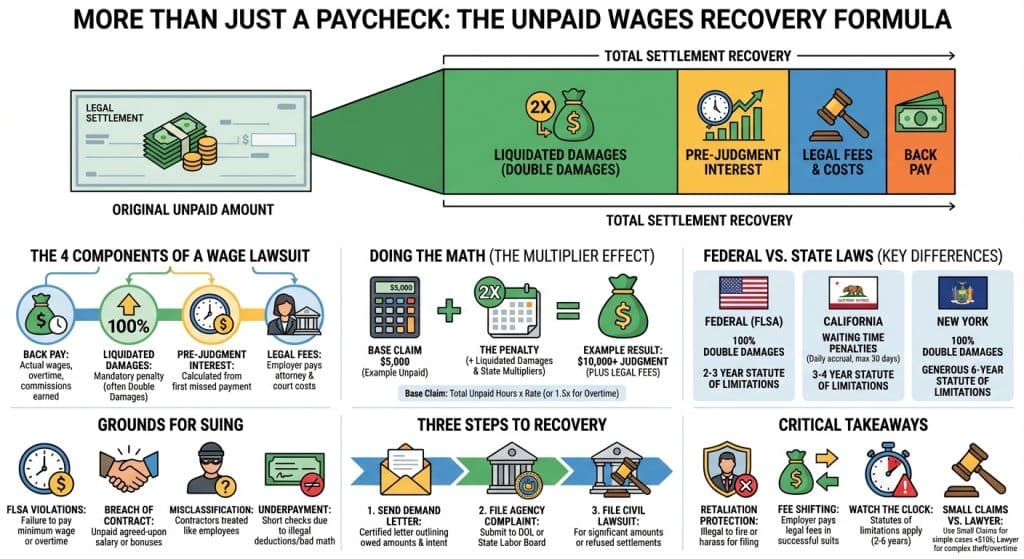
When an employer withholds your paycheck, the law rarely limits your recovery to just the missing amount. Under the Fair Labor Standards Act (FLSA) and various state labor codes, the amount you can sue for often exceeds the original unpaid wages significantly.
The short answer: In many cases, you can sue for double the amount you are owed (liquidated damages), plus interest, court costs, and 100% of your attorney’s fees. If you live in a state with strong worker protections, such as California or New York, statutory penalties for "waiting time" or missing pay stubs can push the total claim value even higher.
Understanding the difference between a DOL claim and a lawsuit
Before suing, many employees file a claim with the Department of Labor (DOL) or their state labor board. While this process is free, it has limitations. Government agencies may only recover back pay without the additional "liquidated damages" or penalties you might win in court. A private lawsuit is often the only way to maximize the financial recovery if the employer has willfully violated wage laws.
Can you sue someone for not paying you for work?
Yes, you can sue an employer or client for failure to pay for work performed. The legal grounds generally fall into two categories:
- FLSA Violations: Used by employees when an employer violates minimum wage or overtime laws. This allows for federal statutory penalties.
- Breach of Contract: Often used by independent contractors or freelancers. If a contract stated you would be paid $5,000 upon completion and the client refuses, you sue for that amount plus potential damages defined in the contract.
The Statute of Limitations: Time is a critical factor. Under federal law, you generally have two years to file a lawsuit for unpaid wages, extended to three years if the violation was willful. Some states offer longer windows (e.g., New York allows up to six years), but waiting too long can permanently bar you from recovering your money.
The 4 Main Components of a Wage Lawsuit Settlement
To estimate how much your case is worth, you must look beyond the missing hours. A comprehensive wage theft lawsuit typically includes four distinct buckets of money:
1. Back Pay
This is the base amount you earned but were not paid. It includes unpaid regular hours, unpaid overtime, illegal deductions (like uniform costs that dip you below minimum wage), and unpaid commissions or bonuses that were contractually guaranteed.
2. Liquidated Damages (The "Double Damages" Rule)
Under the FLSA, if an employer cannot prove they acted in good faith, they are liable for "liquidated damages" equal to the amount of back pay. Essentially, if you are owed $5,000 in wages, the court awards you another $5,000 as a penalty, bringing the total to $10,000.
3. Pre-judgment and Post-judgment Interest
Courts recognize that the money should have been in your bank account earning interest, not your employer’s. You are often entitled to interest calculated from the date the wages were due until the date of the judgment.
4. Attorney’s Fees and Court Costs
This is the most powerful tool for employees. Wage laws usually include a "fee-shifting" provision, meaning the employer must pay your legal bills if you win. This allows workers to hire private attorneys for relatively small claims (e.g., $2,000 in unpaid wages) because the lawyer knows their fees will be covered by the employer, not taken out of the worker’s pocket.
How much can you get for lost wages?
Calculating lost wages requires determining your regular rate of pay and applying the correct overtime multiplier where necessary. You are entitled to recover pay for every minute you were "suffered or permitted" to work.
- Base Rate vs. Overtime: Regular hours are calculated at your agreed hourly rate. Hours over 40 in a workweek (in most states) must be paid at 1.5 times your regular rate.
- Off-the-Clock Work: You can recover wages for time spent working through lunch breaks, putting on safety gear before clocking in, or answering emails after hours.
Example Calculation
Imagine an employee earning $20/hour who was denied overtime pay for 5 hours a week over a 10-week period.
| Component | Calculation | Total |
|---|---|---|
| Unpaid Overtime Hours | 50 hours total | – |
| Overtime Rate | $20 x 1.5 | $30/hr |
| Total Back Pay | 50 hours x $30 | $1,500 |
| Liquidated Damages | Equal to Back Pay | $1,500 |
| Total Claim Value | $1,500 + $1,500 | $3,000 |
Note: This total excludes attorney fees and state-specific penalties, which would increase the final amount.
State vs. Federal: Where the Big Penalties Live
Federal law sets the floor, but state laws often raise the ceiling. If you are in a pro-labor state, your claim could be worth significantly more due to specific statutory penalties.
- Waiting Time Penalties: In California (Section 203 of the Labor Code), if an employer willfully withholds final wages after you quit or are fired, they may owe you a full day’s worth of wages for every day the payment is late, up to 30 days. For a worker earning $200/day, this penalty alone could add $6,000 to the claim.
- Pay Stub Violations: Some states impose penalties (e.g., $50 to $100 per pay period) simply for failing to provide accurate itemized wage statements.
- Minimum Wage Differences: If your state minimum wage is higher than the federal $7.25, your damages are calculated based on the higher state rate.
How much can you sue your employer for emotional distress?
In pure wage and hour lawsuits, you generally cannot sue for emotional distress. Courts view unpaid wages as an economic dispute, remedied by paying the money owed plus interest and penalties.
The Exceptions: Emotional distress damages (non-economic damages) are typically only awarded if the wage theft is tied to other illegal acts, such as:
- Discrimination: Being underpaid specifically because of your race, gender, or age.
- Sexual Harassment: If the withholding of wages was part of a hostile work environment.
- Retaliation: If you were fired or demoted specifically for asking about your unpaid wages.
If your case involves these elements, the potential recovery increases drastically, as juries can award punitive damages for the distress caused.
Is it worth suing your former employer?
Deciding whether to sue involves a cost-benefit analysis. For very small amounts (e.g., under $500), the effort of a lawsuit might outweigh the reward, though filing a DOL claim remains a viable option.
- Small Claims Court: If your claim is under your state’s limit (often $5,000–$10,000), you can represent yourself. It is faster and cheaper, but you generally cannot claim attorney’s fees since you aren’t using one.
- Hiring a Lawyer: For claims involving overtime, systematic underpayment, or class actions, a lawyer is essential. Because of fee-shifting laws, a lawyer will often take your case on a contingency basis (you pay nothing upfront).
- Retaliation Risk: If you are still employed, you might fear retaliation. However, firing an employee for filing a wage claim is illegal and creates a separate, highly valuable legal claim for wrongful termination.
Summary: Estimating Your Total Potential Claim
To maximize your settlement, you need documentation. Gather your employment contract, pay stubs, bank statements, and a personal log of hours worked. Without these, it is your word against theirs.
Your Final Formula:
Total Claim = (Unpaid Wages + Unpaid OT) x 2 [Liquidated Damages] + State Penalties + Interest + Legal Fees
While no calculator can predict the exact outcome of a trial, understanding these components ensures you don’t settle for less than you are legally owed.
FAQs
Can you sue someone for not paying you for work?
Yes, you can sue for unpaid work. Employees can file lawsuits under the Fair Labor Standards Act (FLSA) for minimum wage or overtime violations, while independent contractors can sue for breach of contract. You typically have two to three years to file a claim under federal law.
Is it worth suing your former employer?
It is often worth suing because wage laws allow you to recover double the amount owed (liquidated damages) and require the employer to pay your legal fees. This makes it financially viable for attorneys to take even smaller cases. However, for very small amounts, a Department of Labor claim or Small Claims Court might be faster.
How much can you get for lost wages?
You can recover 100% of your unpaid base wages and overtime, usually doubled as a penalty (liquidated damages). For example, if you are owed $2,000 in back pay, you can typically sue for $4,000 total, plus interest and attorney’s fees.
How much can you sue your employer for emotional distress?
You generally cannot sue for emotional distress in a standard unpaid wage case. Emotional distress damages are typically reserved for cases involving discrimination, sexual harassment, or wrongful termination retaliation. Pure wage disputes are treated as economic damages only.
What is the difference between back pay and front pay?
Back pay covers the wages you have already lost up to the date of the trial or settlement. Front pay is money awarded for future lost wages if you were wrongfully terminated and cannot be reinstated to your job immediately.