

Table of contents
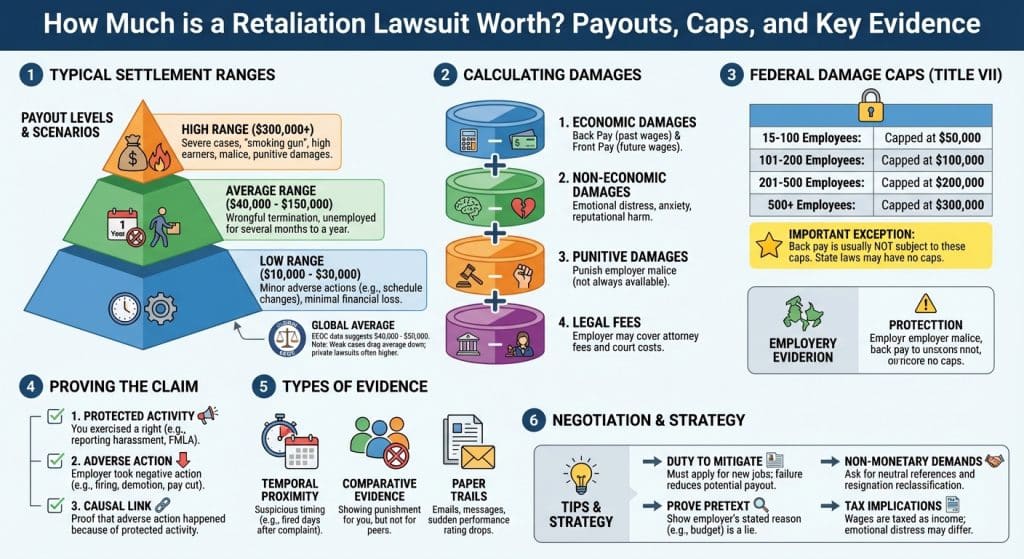
The average settlement for a retaliation lawsuit typically ranges from **$40,000 to $250,000**, though severe cases involving high-wage earners or egregious conduct can exceed **$1 million**. Total compensation depends on economic damages (lost wages), non-economic damages (emotional distress), and punitive damages, subject to federal caps based on employer size.
How Much Is a Retaliation Case Worth? (The Short Answer)
While every case is unique, the average settlement for a workplace retaliation lawsuit typically ranges from $40,000 to $250,000. However, cases involving high-income earners or egregious employer conduct can result in verdicts exceeding $1 million.
It is important to distinguish between a settlement (a negotiated agreement to avoid trial) and a jury verdict (a decision made in court). Settlements are generally lower but guaranteed, whereas jury verdicts can be significantly higher but come with the risk of losing the case entirely.
The guiding principle in these lawsuits is the “Make Whole” legal standard. The court aims to restore you to the financial and professional position you would have held had the retaliation never occurred. This means the bulk of your payout is often calculated based on what you actually lost, rather than arbitrary punishment of the employer.
The 3 Main Types of Damages You Can Recover
To calculate how much you can sue for, you must understand the three specific categories of damages available under employment law.
1. Economic Damages
This is the most objective part of your claim. It covers the actual money you lost.
- Back Pay: Wages, bonuses, and benefits (like health insurance premiums or 401k matching) lost from the date of termination up to the date of the verdict or settlement.
- Front Pay: Estimated future earnings if you cannot reasonably find a comparable job immediately. This compensates for the time it will take to get your career back on track.
2. Non-Economic Damages
Often called “compensatory damages,” these cover the human cost of retaliation.
- Emotional Distress: Compensation for anxiety, depression, insomnia, or reputation damage caused by the employer’s actions.
- Pain and Suffering: Physical manifestations of stress, such as migraines or ulcers, supported by medical records.
3. Punitive Damages
Punitive damages are not meant to compensate you, but to punish the employer. These are awarded only when the employer’s behavior was malicious or recklessly indifferent to your rights. For example, if HR ignored multiple reports of harassment and then fired you for complaining, a jury might award punitive damages to send a message.
Are Attorney Fees Covered?
Yes. Under many federal statutes (like Title VII), if you win your case, the court may order the employer to pay your attorney’s fees and court costs. This is a powerful leverage point during settlement negotiations.
Understanding Damage Caps in Retaliation Lawsuits
Federal law places a hard limit (cap) on the total amount you can recover for non-economic and punitive damages combined. These caps are based on the size of the employer:
| Number of Employees | Federal Damage Cap (Title VII) |
|---|---|
| 15 – 100 | $50,000 |
| 101 – 200 | $100,000 |
| 201 – 500 | $200,000 |
| 500+ | $300,000 |
Crucial Note: These caps do not apply to economic damages (back pay and front pay). If you lost $500,000 in wages, you can recover that full amount regardless of the company size. Additionally, some state laws do not have damage caps, which is why filing under both state and federal law is often a strategic necessity.
What Is Legally Considered Retaliation?
Retaliation occurs when an employer takes an adverse action against an employee for engaging in a “protected activity.” To have a valid claim, you must prove three elements:
- Protected Activity: You exercised a legal right, such as reporting sexual harassment, requesting FMLA leave, complaining about wage theft, or cooperating in an investigation.
- Adverse Action: The employer negatively impacted your employment. This includes firing, demotion, pay cuts, or reassignment to a less desirable shift.
- Causal Link: You must show that the adverse action happened because of the protected activity, not for a legitimate business reason like poor performance.
What Are Three Examples of Retaliation?
Retaliation isn’t always as obvious as being fired on the spot. Courts recognize various forms of punishment:
- Example 1: Termination via “Layoff”: An employee files a discrimination complaint on Monday. On Friday, they are the only person “laid off” due to supposed budget cuts, despite having a stellar performance record.
- Example 2: “Silent Retaliation”: A manager stops inviting an employee to key meetings, removes them from high-profile projects, or gives them the “cold shoulder” to isolate them professionally after they report safety violations.
- Example 3: Papering the File: Shortly after an employee requests overtime pay they are owed, the manager suddenly begins documenting minor errors that were previously ignored, leading to a negative performance review and eventual termination.
What Evidence Proves Retaliation?
Proving what was in your employer’s mind is difficult, so courts rely on specific types of evidence to infer retaliatory intent.
- Temporal Proximity: Timing is your strongest asset. If the negative action happened days or weeks after your complaint, it creates a strong suspicion of retaliation.
- Comparative Evidence: Showing that you were treated differently than colleagues who did not complain. For example, if you were fired for being five minutes late, but other employees are regularly late without consequence, that is evidence of pretext.
- Paper Trails: Emails, Slack messages, and performance reviews are critical. A sudden drop in performance ratings immediately following a complaint is a classic “smoking gun.”
- Witness Testimony: Colleagues who heard a manager express frustration about your complaint can provide vital corroboration.
How Hard Is It to Win a Retaliation Lawsuit?
Retaliation claims are often easier to win than the underlying discrimination claims. However, the legal standard is strict. Under the Supreme Court ruling in University of Texas Southwestern Medical Center v. Nassar, you must prove “but-for” causation. This means you must show that the adverse action would not have happened if you hadn’t complained.
Employers will almost always argue a “pretext”—a fake, legitimate reason for firing you (e.g., “They were fired for being late”). To win, you must prove this reason is false and that retaliation was the true driver. Despite this hurdle, juries tend to sympathize with employees who are punished for speaking up, making these claims highly valuable.
Factors That Increase or Decrease Your Settlement Value
Several variables will determine where your case falls on the $40,000 to $250,000 spectrum:
- Severity of the Adverse Action: Being fired is worth more than being moved to a different desk.
- Strength of Evidence: Written proof of retaliation drives settlements higher than “he-said, she-said” scenarios.
- Employer Size & Insurance: Larger companies (500+ employees) have higher damage caps and deeper pockets, often leading to larger settlements.
- Mitigation of Damages: You have a legal duty to look for a new job. If you sit at home and do not try to find work, your potential award for lost wages will be significantly reduced.
FAQs
What is legally considered retaliation?
Retaliation occurs when an employer takes an ‘adverse action’ (like firing or demotion) against an employee for engaging in ‘protected activity’ (like reporting harassment). You must prove a causal link showing the punishment happened specifically because of the protected activity.
What are three examples of retaliation?
Common examples include: 1) Firing an employee shortly after they file an HR complaint; 2) ‘Silent retaliation,’ such as excluding an employee from meetings or shifting them to a less desirable schedule; and 3) Suddenly giving negative performance reviews for behavior that was previously acceptable.
What evidence proves retaliation?
Key evidence includes ‘temporal proximity’ (suspicious timing between the complaint and the punishment), comparative evidence (showing you were treated more harshly than peers), and paper trails like emails or sudden negative performance reviews that contradict previous feedback.
How hard is it to win a retaliation lawsuit?
Winning requires meeting the ‘but-for’ causation standard, meaning you must prove you wouldn’t have been fired if you hadn’t complained. However, retaliation claims are often more successful than discrimination claims because juries naturally dislike employers who punish whistleblowers.
Is there a cap on how much I can sue for?
Yes and no. Federal law caps non-economic and punitive damages between $50,000 and $300,000 depending on company size. However, economic damages (lost wages) are generally uncapped, and some state laws allow for unlimited damages.