

Table of contents
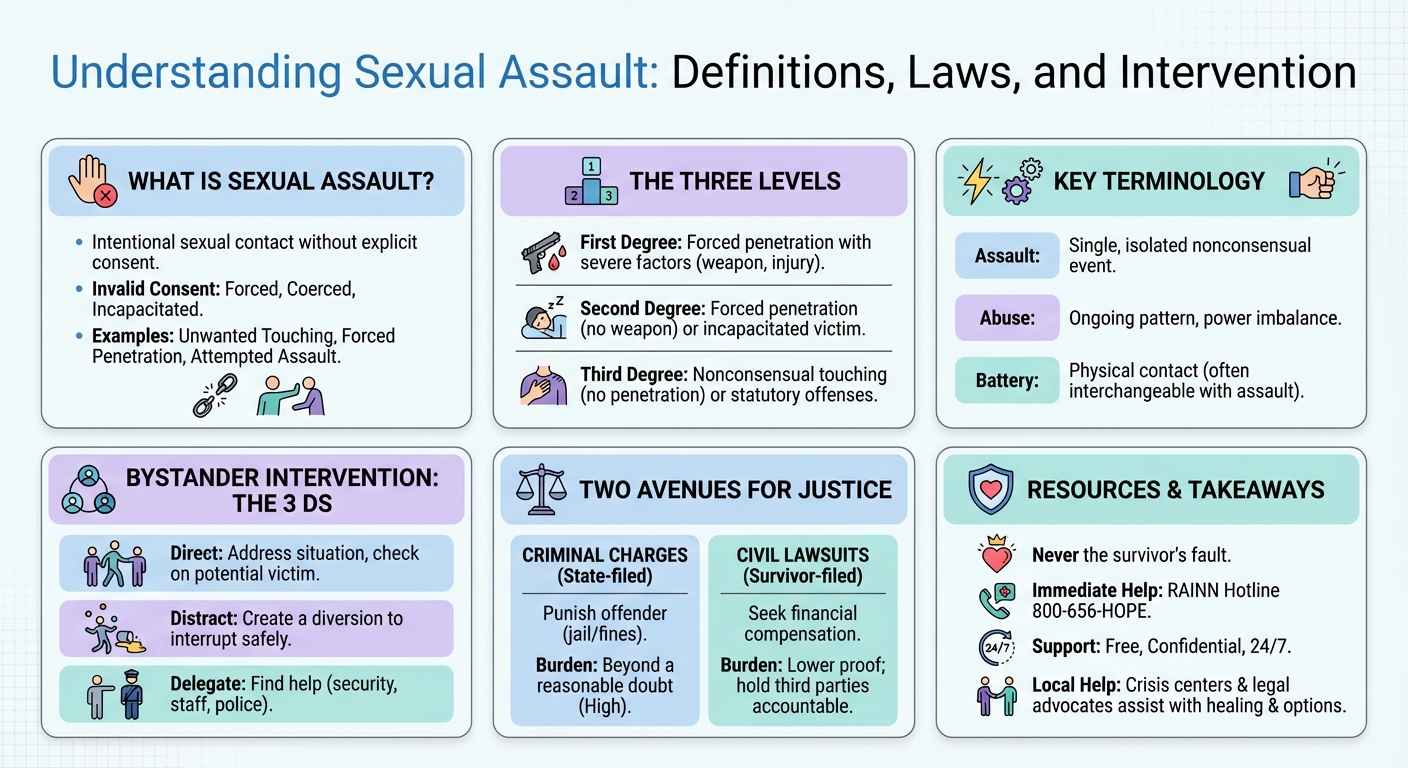
Sexual assault is defined as any intentional sexual contact or behavior that occurs without the explicit consent of the recipient. Under federal and state laws, this includes unwanted touching, groping, attempted rape, and forced penetration through physical force, threats, or coercion.
What is Sexual Assault? Legal Definition and Overview
Sexual assault is a broad term that encompasses a range of nonconsensual sexual acts. While specific definitions vary by jurisdiction, the core element of sexual assault is the lack of explicit, voluntary consent. Understanding the legal parameters is crucial for survivors seeking justice through both the criminal court system and civil lawsuits.
The Legal Definition of Sexual Assault
According to the Office on Violence Against Women (OVW) and federal guidelines, sexual assault is defined as any nonconsensual sexual act proscribed by federal, tribal, or state law. This includes situations where the victim lacks the capacity to consent. The legal definition covers everything from unwanted touching and fondling to attempted rape and forced penetration.
Understanding Consent and Coercion
Consent is the cornerstone of defining sexual assault. Legally and ethically, consent must be clear, knowing, and voluntary. It cannot be obtained through:
- Physical force: Using violence or physical restraint to overpower someone.
- Coercion: Using emotional manipulation, threats, or intimidation to force compliance.
- Incapacitation: Engaging in sexual acts when a person is unable to consent due to alcohol, drugs, sleep, or mental disability.
What are the 3 levels of sexual assault?
Many states categorize sexual assault into three distinct levels based on severity. First-degree involves severe force or a weapon, second-degree involves force without a weapon, and third-degree involves nonconsensual contact or statutory violations. These classifications dictate the severity of criminal penalties.
First-Degree Sexual Assault
This is typically the most severe charge. It generally involves forced sexual penetration accompanied by aggravating factors, such as the use of a deadly weapon, kidnapping, or causing serious bodily injury to the victim.
Second-Degree Sexual Assault
Second-degree charges usually involve sexual penetration achieved through force or the threat of force, but without the aggravating factors (like a weapon) present in first-degree cases. It also applies to cases involving victims who are mentally incapacitated or physically helpless.
Third-Degree Sexual Assault
Third-degree sexual assault often refers to nonconsensual sexual contact or touching (rather than penetration) achieved through force or coercion. In some states, it also covers statutory offenses where the victim is under the age of consent.
What is the difference between sexual abuse and sexual assault?
Sexual assault generally refers to any specific act of nonconsensual sexual contact, which can be a single isolated event. Sexual abuse typically describes an ongoing pattern of nonconsensual sexual behavior, often occurring within a relationship where there is an imbalance of power or trust.
What is sexual assault vs battery?
In traditional tort law, assault is the threat of harm, while battery is the actual physical contact. However, in modern criminal statutes, the terms sexual assault and sexual battery are frequently used interchangeably to describe any unwanted, nonconsensual sexual touching or penetration.
What are the 3 D’s of sexual assault?
The 3 D’s of sexual assault refer to bystander intervention techniques used to prevent an assault from occurring. They stand for Direct, Distract, and Delegate. These strategies empower individuals to safely intervene when they witness a potentially dangerous or nonconsensual situation.
Direct, Distract, and Delegate
- Direct: Stepping in to directly address the situation, such as asking the potential victim if they are okay or telling the aggressor to stop.
- Distract: Creating a diversion to interrupt the interaction, like spilling a drink, asking for directions, or starting an unrelated conversation.
- Delegate: Finding someone else to help, such as a bartender, security guard, or law enforcement officer, if intervening directly feels unsafe.
Common Examples of Sexual Assault
Sexual assault is not limited to a single type of action. It encompasses a wide spectrum of behaviors that violate a person’s bodily autonomy.
Nonconsensual Touching and Groping
Any intentional, unwanted touching of a person’s intimate body parts (such as breasts, buttocks, or genitals) over or under clothing constitutes sexual assault. This is often referred to legally as sexual battery or abusive sexual contact.
Forced Penetration or Rape
Rape is a specific type of sexual assault involving nonconsensual sexual penetration (vaginal, anal, or oral) by any body part or object. This is widely recognized as one of the most severe forms of sexual violence.
Attempted Assault and Coercion
Attempting to force someone into a sexual act, even if unsuccessful, is still a crime. Additionally, using relentless pressure, blackmail, or threats to wear down someone’s boundaries until they submit is considered sexual coercion, which invalidates consent.
Criminal Charges vs. Civil Lawsuits for Sexual Assault
Survivors of sexual assault have two primary legal avenues for seeking justice: the criminal justice system and civil litigation. These two paths serve different purposes and operate under different rules.
| Feature | Criminal Charges | Civil Lawsuits |
|---|---|---|
| Primary Goal | Punish the offender (prison, probation, fines) | Compensate the survivor (financial damages) |
| Burden of Proof | Beyond a reasonable doubt | Preponderance of the evidence |
| Initiated By | State or federal prosecutors | The survivor (plaintiff) |
The Criminal Justice Process
In a criminal case, the state prosecutes the accused. The goal is to secure a conviction that results in jail time, mandatory registration as a sex offender, or other criminal penalties. Because the stakes involve the defendant’s freedom, the burden of proof is extremely high.
Filing a Civil Lawsuit for Damages
A civil lawsuit allows the survivor to sue the perpetrator directly for damages, such as medical bills, therapy costs, lost wages, and pain and suffering. Civil cases have a lower burden of proof, meaning a survivor can sometimes win a civil settlement even if the perpetrator was not criminally convicted.
Holding Rideshare Companies Accountable (Uber and Lyft)
In many civil cases, liability extends beyond the individual attacker to negligent third parties. For example, if an assault occurs in a rideshare vehicle, survivors may pursue an Uber sexual assault lawsuit or a Lyft driver lawsuit. These claims often argue that the company failed to conduct adequate background checks, ignored previous safety reports, or lacked sufficient safety features to protect passengers.
Resources and Support for Survivors
If you or someone you know has experienced sexual assault, immediate help and long-term support are available. You are not alone, and the assault is not your fault. The Rape, Abuse & Incest National Network (RAINN) operates the National Sexual Assault Hotline at 800-656-HOPE, offering free, confidential support 24/7. Additionally, local crisis centers, medical professionals, and experienced legal advocates can help you navigate your healing and your legal options.