

Table of contents
Introduction
The moments immediately following a Houston car accident are chaotic. Your heart is racing, your hands may be shaking, and your mind is focused on immediate concerns: Is everyone okay? Is my car drivable? What do I do now? Should I call the police? Where’s my phone?
In that chaos, evidence disappears. Skid marks fade in the rain or get driven over by passing traffic. Witnesses who saw everything drive away, never to be found again. Debris gets cleared by road crews. Weather conditions change. The sun sets and lighting that showed a critical detail is gone. Within hours—sometimes within minutes—evidence that could prove your case and establish the other driver’s fault is lost forever.
As a Texas personal injury attorney, I’ve seen too many cases weakened or lost because crucial evidence wasn’t preserved at the scene. I’ve watched insurance companies exploit missing documentation to deny legitimate claims. I’ve seen defense attorneys argue that without photographic evidence, my client’s version of events can’t be trusted.
But I’ve also seen cases won because clients had the presence of mind to document everything in those critical moments after the collision. Clients who pulled out their phones and captured the scene gave themselves—and me—the tools we needed to prove their cases and recover fair compensation.
This guide explains exactly what evidence to gather, how to document it properly, and why each piece matters under Texas law. Follow these steps, and you’ll give yourself the strongest possible foundation for your claim.
Why Scene Documentation Matters Under Texas Law
Texas personal injury law requires plaintiffs to prove four essential elements: duty, breach, causation, and damages. Your scene documentation directly supports multiple elements and can make the difference between a successful claim and a denied one.
Proving Breach of Duty: To show the other driver breached their duty of care—that they did something negligent—you need evidence of what actually happened. Photographs of traffic signals, stop signs, yield signs, speed limit markers, and road conditions help establish the rules that applied at the location. Photos of vehicle positions show how the accident occurred. Skid marks reveal who was speeding or who tried to stop. All of this evidence helps prove what the other driver did wrong.
Establishing Causation: You must prove the accident caused your injuries. Photographs showing the severity of the collision, the point of impact, and the extent of vehicle damage support the argument that the forces involved were sufficient to cause injury. If your car is barely scratched, the insurance company will argue you couldn’t have been seriously hurt. If your car is crumpled, the photographs speak for themselves.
Documenting Damages: Property damage documentation establishes one category of your damages while also supporting claims about collision severity. Under Texas law, juries can consider vehicle damage when evaluating the credibility of injury claims. A totaled vehicle supports claims of serious injury; a minor dent undermines them.
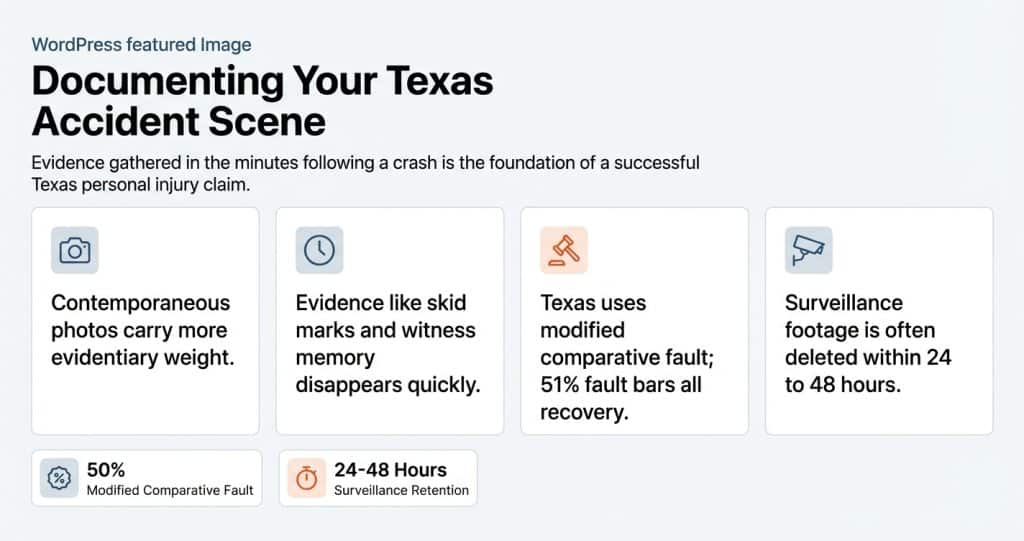
Supporting Your Version of Events: Under Texas’s modified comparative fault system established in Civil Practice and Remedies Code Section 33.001, fault is allocated between parties. If you’re found more than 50% at fault, you recover nothing. If you’re found partially at fault, your recovery is reduced proportionally. Scene evidence often determines how fault is allocated. Without documentation, it becomes your word against theirs—and insurance companies will always believe their policyholder over you.
Evidentiary Weight: Texas Rules of Evidence give significant weight to photographs and contemporaneous documentation. Evidence gathered at the scene, in real-time, is considered more reliable than reconstructions or recollections created days or weeks later. A photograph taken at 3:47 PM on the day of the accident is far more persuasive than your memory of what the scene looked like when you’re testifying months later.
Photographing the Vehicles: A Comprehensive Approach
Your smartphone is your most valuable evidence-gathering tool at the accident scene. Use it systematically and thoroughly. You can never have too many photographs.
Overall Scene Photos: Before anyone moves the vehicles (if it’s safe and legal to leave them in place briefly), photograph the overall scene from multiple angles. These wide-angle photos establish the positions of vehicles relative to each other, to the road, to traffic signals, and to other fixed reference points. Stand at a distance that captures the entire scene, including both vehicles and their surroundings. Then move to different positions and take additional photos from various vantage points—from all four corners of the intersection if possible.
All Vehicles from Multiple Angles: Photograph every vehicle involved from all four sides—front, rear, driver’s side, and passenger’s side. Also try to get photos from the corners (front-left, front-right, rear-left, rear-right) to show the three-dimensional nature of the damage. If you can safely photograph from above—standing on a curb or elevated position—overhead shots can be valuable.
Close-Up Damage Photos: After the overall shots, get detailed close-up photographs of specific damage areas. Show dents, scrapes, broken glass, deployed airbags, crumpled metal, paint transfers from the other vehicle, and any other visible damage. These close-ups document the severity and nature of the impact.
Point of Impact Documentation: Try to identify and photograph the precise point of impact on each vehicle. This evidence is crucial for accident reconstruction. The location of damage tells the story of how the collision occurred—who hit whom, at what angle, with what force.
Interior Damage: If it’s safe to do so, photograph any interior damage to your vehicle. This includes deployed airbags, broken glass inside the cabin, blood stains on seats or surfaces, damaged steering wheels or dashboards, seat belt marks on upholstery, and any personal items that were thrown around or damaged. Interior damage supports claims about collision severity and can corroborate injury claims.
License Plates and Vehicle Identification: Photograph the license plates of all vehicles involved, including your own. If possible, photograph the VIN (Vehicle Identification Number) visible through the windshield on the dashboard. This ensures you have accurate vehicle identification even if the other driver provides incorrect information or if there’s later dispute about which vehicles were involved.
Tire Condition: Photograph the tires of the other vehicle if you can do so safely. Bald tires, damaged tires, or improperly inflated tires can be evidence of negligent vehicle maintenance, supporting your claim that the other driver was careless.
Documenting Road Conditions and Environment
The physical environment often plays a role in accident causation—and sometimes creates additional liability. Document it thoroughly.
Road Surface Conditions: Photograph the road surface where the accident occurred. Look for and document potholes that may have contributed to the accident, uneven pavement or road defects, oil slicks or fluid spills on the roadway, debris in the road, standing water or evidence of recent rain, ice or snow (rare in Houston but possible), construction zones or road work, and faded or missing lane markings.
In some cases, poor road maintenance by a government entity may create additional liability. Texas has specific rules about governmental immunity and road maintenance claims, but documenting hazardous conditions at the scene preserves your options for pursuing all potentially responsible parties.
Weather Documentation: Note and photograph weather conditions at the time of the accident. If it was raining, photograph wet road surfaces, standing water, and reduced visibility. If it was foggy, photograph the fog. Texas law requires drivers to adjust their speed and driving behavior for weather conditions. Evidence of adverse weather can support claims that the other driver was traveling too fast for conditions.
Lighting Conditions: Note whether the accident occurred during daylight, dusk, dawn, or nighttime. Photograph any relevant lighting or lack thereof. If a streetlight was out, document it. If the sun was creating glare, note the sun’s position. Poor lighting conditions can be relevant to visibility arguments and may implicate government entities responsible for maintaining streetlights.
Traffic Control Devices: Photograph all traffic signals, stop signs, yield signs, speed limit signs, warning signs, and lane markings in the area. These establish the rules that applied at the location and can prove the other driver violated traffic laws. If a traffic signal was malfunctioning, document it.
Sight Lines and Obstructions: Photograph anything that might have affected visibility at the accident location. This includes parked cars that may have obstructed views, bushes, trees, or landscaping blocking sight lines, buildings or structures affecting visibility, signs or advertisements that may have been distracting, and any other obstructions. These photos can support or refute claims about whether a driver should have seen oncoming traffic.
Skid Marks and Debris: Photograph any skid marks on the roadway. Skid marks indicate where vehicles braked or lost control, helping reconstruct the accident sequence. Also photograph debris fields—broken glass, vehicle parts, personal items scattered on the road. The pattern and location of debris shows the violence of the impact and helps establish the point of collision.
Gathering Witness Information
Witnesses can make or break a personal injury case. An independent witness—someone with no connection to either driver—who saw the accident happen is incredibly valuable evidence. But in the chaos after an accident, witnesses often leave the scene before anyone thinks to get their information. This is a critical mistake.
Identify All Potential Witnesses: Look around the scene carefully. Who might have seen what happened? Potential witnesses include drivers of other vehicles who witnessed the accident, passengers in any vehicle including your own, pedestrians on sidewalks or in nearby parking lots, workers at nearby businesses who may have seen or heard the collision, residents who may have witnessed the accident from their homes or yards, and people waiting at bus stops or walking nearby.
Collect Complete Contact Information: For each witness you identify, obtain their full name, phone number (cell and home if they’ll provide both), email address, and home address if they’re willing to share it. Ask if they’d be willing to provide a statement about what they saw. Most people are willing to help if asked politely.
Ask What They Observed: Without leading them or putting words in their mouth, ask witnesses what they saw. Note their responses. Did they see the other driver run a red light? Was the other driver speeding? Were they looking at their phone? Did they fail to stop at a stop sign? Did they make an unsafe lane change? This information is valuable even if you don’t formally record statements at the scene.
Document Witness Vantage Points: Note where each witness was positioned when they saw the accident. A witness who was directly at the intersection has a different perspective than someone half a block away. If possible, photograph the location where each witness was standing or the position of their vehicle when they witnessed the collision.
Check Nearby Businesses: Employees at gas stations, restaurants, convenience stores, and retail businesses near intersections often witness accidents. Don’t be afraid to walk into nearby businesses and ask if anyone saw what happened. Get the business name and contact information even if no specific witness is identified—your attorney can follow up with a formal inquiry.
Your Passengers Are Witnesses: Don’t forget that your own passengers witnessed the accident. While family members and friends may face credibility challenges as “interested” witnesses, their testimony is still valuable. Make sure their observations and contact information are documented.
Surveillance Footage: Time Is Critical
We live in an age of ubiquitous surveillance cameras. Traffic intersections, businesses, ATMs, parking lots, and even private homes often have cameras that may have recorded your accident. This footage can be the most powerful evidence available—but it disappears quickly.
Identify Cameras at the Scene: While at the scene, look carefully for cameras. Check for traffic cameras mounted on signals or poles (some intersections have red-light cameras or traffic monitoring cameras), exterior security cameras on nearby businesses including banks, gas stations, convenience stores, and retail establishments, ATM cameras that may have captured the roadway, residential doorbell cameras and home security systems, parking lot surveillance cameras, and commercial vehicle dashcams.
Understand the Time Pressure: Here’s the critical point: surveillance footage is typically overwritten within days—sometimes within 24-48 hours—as recording systems cycle through their storage. If you see cameras at the scene, this footage could be deleted before you even file your claim. Time is absolutely critical.
Take Immediate Action: At the scene, note the exact locations of any cameras you identify. Get the names and addresses of businesses with exterior cameras. When you get home—or while still at the scene if possible—contact your attorney so they can send preservation letters demanding footage be retained. If you don’t have an attorney, consider calling one specifically for this purpose.
Texas Public Information Act: If the camera is operated by a government entity—city traffic cameras, cameras on public buildings, school zone cameras—footage may be obtainable through Texas Public Information Act requests. These requests take time to process, so initiate them as quickly as possible.
Private Business Cooperation: Private businesses are not legally required to preserve or share surveillance footage with you. However, many will cooperate with polite requests or formal letters from attorneys, especially when asked shortly after the incident occurs. The longer you wait, the less likely the footage still exists.
Dashcam and Rideshare Footage: If any vehicle involved had a dashcam—including rideshare vehicles like Uber or Lyft—that footage could be crucial evidence. Rideshare companies maintain trip records and some drivers use dashcams. This footage can potentially be subpoenaed in litigation if the driver won’t voluntarily provide it.
Physical Evidence Preservation
Beyond photographs, certain physical evidence should be preserved for your claim.
Your Clothing: Don’t wash or discard the clothes you were wearing in the accident. Blood stains, glass fragments, airbag residue, and other trace evidence can support your claim. Place clothing in a paper bag—not plastic, which can trap moisture and cause deterioration—and store it in a safe, dry location.
Damaged Personal Items: If personal items were damaged in the accident—glasses, phones, watches, laptops, bags, child car seats—preserve them. Photograph them in their damaged condition and keep them as evidence. The damage to these items demonstrates the collision’s force.
Vehicle Preservation: If your vehicle is being declared a total loss, don’t let it be destroyed or sold for salvage until your attorney has had a chance to inspect it or hire an accident reconstruction expert to examine it. Crushed metal and impact patterns provide crucial evidence in disputed liability cases. Once the vehicle is gone, that evidence is gone forever.
Medical Evidence: If medical devices were damaged in the accident—braces, crutches, wheelchairs, medical equipment being transported—preserve them. These items demonstrate the collision’s force and may be relevant to your damage claims.
Debris Collection: If it’s practical and safe, collect any debris from your vehicle that you find at the scene—pieces of trim, broken parts, fragments. These physical items can be analyzed by experts if needed.
Working With the Police Report
The police report is an important document, but it has limitations you should understand.
What the Officer Documents: When police respond to your accident, they’ll create an official crash report (Form CR-3 in Texas). This report includes a diagram of the accident scene, statements from involved parties and any witnesses the officer interviews, the officer’s assessment of contributing factors, weather and road conditions, and any citations issued.
Provide Your Account Clearly: When speaking to the investigating officer, stick to facts. Describe what happened from your perspective clearly and completely. Don’t speculate about what the other driver was doing—describe what you observed. Don’t admit fault or apologize. If you’re injured or disoriented, it’s okay to keep your statement brief and indicate you’ll provide more detail later.
The Report’s Limitations: Remember that the police officer didn’t witness your accident. Their report reflects their interpretation of physical evidence and statements made by involved parties—people who may have reasons to shade the truth. Officers can make mistakes. Reports can contain errors.
Your Documentation Complements the Report: Your photographs and documentation complement the police report. If the report contains errors, your evidence can challenge it. If the report supports your account, your evidence corroborates it. Either way, having independent documentation is valuable.
Obtain a Copy: Request a copy of the police report once it’s available, typically within 10 business days. Review it for accuracy. If there are errors, discuss with your attorney whether a supplemental statement should be filed.
Documenting Your Physical Condition
While your focus at the scene is naturally on vehicles and the environment, documenting your own physical condition is equally important.
Photograph Visible Injuries: If you have any visible injuries at the scene—cuts, bruises, swelling, abrasions, burns—photograph them before you receive medical treatment. These images document your condition in the immediate aftermath of the accident.
Record Your Symptoms: Consider recording a brief video statement on your phone describing how you feel physically and what happened. Note any pain, dizziness, confusion, nausea, or other symptoms you’re experiencing. This contemporaneous statement can be valuable evidence of your condition immediately after the accident.
Don’t Minimize to Others: When talking to police, witnesses, or the other driver, don’t say you’re “fine” if you’re not sure. It’s okay to say “I’m not sure how I feel yet” or “my neck is hurting but I don’t know how serious it is.” Statements minimizing injury at the scene will be used against you later if your injuries turn out to be serious.
Request Ambulance Transport If Appropriate: If you’re injured, request ambulance transport to the hospital. The ambulance run report becomes part of your official medical documentation, and being transported by ambulance demonstrates the seriousness of your condition.
Conclusion: Evidence Wins Cases
The few minutes you spend documenting the accident scene can determine the outcome of your entire claim. Photographs don’t fade or become confused like memories. Video doesn’t get nervous on cross-examination. Physical evidence speaks for itself in ways that testimony cannot.
Texas personal injury law favors parties who can prove their claims with solid evidence. Your scene documentation creates that evidence in real-time, preserving what would otherwise be lost forever to time, weather, and the normal clearing of accident scenes.
Before leaving any accident scene, ask yourself: Have I photographed all vehicles and their damage from multiple angles? Have I documented road conditions, traffic signals, and the physical environment? Have I identified and gotten contact information for all witnesses? Have I looked for surveillance cameras and noted their locations? Have I preserved physical evidence? Have I documented my own physical condition?
If you can answer yes to these questions, you’ve given yourself—and your attorney—the best possible foundation for your claim.
Evidence wins cases. The insurance company will have its evidence. Make sure you have yours. Document everything.

About the Author
Chi Nguyen is a Houston personal injury attorney dedicated to helping accident victims understand their rights and receive fair compensation under Texas law. With extensive experience representing injured Texans, Attorney Nguyen combines legal expertise with a commitment to client education and empowerment.